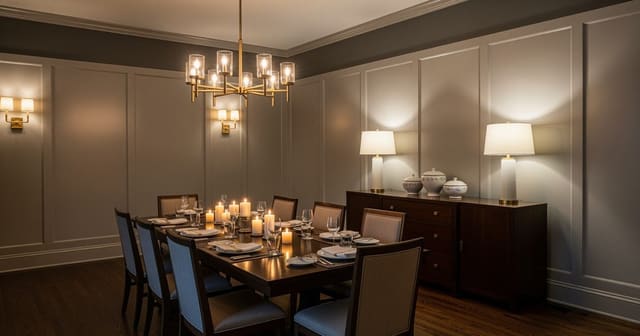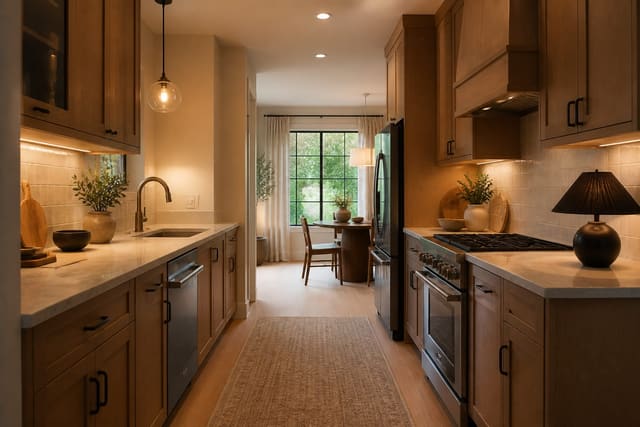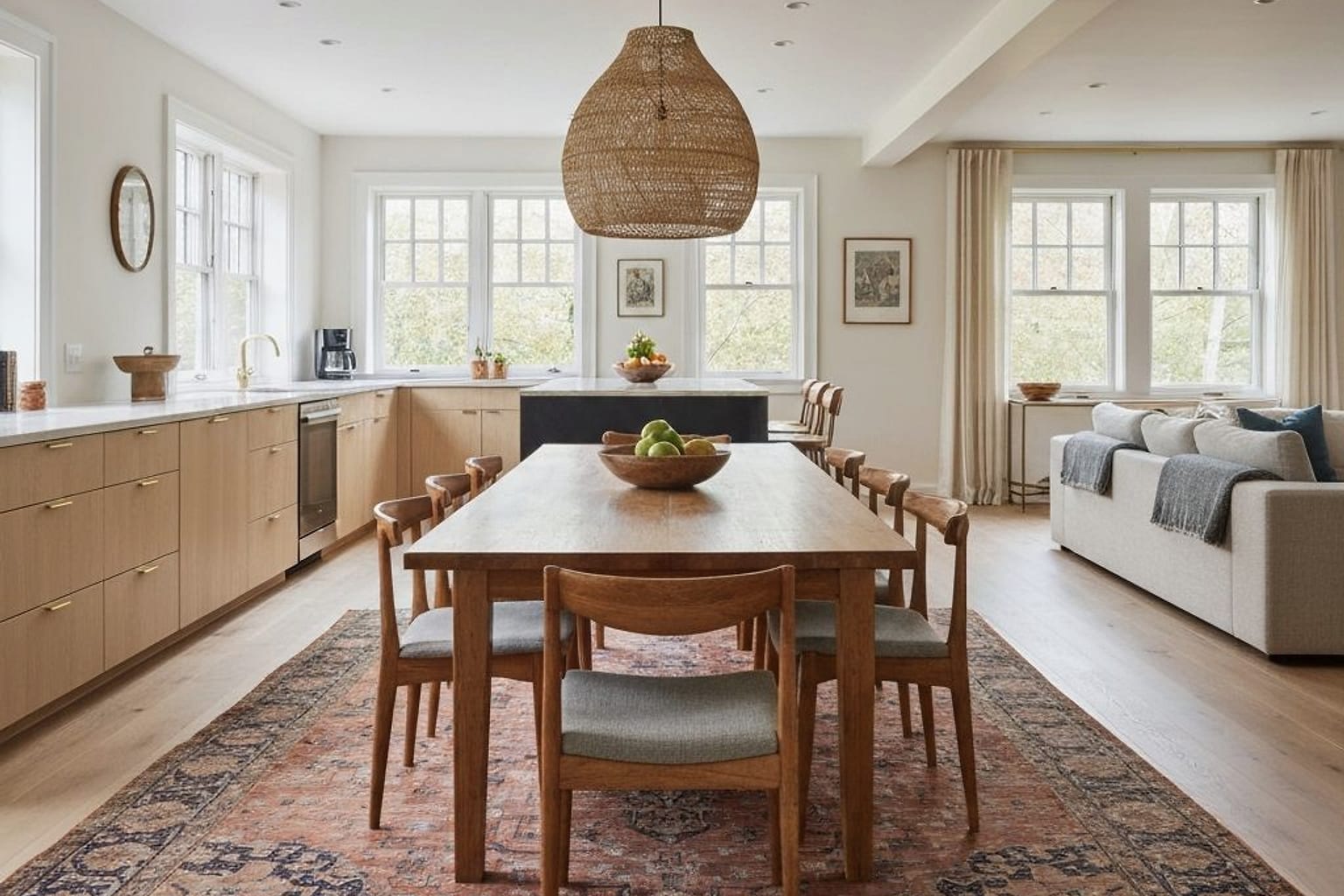
AI kitchen dining room design uses one uploaded photo showing the cooking edge, table area, ceiling line, windows, floor, and main walkway to preview table size, seating, lighting splits, and storage. The dining zone should never be an afterthought squeezed around the cabinets and island — treat it as its own job with its own clearances and light.
What has to be visible in one kitchen-diner photo?
A useful photo shows both jobs of the room: cooking and sitting down to eat. If the camera only captures the table, the tool cannot judge how the island, counters, and refrigerator path affect dining. If it only captures the kitchen, the table becomes an afterthought again.
Stand in the widest corner or just outside the entry. Include the island or peninsula, the table wall, ceiling fixtures, floor line, at least one window, and any opening to another room. A kitchen-diner is about relationships: island edge to chair backs, chandelier to table center, buffet to walkway, cabinet color to dining furniture.
Don't stage a fake showroom. Clear dishes and mail, but leave real furniture so proportions stay honest. Try a prompt like: "keep the white cabinets, oak floor, black window frames, island size, and exterior door; redesign this kitchen dining combo with a calmer table zone, better pendants, warm chairs, storage for serving pieces, and a clear path from fridge to table." For more table-specific direction, see AI dining room design ideas for real table zones.
What separates one big room from two useful zones?
The hardest choice isn't style — it's the border between kitchen and dining. That border comes from clearance, lighting, rug edge, and material shifts, not a wall.
Start with circulation: leave about 36 inches for a basic walking route between island and dining chairs, and 42 inches where someone cooks while another pulls out a chair. Measure from the counter edge to the back of an occupied chair, not a tucked-in one — that's where many plans fail.
| Table shape | Best fit | Chair note |
|---|---|---|
| 42" round | Square pocket or bay window | Armless chairs, 18-20" wide, ease tight combos |
| 48" round | More generous nook | Needs extra breathing room around chairs |
| Narrow rectangular/oval | Long galley-style kitchen-diner | Preserves route better than a round pedestal |
If you already have four stools at the island, keep the table quieter with slimmer chairs and a simple light. If the island is prep-only, let the table carry more weight with a deeper wood tone or stronger pendant.
Test this on your own room photo with ReDesign — keep the room structure, daylight, ceiling line, and main path visible so the preview solves your actual space.
What makes a kitchen-diner before-and-after believable?
A convincing transformation fixes visual hierarchy first. The before often has good cabinets and furniture, but every piece competes for equal importance. The after gives the kitchen edge a job, the dining zone a job, and the walkway room to breathe.
Lighting separates the zones fastest. Island pendants typically sit 30-36 inches above the counter; dining pendants sit 30-36 inches above the tabletop. Keep the fixtures related but not identical — slim linear pendants over the island, a softer drum or globe over the table. Use warm 2700K-3000K bulbs so wood, stone, and upholstery don't look cold at night, and add a dimmer so dinner doesn't feel lit like meal prep.
Rugs help define the zone: extend one roughly 24 inches beyond the table on each side so chairs stay on it when pulled back. A 72x36 inch table often needs an 8x10 rug minimum. Skip the rug if it blocks the kitchen path and rely on lighting and a stronger table finish instead.
A sideboard 16-20 inches deep adds storage for linens, serving bowls, and chargers without stealing the walkway. If the kitchen has open shelving, keep dining storage more closed.
What AI mistakes should you avoid in a kitchen-diner?
- Trusting a preview that quietly widens the aisle. Check island-to-table clearance, chair pullout, and the fridge-to-sink-to-table route before you love a generated scene.
- Matching kitchen and dining furniture too tightly. All-white everything washes out the room — repeat one or two finishes, then add contrast (oak chairs with painted cabinets, black pendants with black chair legs).
- Treating island stools as decoration. High backs, thick arms, or heavy upholstery block the sightline into dining; low-back or backless stools keep the kitchen edge quieter.
- Using vague style prompts. Name the real conflict — table too close to island, chandelier off-center, no serving storage — instead of asking for "cozy" or "luxury." See the best AI tool for kitchen design for tool selection, then judge outputs against your exact room.
- Ignoring floor color. The same cabinet or chair reads differently beside orange oak, gray vinyl plank, or dark tile — a kitchen-diner has fewer walls to hide a mismatch.
How do you use AI to preview a kitchen-diner before buying?
Use AI as rehearsal for decisions that are expensive to reverse: table shape, stool style, pendant size, rug, cabinet color, and sideboard depth. Uploading your own photo forces every idea into your actual sightline instead of a showroom corner.
Run the first set wide — a warm modern combo, a classic painted-cabinet version, a colorful nook, a minimal apartment layout, a family-friendly closed-storage version. Choose the one where the path from stove to table works and chairs have room, not just the prettiest screenshot.
In the second set, keep the best layout and vary only the big decisions. If several versions improve with a larger dining light or quieter stools, that's useful evidence.
Renters should test reversible moves first: plug-in sconces, washable rugs, freestanding sideboards, slipcovered chairs, and better stools. Owners can explore repainting, hardwired pendants, banquettes, or widened openings — but let the image lead to real measurements and quotes. For more kitchen-side prompts, see AI kitchen design ideas for real homes.
The winning preview isn't the most dramatic one — it's the one where someone can cook, another can sit, a chair can pull out, and the two zones stop competing for the same square foot. For the full upload workflow, see the AI design complete guide.
Frequently Asked Questions
Can AI redesign an eat-in kitchen from one photo?
Yes — upload a corner photo showing the dining nook and adjacent counter run; the AI tests table shape, seating type, lighting, and rug while preserving cabinets, windows, and appliance positions. Treat the preview as a scale and circulation test, not a shopping command, and keep openings, ceiling line, and daylight visible in the photo.
Round or rectangular table for an eat-in kitchen?
A 36-42 inch round table fits four comfortably in 7x7 ft of clear floor; a 60x36 inch rectangle suits longer nooks but needs 36 inches of chair-pullout clearance at one end. Compare the result against door swing, walkway width, storage reach, and evening light rather than just catalog looks.
Should an eat-in kitchen use a banquette?
Yes for narrow nooks — a banquette returns 8-12 inches of floor compared with chairs and sleeves storage under the seat. Skip it when the table needs to pull away from the wall for larger meals; test both a conservative and bolder version against your existing windows, trim, and floor color.
How do I light an eat-in kitchen table separately from the prep zone?
Hang one pendant 30-34 inches above the table on a dedicated dimmer, and keep the prep zone on cooler task light so the dining nook stays warm while you cook. Use the preview to narrow measurements and priorities, but confirm outlet locations and product clearances before ordering anything custom.
Does a rug belong under an eat-in kitchen table?
A low-pile washable rug extending 24 inches beyond the table on each side handles spills and noise well; skip wool, jute, or anything that resists vacuuming in a high-traffic eating area.
Ready to see this on your own room? Open Re-Design and run the preview before you buy, paint, drill, or move furniture.
Three transformations to try
1. Round-table pass with pendant and chairs 2. Banquette pass with storage seating and rectangular table 3. Open-shelf pass with bench seating and washable rug