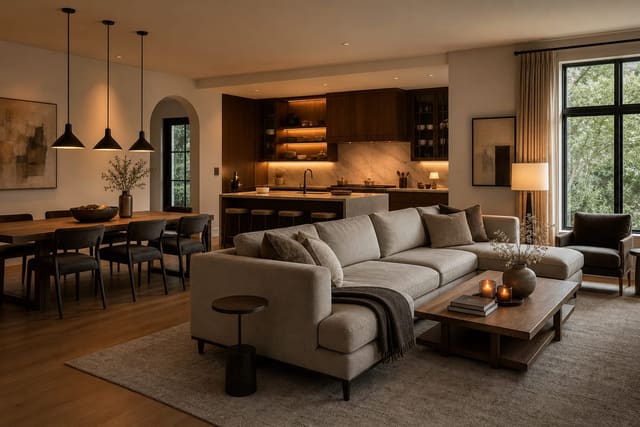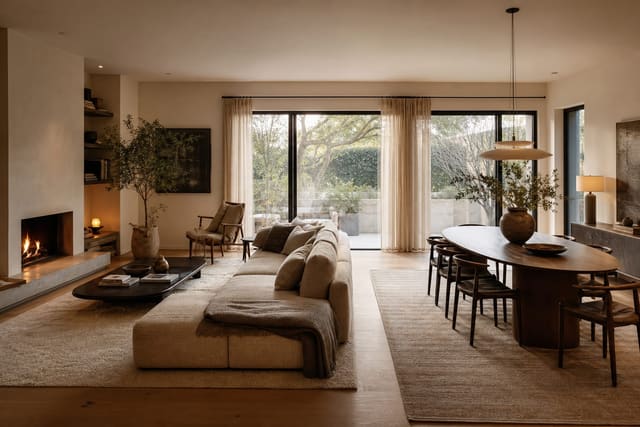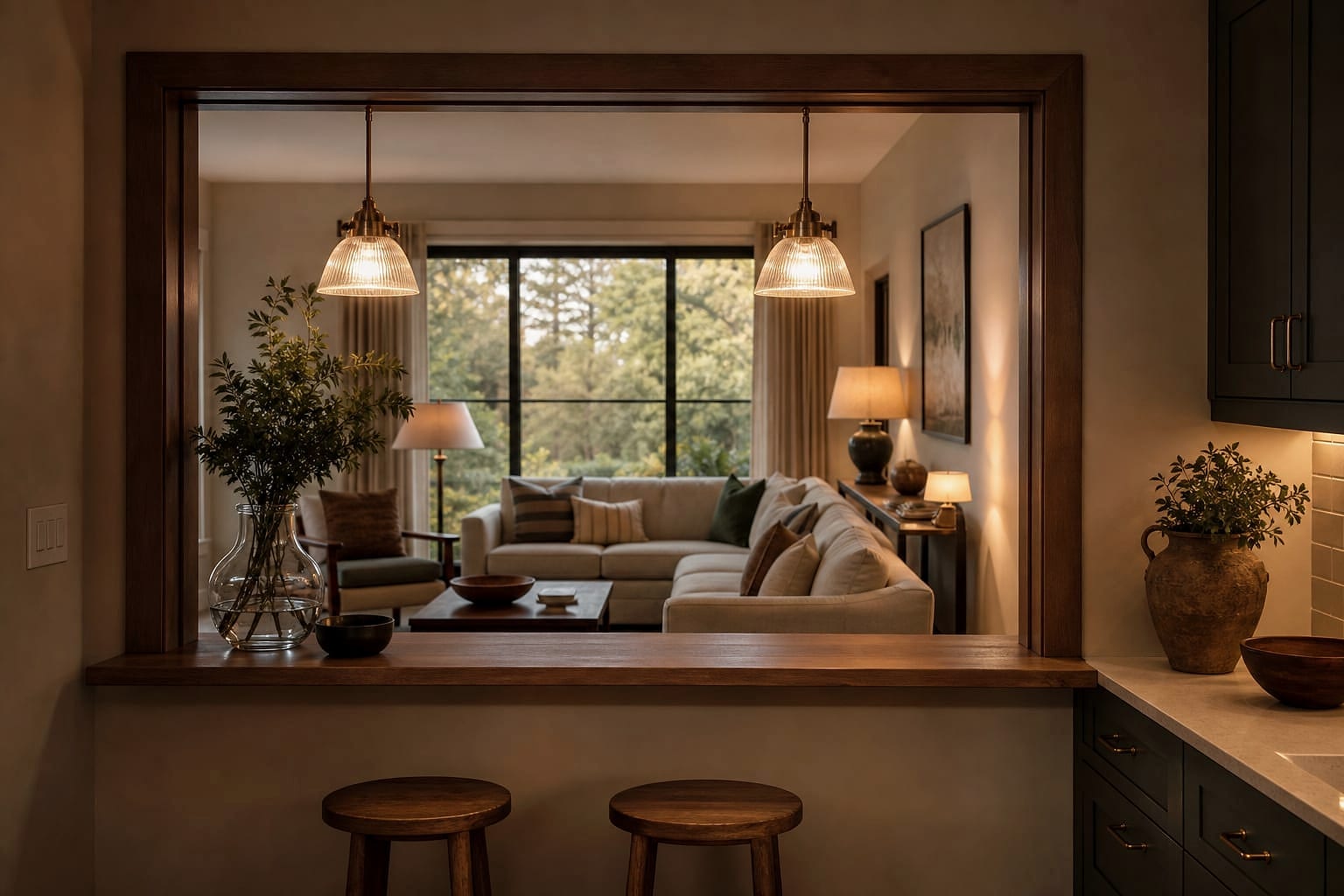
AI open plan living room kitchen design previews island scale, sightline anchors, lighting separation, and rug zoning from a single uploaded photo, so kitchen, dining, and living zones read as distinct rooms inside one shared volume. One big room needs stricter design rules than separate rooms, not looser ones — if the kitchen looks polished and the living area looks improvised, the whole floor feels unfinished.
Can AI redesign an entire open-plan kitchen and living area?
Yes, if the uploaded photo shows the kitchen edge, living zone, ceiling line, windows, flooring, and the main path between them. The result should stay tied to your real architecture, not invent a new footprint, while testing layout, color, lighting, rugs, stools, sofas, and storage together.
Shoot the first photo from the widest corner or the entry, including the island, sofa wall, a window, any floor transition, and the ceiling fixtures. If the room wraps a corner, add a second angle so the AI understands the blind side instead of treating the plan as a rectangle.
Protect what isn't changing in your prompt. Try: keep the white oak floor, existing kitchen cabinets, black window frames, island size, and fireplace wall; redesign this open-plan kitchen-living space with warmer seating, clearer zones, a larger rug, coordinated lighting, and a cohesive palette. That gives the AI a room to solve, not permission to replace your house.
What makes an open-plan before-and-after actually work?
A believable redesign fixes hierarchy first: one dominant anchor, one supporting zone, one clear circulation path. If the island is large and centered, don't let a loud rug and oversized sectional compete with it. If the fireplace is the emotional center, quiet the kitchen lighting so the room doesn't read as two showrooms touching shoulders.
Circulation is the unglamorous test. Keep about 36 inches for the main route between kitchen, sofa, patio door, and hallway, and 42 inches around an island with stools if people cook while others sit. If a preview shows a gorgeous chair blocking the path from fridge to sofa, keep the mood and reject the layout.
Rugs do real work in an open plan. An 8x10 rug often beats a 5x7 under a compact seating area because at least the front legs land on it; a 9x12 rug can be what finally makes a larger great room's living zone feel intentional instead of floating.
Lighting should speak the same language without matching exactly. Island pendants typically sit 30 to 36 inches above the counter; a living room fixture needs enough head clearance to stay safe. Warm bulbs around 2700K to 3000K usually calm wood floors, cream cabinets, stone counters, and upholstery better than cool white light.
Test this on your own room photo with ReDesign — keep the structure, daylight, ceiling line, and main path visible so the preview solves the space you actually have.
How do I decide where one zone stops and another starts?
Open plan doesn't mean borderless. Borders come from furniture backs, rug edges, ceiling fixtures, color shifts, and walking paths instead of walls.
A sofa can be the most useful divider if its back faces the kitchen and leaves a clean route behind it. Choose depth carefully: a 40-inch lounge sofa may feel luxurious in a showroom but steal the walkway in a 15-foot-wide room. In tight rooms, a 34 to 36 inch sofa plus one chair often beats a sectional that forces every path to bend around it.
Give the dining zone enough respect that it doesn't become leftover space between island and couch — see these living-dining combo furniture scale rules before treating the table as an afterthought.
Color should connect kitchen and living side without making them identical. Cool white cabinets and counters often need warm wood, oatmeal upholstery, brass, clay, or olive nearby to avoid feeling sterile; walnut or saturated cabinets usually need softer sofa and rug tones to balance them.
Built-ins and media walls are where cohesion often breaks. Slab kitchen cabinets beside farmhouse living room shelving feel confused unless a material bridges the gap — repeat one finish deliberately, such as black metal on pendants and lamps, or white oak on stools and coffee table.
Use visual boundaries before physical ones: a rug edge, a console behind the sofa, a pendant over the dining table, or a paint shift at a fireplace wall. For separation without construction, see zoning an open plan without walls.
What are the most common open-plan AI redesign mistakes?
- Erasing daily life. Real open-plan rooms include backpacks, pet bowls, mail, chargers, and the pan that lives on the stove. A good concept plans storage for those things instead of relying on empty surfaces.
- Matching every finish too literally. All-black pendants, stools, coffee table, frames, sconces, and pulls can stamp out the room. Repeat a finish two or three times, then let another material take over.
- Choosing the biggest sofa because the room is open. Open rooms still have pinch points at islands, patio doors, and hallways. Keep 16 to 18 inches between sofa and coffee table for real knees, not just a render.
- Letting island stools and dining chairs compete. High-back, heavy-arm stools next to strong dining chairs can crowd the kitchen edge. Quieter backless or low-back stools usually keep the kitchen-to-living sightline open.
- Assuming every room type follows the same rules. A bathroom preview is dominated by plumbing and fixed clearances; an open-plan kitchen-living preview is dominated by sightlines and shared scale. See this AI bathroom design apps guide for how fixed-fixture rooms differ.
How should I use AI to preview the whole room before buying?
Use AI as a rehearsal for expensive, hard-to-reverse choices: sofa size, rug scale, stool style, pendant finish, table shape, cabinet color, backsplash tone, and whether the room needs stronger zoning. Because open-plan success depends on the relationship between kitchen edge and living area, test the whole visual field, not isolated products.
Run a first set as broad directions: warm modern, soft traditional, clean minimal, moody cabinet-and-stone, and a durable family-friendly layout. Pick the version that's easiest to walk through and understand from the entry, not the most dramatic image.
In a second set, keep the winning layout and vary only the big purchases: an 8x10 rug against a 9x12, a 78-inch sofa against an 84-inch, backless against low-back stools, round against rectangular table, warm white against mushroom or olive walls. If three versions improve with a larger rug and quieter stools, that's useful evidence.
Renters should focus on reversible cohesion: washable rugs, plug-in sconces, freestanding storage, slipcovers, peel-and-stick backsplash where allowed, better stools, art, curtains, and a console behind the sofa. Owners can test bigger moves — cabinet repainting, new pendants, a fireplace surround, widened openings — but should follow the preview with real measurements and quotes.
The winning concept isn't the slickest screenshot. It's the version where the kitchen still functions, the sofa doesn't block the room's spine, the dining area has a reason to exist, and the lighting feels related.
For the broader workflow, see the AI design complete guide, then return here for scale, light, and layout choices specific to open-plan rooms.
Frequently Asked Questions
Can AI design an open-concept kitchen from one photo?
Yes — upload a corner photo showing kitchen, dining, and living in one frame; the AI tests island length, lighting separation, rug zones, and furniture scale while preserving cabinet runs, columns, and window walls. Treat the preview as a scale and circulation test, not a shopping command, and keep openings, ceiling line, daylight, and fixed storage visible in the photo.
How big should an open-concept kitchen island be?
A 4x8 ft island with 36 inches of clearance on the working side and 42 inches on the seating side fits most open-concept kitchens; islands wider than 5 ft become hard to reach unless the cooktop sits centered. Check door swing, chair pullout, walkway width, storage reach, and evening light against the preview before committing.
How do I separate zones in an open-concept room?
Use a rug under the dining table, a sectional facing the living anchor (TV or fireplace), and three lighting layers — island pendant, table pendant, and recessed plus floor lamps in the living zone — each on its own dimmer. Test a conservative and a bolder version, then pick whichever still works with your existing windows, trim, and floor color.
Where should the TV go in an open-concept living room?
Mount the TV on the wall the sofa naturally faces, never on the kitchen wall; if that's the only option, use a smaller TV or a standing-height media console. Use the AI preview to narrow measurements and priorities, then confirm outlet locations and product clearances before ordering anything custom.
How do I keep cooking smells out of an open-concept living room?
A 600+ CFM range hood vented outside is the only reliable fix; recirculating hoods filter grease but not smell, and an open kitchen without real ventilation leaves the sofa smelling like dinner.
Ready to see this on your own room? Open Re-Design and run the preview before you buy, paint, drill, or move furniture.
Three transformations to try
1. Island-anchor pass with 4x8 island, pendant trio, and sectional 2. Dining-anchor pass with banquette and visual rug separation 3. Living-anchor pass with fireplace facing sofa and offset kitchen