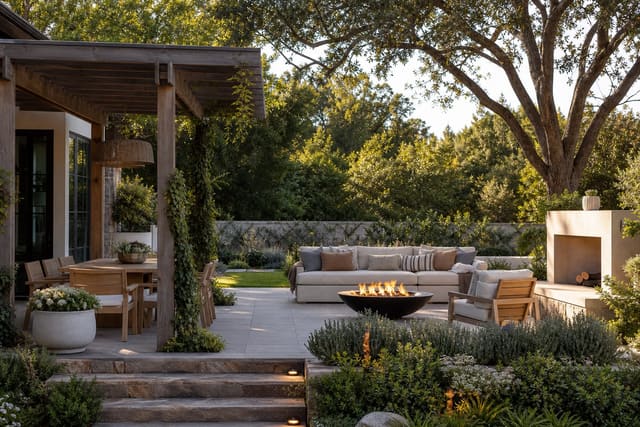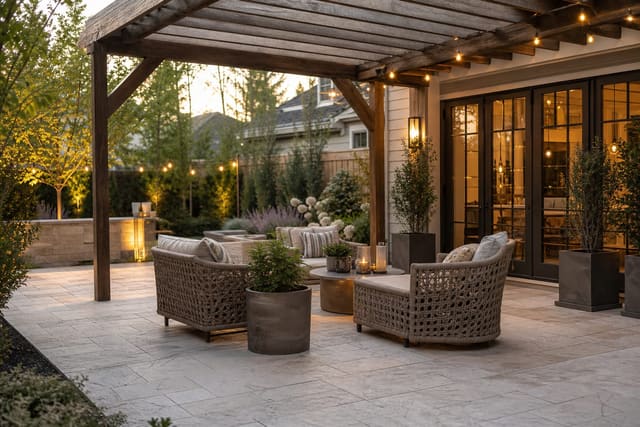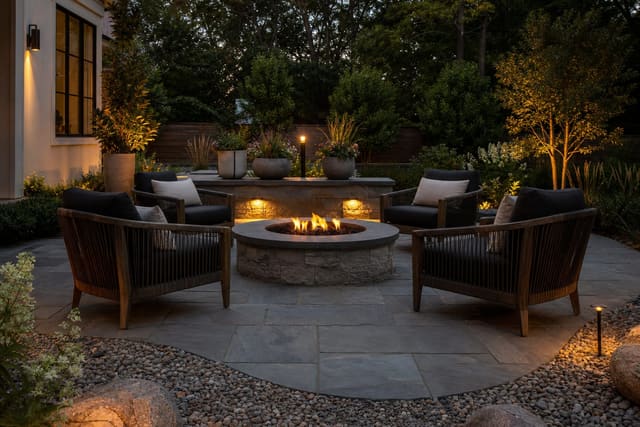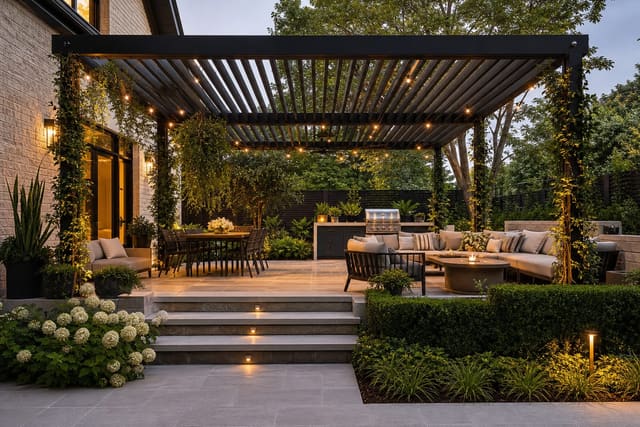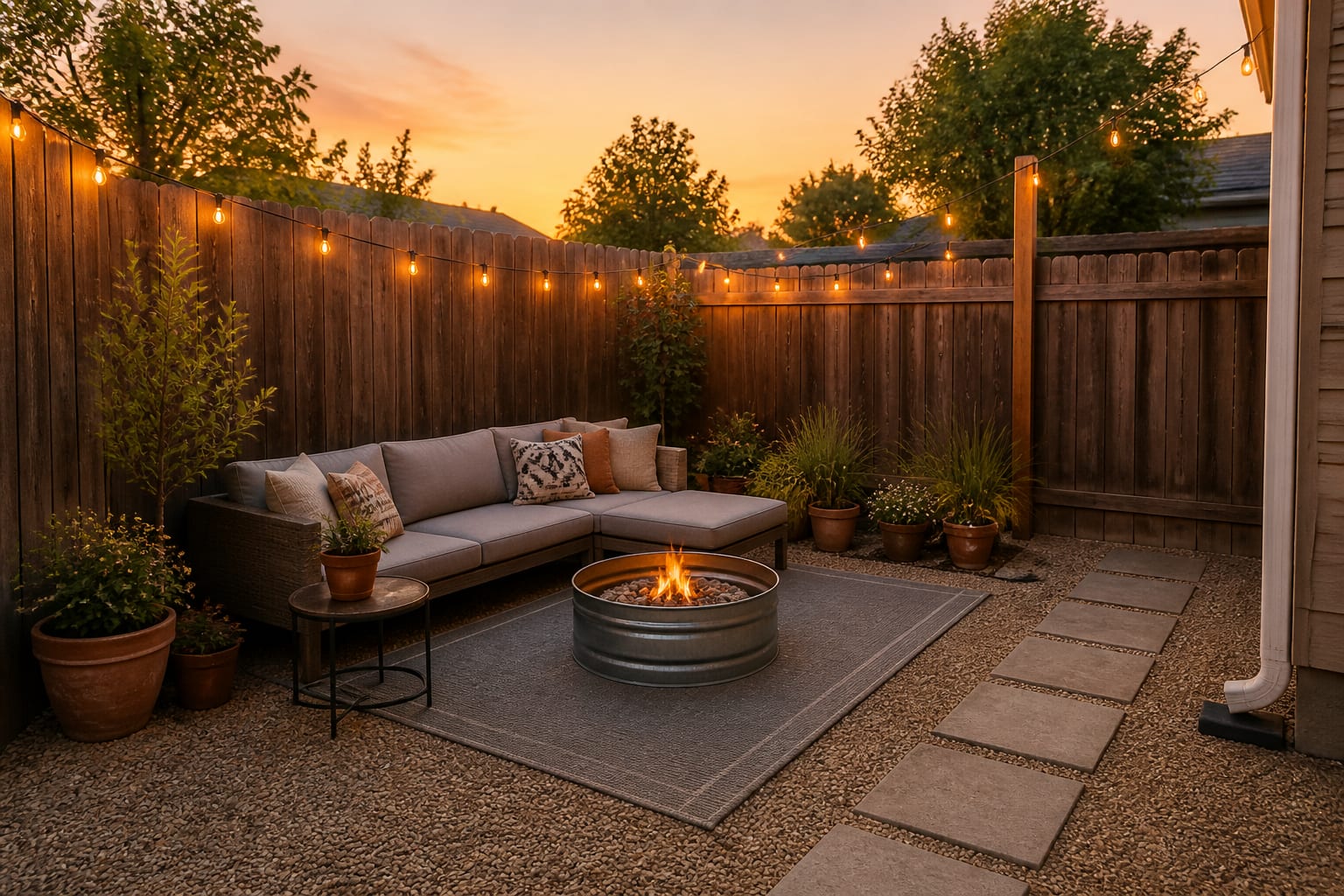
The patios that look expensive are rarely the ones that cost the most. A tight thousand-dollar budget forces good decisions: a clean ground plane, a few well-chosen pieces, and warm light after dark. Spend the money on the surface and the lighting, then scavenge everything else. Do that and almost nobody can tell you skipped the contractor.
Where the thousand dollars actually goes
The smartest way to plan a cheap patio is to decide the floor first and let everything else follow. A defined surface is what separates a patio from a patch of yard, and it is the one thing your eye reads instantly. For a 200-square-foot space, a compacted gravel base runs about $1.50 to $3 per square foot in materials, so $300 to $600 buys the entire floor if you rent a plate compactor for a day at around $60. Pavers laid over that same base push the cost up, but you can mix a paver path through gravel and get most of the polish for half the stone.
After the floor, the budget splits between seating, light, and a focal point. A used sectional or a pair of solid lounge chairs from a marketplace listing often lands at $150 to $300 for pieces that retail north of $1,200 new. Reserve roughly $80 for lights and $100 for a fire feature, and you still have room for plants and a rug. The whole point of a covered patio build is shade and shelter, but a budget patio earns its keep on the cheap by nailing the floor and the glow first.
Resist the urge to spread your dollars evenly across every category. The eye forgives cheap accessories far more readily than it forgives an uneven, weedy floor, so a disproportionate share of the budget belongs underfoot. Decomposed granite compacts harder than loose pea gravel and stays put under chair legs, which is why it is worth the extra dollar a bag for a seating area. Edge the gravel with a buried 4-by-4 or steel landscape edging for about $40 so it holds its shape instead of migrating into the lawn over a season.
A line-item plan under $1,000
Here is how the money breaks down for a 200-square-foot patio you build over a weekend. These are real, current materials prices, and the total leaves a small cushion:
- Gravel or decomposed granite base, leveled and compacted: $350 to $500.
- Secondhand sectional or two lounge chairs plus a side table from a marketplace: $200.
- A 48-foot run of weatherproof string lights at 2700K with shatterproof bulbs: $70.
- A DIY fire feature, either a stock-tank bowl or a stacked-block ring: $90 to $150.
- A flat-weave outdoor rug, 5 by 8 feet, to anchor the seating: $80.
- Four to six container plants in mixed sizes with potting soil: $120.
That list lands between $910 and $1,020 depending on your furniture luck, which is exactly the kind of margin a real budget needs. If a marketplace sofa falls in your lap for $80, roll the savings into better plants or a second string of lights. The single line worth protecting is the base, because everything else can be upgraded later but a sloppy floor undermines the whole project. Set a search alert on your local marketplace a few weeks before you build, since patio furniture turns over fastest in early fall when people are clearing patios for winter.
Make it look intentional, not improvised
The trick to a cheap patio reading as designed is repetition and restraint. Pick one or two materials and let them carry the whole space rather than buying a different finish for every element. A gravel floor, black metal lights, and terracotta pots is a complete palette, and three notes played consistently beat ten played at random. Lay the rug so it sits fully under the front legs of the seating, which visually ties the furniture into one zone instead of floating chairs on a sea of gravel.
Light is where the budget patio wins after dark. Hang string lights in straight, taut lines or a single sagging swag overhead, never a tangle, and aim for warm 2700K bulbs so skin and wood look good under them. A fire pit or a stock-tank fire bowl gives people a reason to stay out past sunset, and the flicker hides any rough edges your daytime patio still has. Cluster the container plants in odd-numbered groups at the corners and the entry, mixing one tall plant with two shorter ones so the grouping has a clear top. Skip the matching patio set; a mismatched chair you actually like beats a flimsy four-piece bundle every time.
String lights need somewhere to hang from, and that is where a little structure pays off. If you have no fence or eave to run a swag to, a single tall post sunk in a bucket of concrete gives the lights an anchor for under $30. Homeowners who later want real overhead shelter graduate to a pergola, but a budget patio gets the same evening glow from one well-placed post and a taut cable. Keep the plant containers in two or three repeating pot finishes rather than a different style for each, since matching pots read as intentional even when the plants inside them are clearance-rack survivors. A single large statement planter near the seating does more work than five small pots scattered around the edge.
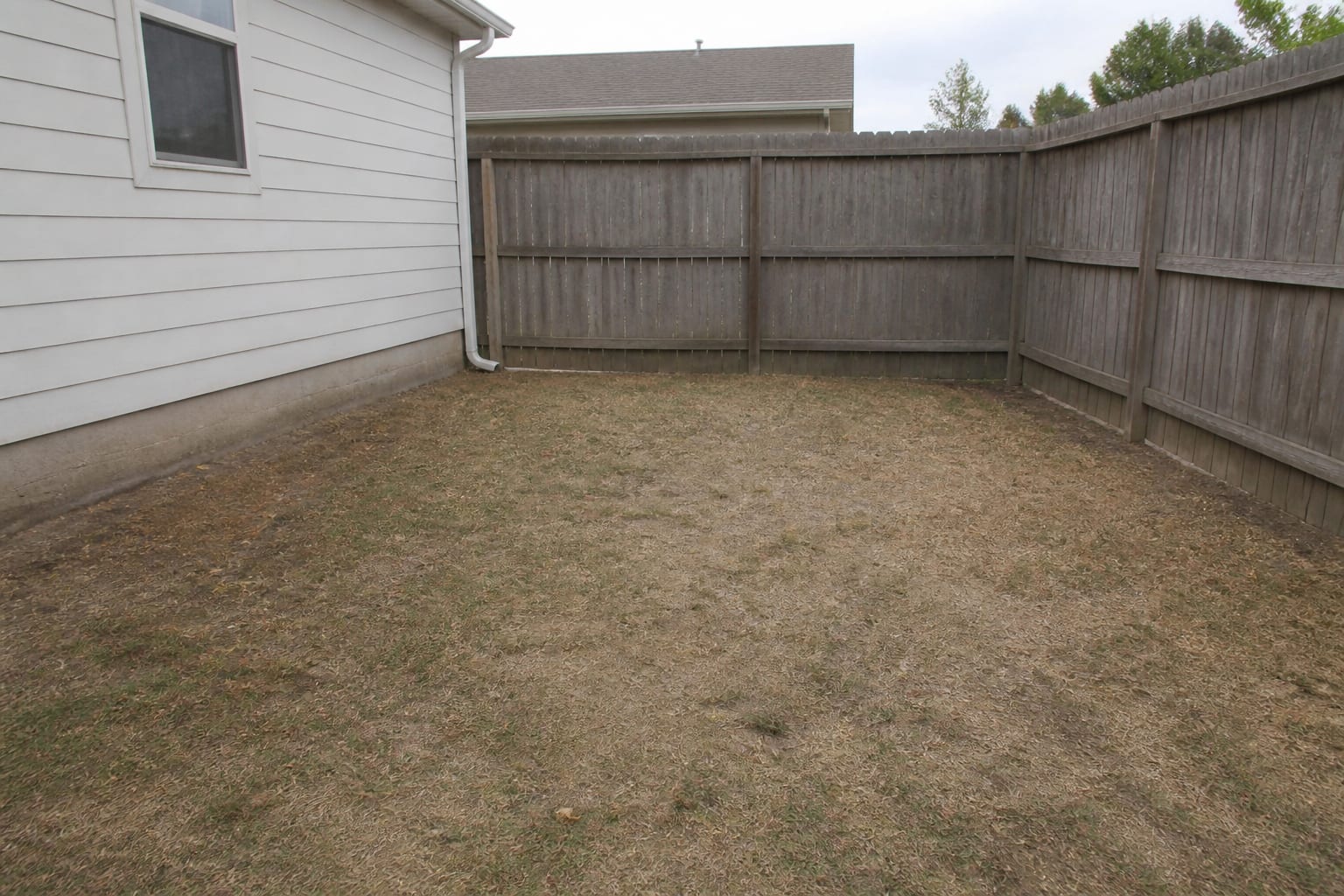
Before and after, in your own yard
Frequently Asked Questions
Can you really build a patio for under $1,000?
Yes, if you do the labor yourself and choose a gravel or decomposed-granite base instead of a poured slab. A 200-square-foot floor in gravel costs $300 to $600 in materials, which leaves enough for secondhand furniture, lights, and plants. The savings come from skipping the contractor and buying seating used.
What is the cheapest patio surface?
Compacted gravel or decomposed granite is the cheapest durable surface, at roughly $1.50 to $3 per square foot in materials. It drains well, needs no concrete work, and you can install it with a rented plate compactor in a weekend. A paver path set into the gravel adds polish without the full cost of a paved floor.
How do I make a cheap patio look expensive?
Spend on the floor and the lighting, then stay disciplined on materials. Use one or two finishes throughout, anchor the seating with a rug, add warm 2700K string lights, and cluster container plants in odd-numbered groups. A consistent palette and good light read as designed even when the furniture was free.