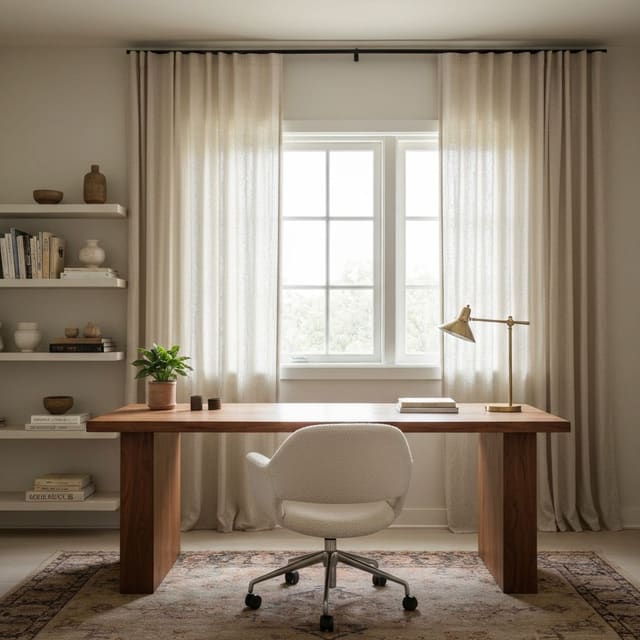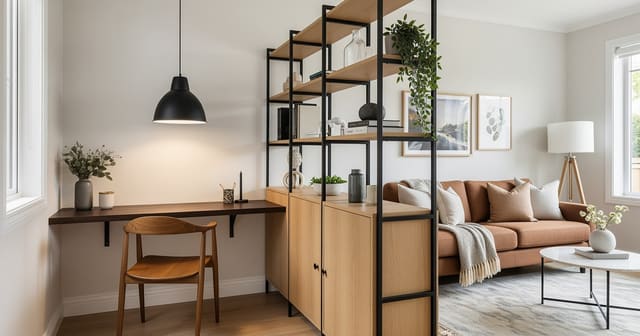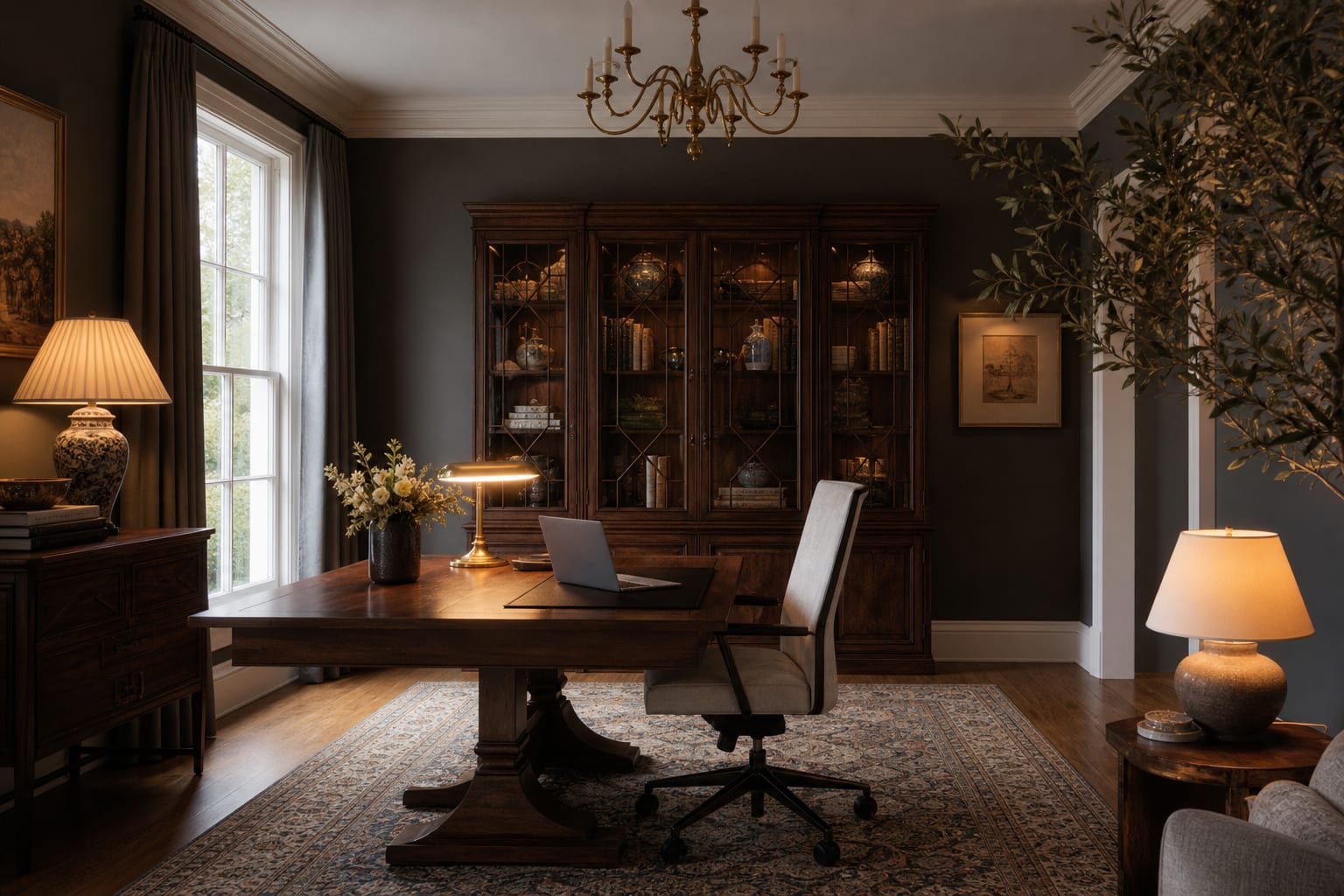
A formal dining room used twice a year is the single biggest unused asset in most homes, and the simplest place to put a real office is right on top of it. My opinion is blunt: most dining-to-office conversions fail because the homeowner buys a desk and a task chair, parks them in the corner, and leaves the rest of the room frozen as a dining room. That produces a half-room that is neither comfortable to work in nor usable to eat in. The better move is to commit: treat the dining table as the desk, the sideboard as the storage wall, and the chandelier as the lighting layer, then add only what is missing.
How do you convert a dining room into a home office?
Convert a dining room into a home office by turning the dining table into a primary work surface, replacing two dining chairs with one ergonomic task chair, repurposing the sideboard or china cabinet for office storage, and swapping the chandelier bulbs for a warm-neutral, higher-output set. Add a quiet rug, a small printer or filing zone, a real desk lamp, and a video-call backdrop. Keep one to two folding chairs in a closet so the room can revert to a dining room for holidays. The whole conversion can usually be done in a weekend without new furniture and reversed in an hour.
Use the dining table as a desk (the real specs)
A standard dining table is usually a better desk than a dedicated office desk. A 6-foot rectangular dining table gives 72 inches of work surface — wider than 90% of consumer desks — and the height is typically 29 to 30 inches, which is the same as office desk height. The legs are usually at the corners, leaving room to slide a real chair under.
Test the table for actual work, not just laptop time. Sit at it for two hours with your monitor, your notebooks, and the cables you really use. If the table is round, you lose corner real estate but gain video-call symmetry — the camera reads a round table as a more neutral backdrop than a rectangular slab. If the table is glass, plan to use a desk pad or a matte runner; glass under a webcam picks up every ceiling fixture and creates glare on the keyboard.
The chair is the part most people get wrong. A dining chair is built for 45-minute meals, not 8-hour workdays. Move a real task chair into the room and store one dining chair behind a door or in a guest closet. The room will still look like a dining room from the doorway because the table, sideboard, and chandelier are intact; the chair is the only obvious change.
If the table is too large for the room without chairs around it, consider a smaller rectangular table positioned the way a desk would be, leaving room for the existing chairs along one wall when guests come. Then use the strategies from home office in a living room to zone the work area cleanly.
Storage, lighting, and the video-call backdrop
The sideboard or china cabinet is the second free upgrade. Most of them have far better proportions, materials, and presence than any IKEA office shelf. Empty the drawer of placemats, group the china into the bottom of the cabinet, and reclaim two drawers and three shelves for office supplies. Use trays, dividers, and bins so the contents look intentional when the cabinet doors are open during a meeting.
A china cabinet with glass doors is the secret weapon. Style the visible shelves with books, a single sculptural object, a small lamp, and one plant. The same cabinet that displayed crystal can become the cleanest video-call backdrop in your house. Avoid leaving printer cables, sticky notes, or stacked paper visible behind the glass.
The chandelier becomes ambient light, not work light. Swap the bulbs to warm-neutral around 3000K and use 800 lumens or higher per bulb when the room is also used for video calls. Add a real desk lamp on the table — an articulating arm or a focused task lamp with a 2700–3000K bulb at 400–600 lumens. If the room has only one window and faces north or east, treat the lighting problem before the layout problem. The same logic in single-window bedroom lighting translates directly.
For video calls, sit so the camera looks toward the sideboard or china cabinet, not toward the window. Backlight from a window flattens your face and makes the room look like a silhouette. If the only viable orientation has a window behind you, add a sheer roller shade and a fill lamp at 60 to 75 percent of the window brightness positioned slightly off-camera-left or camera-right.
Reversibility, storage of the dining gear, and family logistics
The thing that kills most dining-to-office conversions is the fear that holidays will be ruined. Plan the reverse on day one.
Keep at least four matching dining chairs in a closet, a basement, or a guest room. A foldable stack of two extra chairs covers Thanksgiving. Slide them out, slide the task chair out, restore the table, change the bulbs back to warm dim ambiance, and the room hosts twelve people in twenty minutes. If you store the chairs upside-down on a closet shelf with felt pads, they take less space than you expect.
For day-to-day office use, the table needs a rule: nothing stays out overnight except the lamp, the monitor, and the keyboard. A small lidded bin holds the laptop, the notebooks, and the cables every evening so the room reads as a dining room again. This single habit decides whether the conversion feels stylish or chaotic.
If kids share the house, set rules for the table. Dining rooms used as offices often become homework dumping grounds, then craft-project zones, then permanent disaster areas. Give the kids a dedicated desk or table elsewhere — a converted closet, a kitchen counter, or even a flip-down wall desk — so the office stays an office.
If the dining room is shared with other functions, study the unused formal dining room repurpose playbook before fully committing; some rooms work better as part-library, part-office hybrids rather than as a single dedicated workspace.
Common dining-to-office mistakes
- Buying a small parsons desk and shoving it in the corner while leaving the dining table intact.
- Using a dining chair for full-time work — eight hours in a side chair will end with a chiropractor visit.
- Leaving the chandelier bulbs at 2700K and 400 lumens; video calls will look candlelit.
- Putting the camera facing the window; you become a silhouette.
- Forgetting cord management — power strips, monitor cables, and printer wires turn the room into a tangle.
- Letting the printer live on the table; relocate it to a sideboard shelf or a closet cart.
- Storing the dining chairs in the garage where humidity warps them.
Use AI design to preview the office conversion
The dining-to-office conversion looks obvious on paper and confusing in real life. Furniture placement, lighting, and the video-call backdrop all interact. Photograph the empty or partly empty room from the doorway and run two or three preview versions: dining table as desk facing the sideboard, dining table as desk parallel to the window with sheer shades, and a smaller dedicated desk in the corner with the dining table preserved.
When you brief the preview, be specific: convert dining room to home office, keep existing dining table as desk, replace dining chairs with one ergonomic task chair, repurpose sideboard for office storage, add articulating desk lamp at 2700K, keep chandelier as ambient light with 3000K bulbs, video-call backdrop facing china cabinet with styled shelves. Then run a second version that puts the office in the corner and leaves the table set for dining. Seeing both layouts before you move anything will tell you whether to commit fully or hedge.
Transform your space in seconds. No design experience needed. Try Re-Design Free