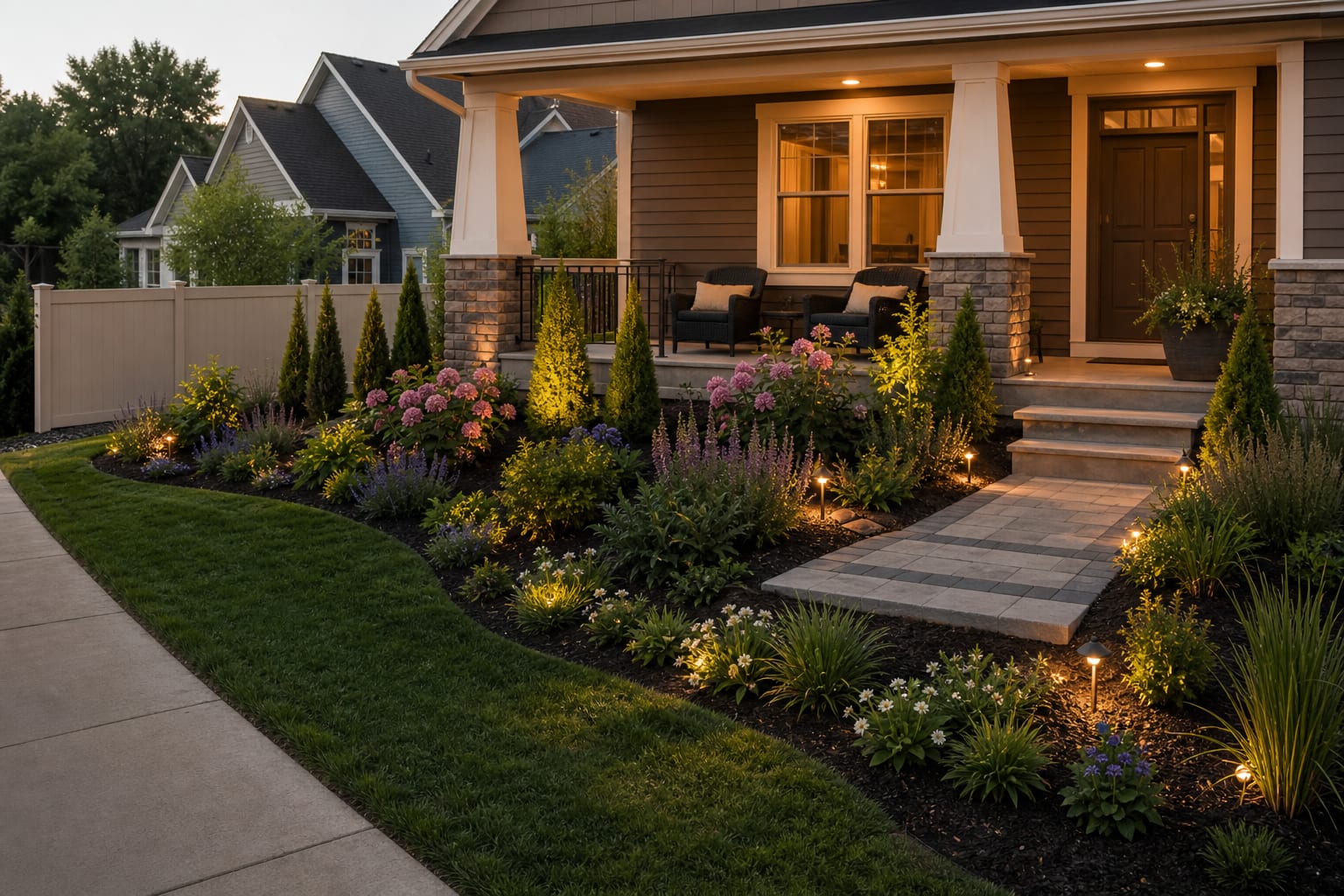
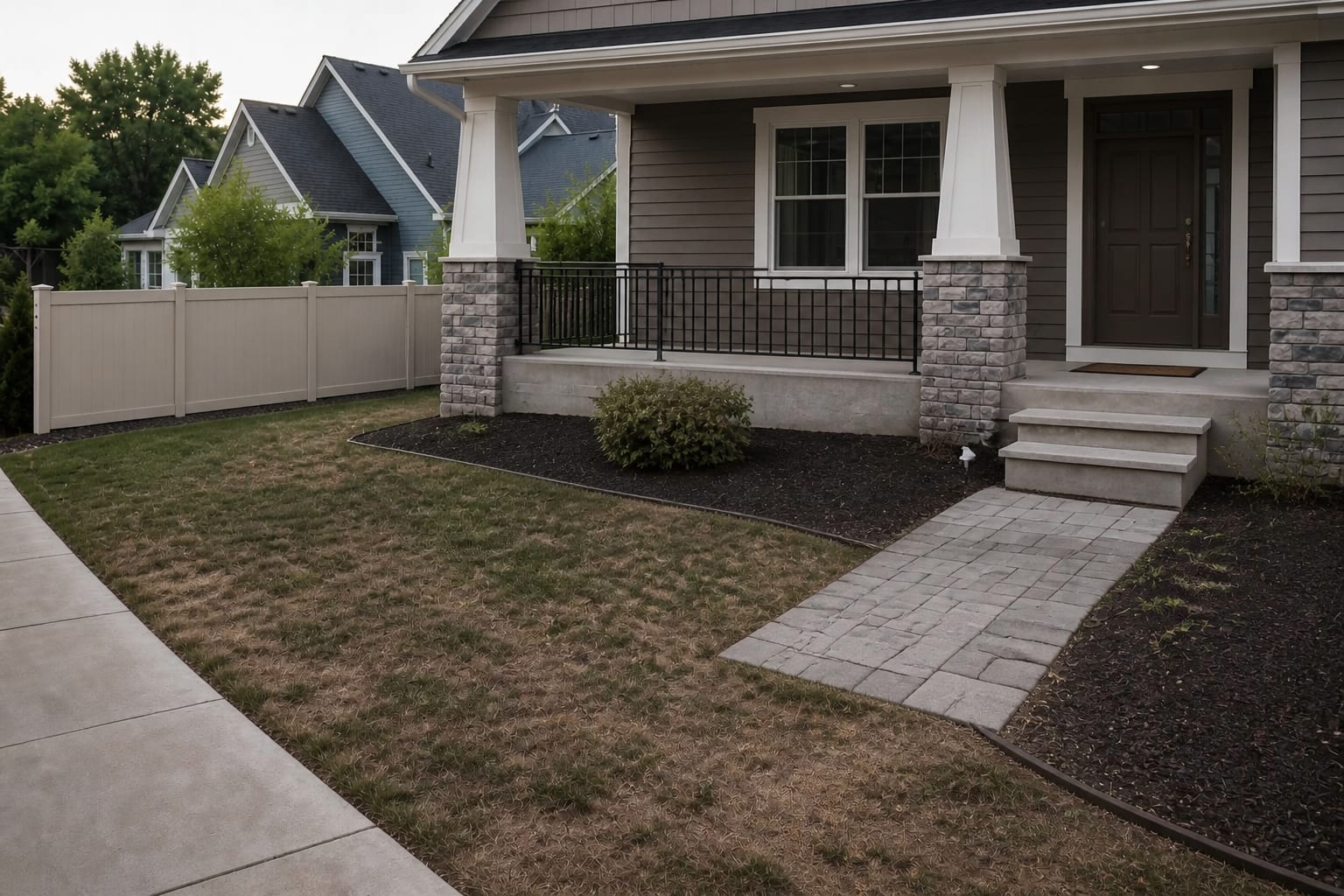
Front yard flower bed ideas that build curb appeal start with depth and repetition: make the border at least 3-4ft deep along the foundation, mirror plantings on both sides of the entry walk, repeat a short plant palette instead of one-of-each, and keep the tallest plants 24-36in below the windowsills so the house stays visible.
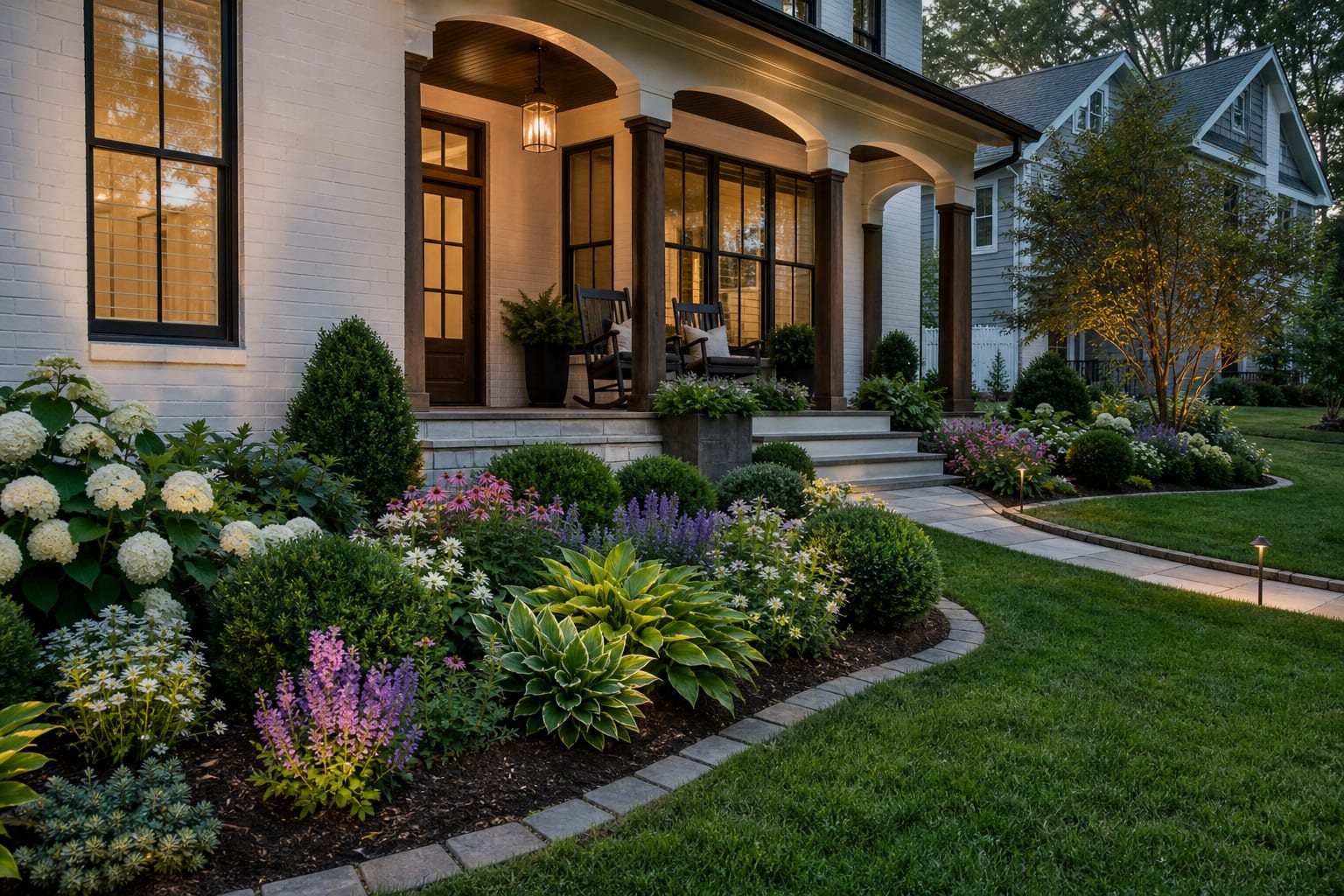
What makes a front yard flower bed look designed?
A designed bed has enough depth for layers, enough repetition to calm the eye, and enough clear walking space that guests don't brush wet foliage. A 2ft strip against the foundation holds mulch and a row of annuals but can't carry a real border. Start with a bed 5 to 8 feet deep along the facade, then widen to 8 to 12 feet at a corner, porch, mailbox, or walk turn.
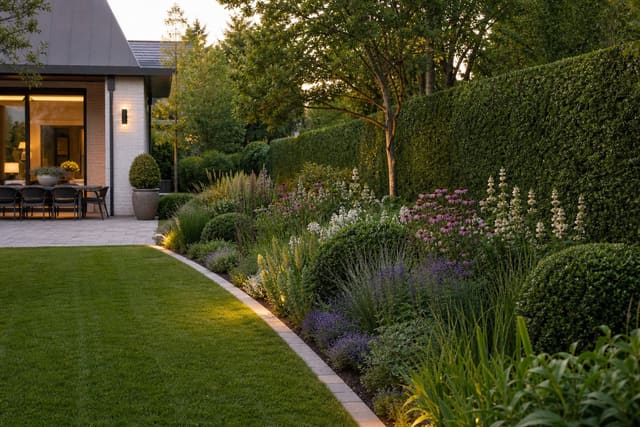
Let the shape answer the architecture. A colonial, craftsman, or ranch usually reads better with a broad, clean curve than tiny scallops; a modern house can take a straighter edge, but the planting still needs rhythm. Repeat one evergreen, one flowering shrub, and two or three perennials across the run so the eye reads a composition, not a plant sale.
Keep the path practical: main walks should stay at least 42 inches wide, with 36 inches the working minimum. Let plants lean toward the walk only if their mature spread leaves a clean edge; a lavender that reaches 30 inches wide needs a bed deep enough to hold that width without grabbing ankles.
Test this on your own photo with ReDesign before you dig. Keep the house edge, horizon line, hardscape, planting beds, and main path visible so the preview solves the space you actually have.
Which front yard flower bed ideas fit the house?
The right idea depends on house width, walk location, sun exposure, and how formal the architecture feels. Pick one concept, then choose plants that support it instead of mixing every style into the same bed.
| Front yard condition | Better flower bed direction | Spec that keeps it clean |
|---|---|---|
| Flat lawn with builder shrubs | Deep curved foundation border | 5-8ft bed depth, repeat shrubs every 6-10ft |
| Narrow lot or short setback | Slim layered entry border | Lowest edge under 12in, protect a 36in walk |
| Long straight walkway | Rhythm planting on both sides | Repeat a plant group every 4-6ft |
| Hot south-facing facade | Drought-tolerant color and gravel mulch | 18-30in spreads, air around crowns |
| Shady porch front | Foliage-first border with pale blooms | Hostas, ferns, carex, heuchera, hydrangea where sun is under 4 hours |
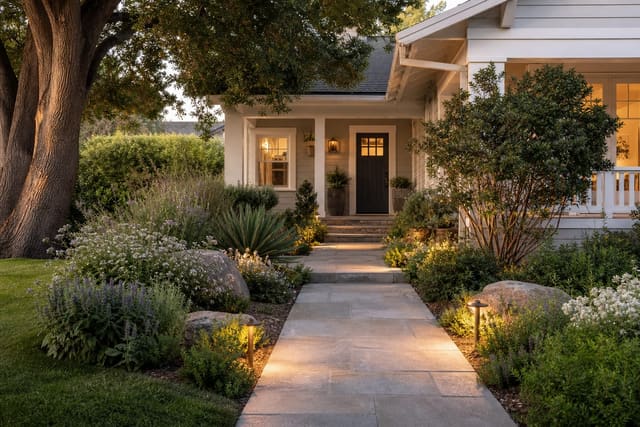
- Foundation sweep: pull the bed out in a smooth curve reaching 7-8ft at its deepest, tall shrubs near blank wall, low flowers below windowsills.
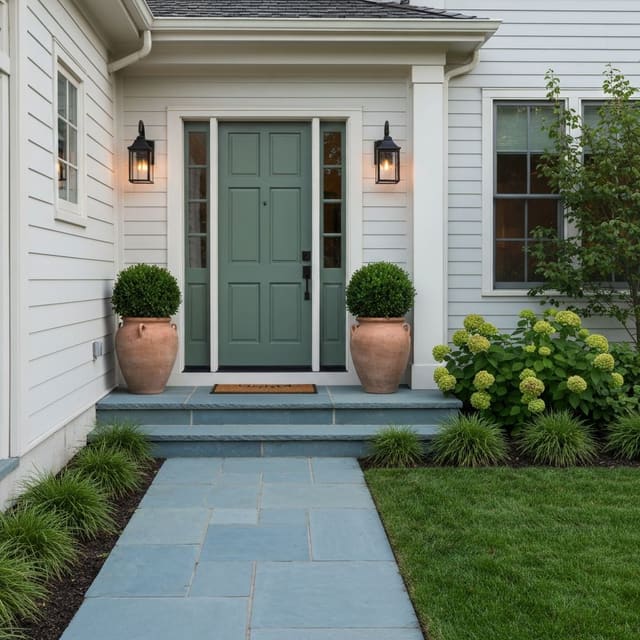
- Walk symmetry: matching low shrubs or grasses on both sides of the first 6-10ft of path, loosening near the porch.
- Mailbox island: a 4x6ft bed can carry one compact evergreen, three perennials, and front-edge bulbs.
- Corner bed: on a narrow lot, wrap the border 6-10ft around the front corner to borrow width; pairs well with narrow lot front yard ideas.
- Sunny border: salvia, catmint, yarrow, grasses, sedum, and dwarf conifers at 18-24in spacing stay full through dry weeks.
- Shaded entry: rely on chartreuse, silver, deep green, and white for color instead of forcing bloom.
- Bulb layer: plant daffodils or alliums 4-6in deep between perennials for early spring color before the border fills in.
A planting plan can't fix a broken arrival on its own. Pair the bed with front walkway ideas so the flowers support a route that already makes sense.
How should you layer plants from curb to door?
Layering works when each plant has a job and a height band: lowest near the lawn or walk, medium perennials through the middle, structural shrubs toward the house or at corners. The goal is a planted scene with enough height change to feel settled, not a staircase of identical rows.
Keep the front edge under 10-14in tall: creeping phlox, low sedum, dwarf catmint, sweet alyssum, thyme, or compact heuchera soften the line without hiding the shape. Set the first row 12-18in back from a hard edge if the plant spreads outward.
The middle layer, 18-36in, is where curb appeal flower beds earn their color: salvia, coneflower, nepeta, compact hydrangea, spirea, dwarf abelia, or regional natives, planted in drifts rather than dots. Three coneflowers spaced 18in apart read stronger than three unrelated flowers scattered around.
The back layer holds winter structure: boxwood alternatives, inkberry holly, dwarf yaupon, compact viburnum, evergreen grasses, and small conifers at 30-48in, depending on window height. Keep shrubs 18in off the siding for airflow and easier maintenance.
Discipline the color: one dominant flower family, one supporting color, one quiet neutral, repeated. The front door can carry the accent color; the bed doesn't need to shout over it.
Common front yard flower bed mistakes
- Keeping the builder bed shape. It's usually too shallow for anything but a shrub row; expand the outline first, even if you plant only half this season.
- Buying flowers for one bloom week. Choose plants for spring, summer, fall, and winter structure, then use annuals in small 12-18in pockets near steps.
- Planting too close to the house. Leave working space behind shrubs, keep mulch off siding, and avoid thorny plants near windows or hose bibs.
- Using too many varieties. Limit a modest bed to 7-10 plant types and repeat them until the pattern reads from the street.
- Ignoring mature height. Keep plants below lower window trim unless screening is the goal; save 3-5ft shrubs for blank walls or corners.
- Forgetting water access. New planting needs deep watering during establishment, so plan hose reach or drip line before it goes in the driest strip.
Use AI design to preview your front yard before you commit
Front yard planting is hard to judge from pots because the real design is the relationship between the house, bed line, path, and mature plant mass. Upload a straight-on photo of the facade and test two or three bed shapes before removing turf: a curved cottage border, a cleaner evergreen-and-perennial layout, or a narrow entry-focused plan for a small setback.
Frequently Asked Questions
How wide should a front-yard flower bed be?
Use 3-4ft minimum for a planted bed against the house and 4-6ft for an island bed, widening the bed further at corners and entry zones for emphasis.
What plants work in a front-yard bed?
Use structural boxwood for a constant green frame, mid-height perennials like coneflower or salvia for summer color, and bulbs underplanted for spring. Pick five species and repeat them rather than buying one of everything.
How do I make a front yard read symmetrical?
Mirror the bed shape and the dominant plant on both sides of the entry walk. Small variations in the mid layer are fine, but the anchor plant and bed footprint must match on each side.
Should the bed match the house style?
Yes. Formal architecture pairs with structured boxwood-and-bulb beds, cottage and farmhouse pair with looser perennial drifts, and mid-century pairs with restrained mass plantings of one or two species.
What's the highest-ROI front-yard upgrade?
Doubling the bed depth to 4ft and edging it sharply, even before adding new planting. Depth and a crisp edge read as a designed yard from across the street.
> Try this: Ready to see this on your own outdoor space? Open ReDesign and run the preview before you buy materials, plant, drill, or move furniture.
Three transformations to try
1. Front yard with mirrored entry beds 2. Foundation bed with boxwood and perennials 3. Cottage-style front border with bulbs