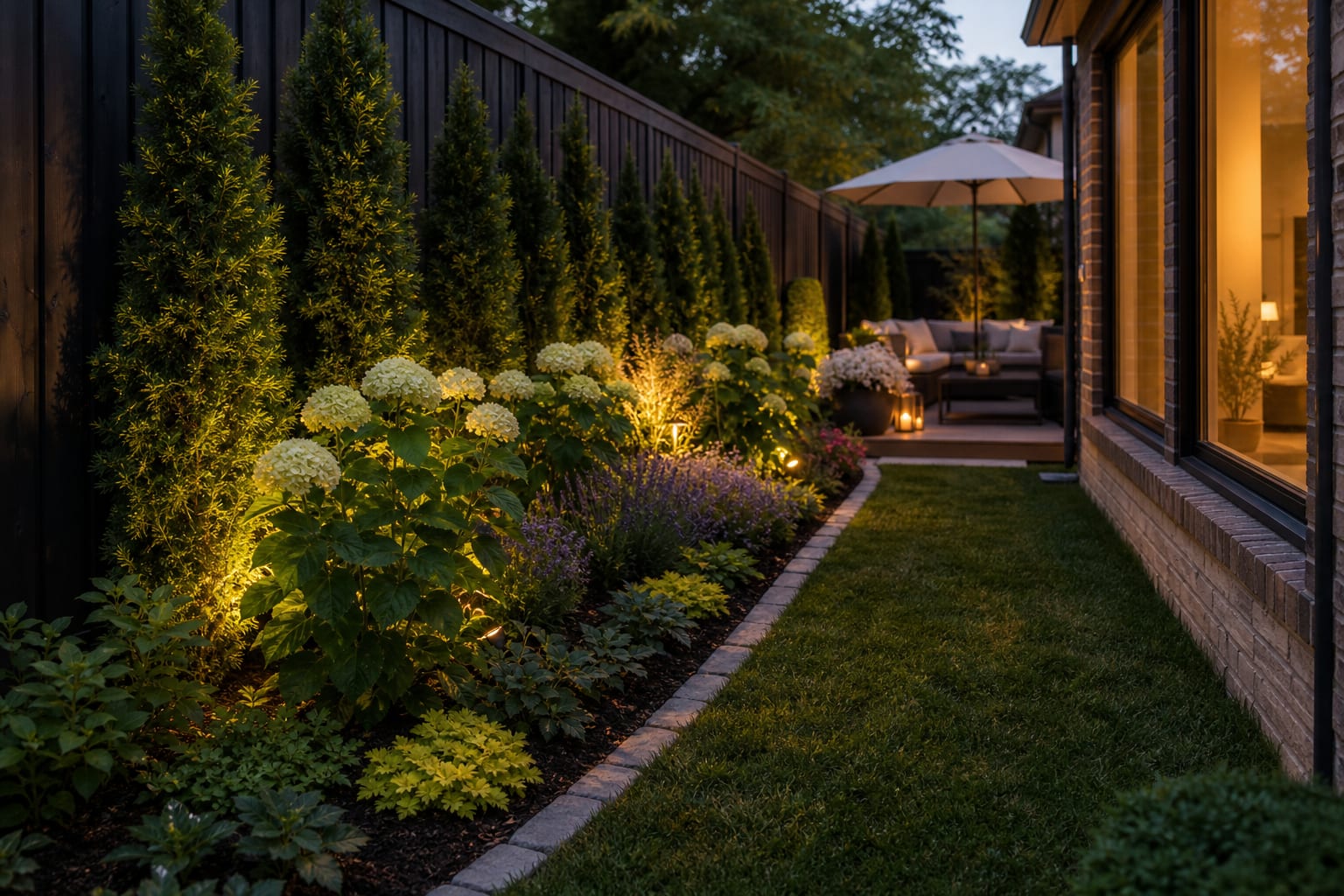
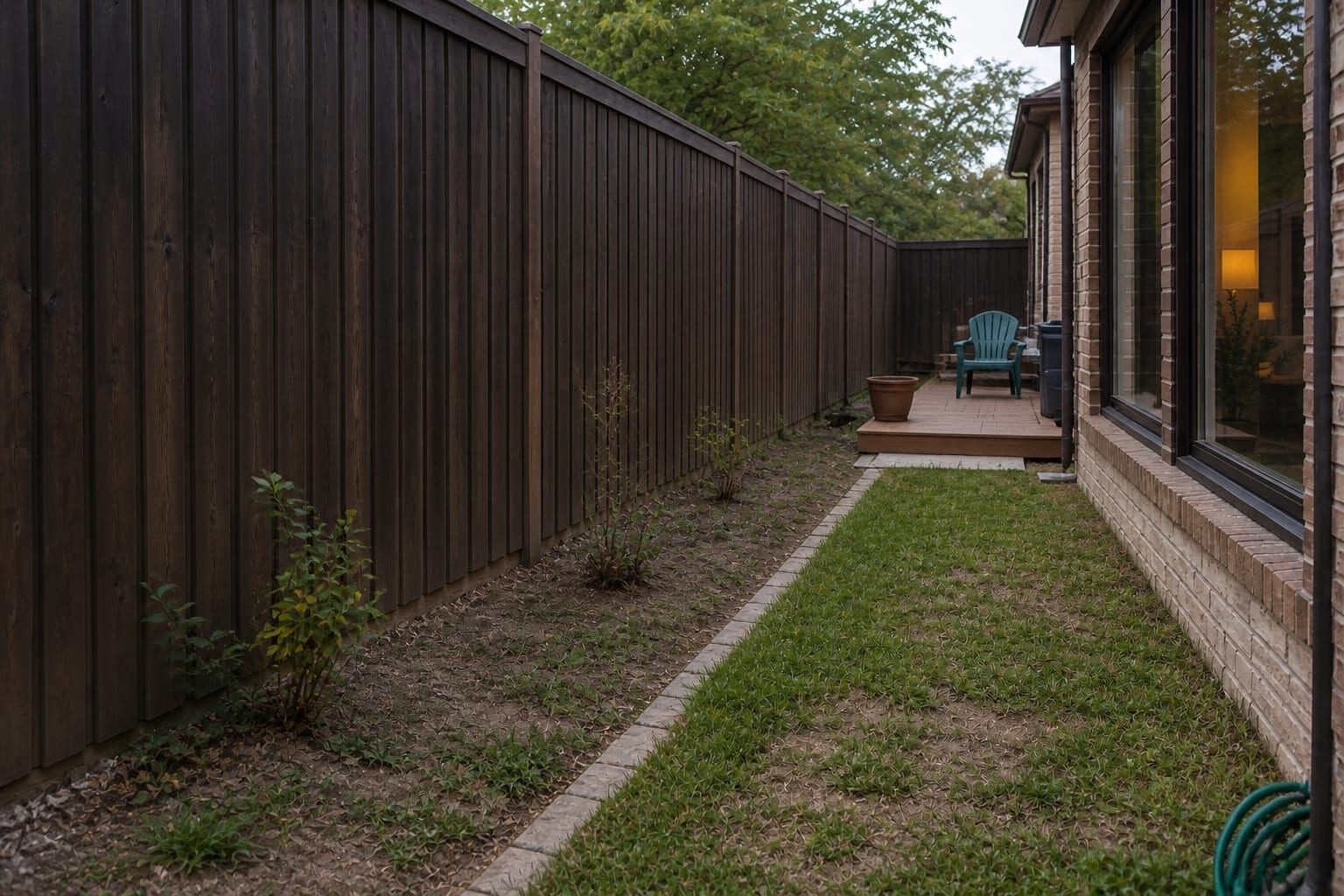
A border looks designed when it's at least 3-4ft deep, layered into back, middle, and front tiers, planted with the same cultivars repeated in odd-numbered groups every 8-12ft, and limited to 6-9 species total. Start with structure before flowers: flowers give you three good weeks, structure gives you a border that works the other 49.
What gives a garden border structure instead of a plant line?
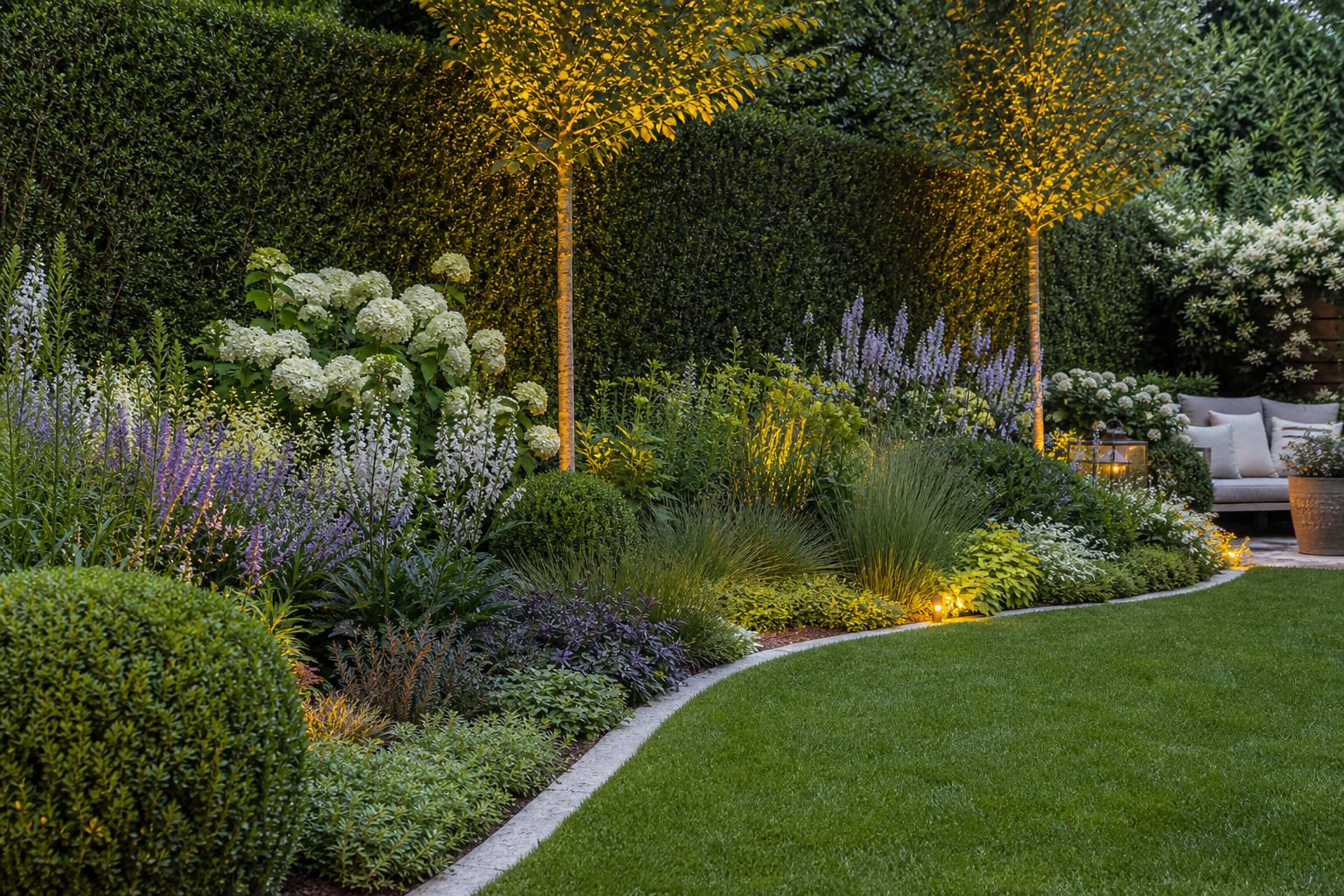
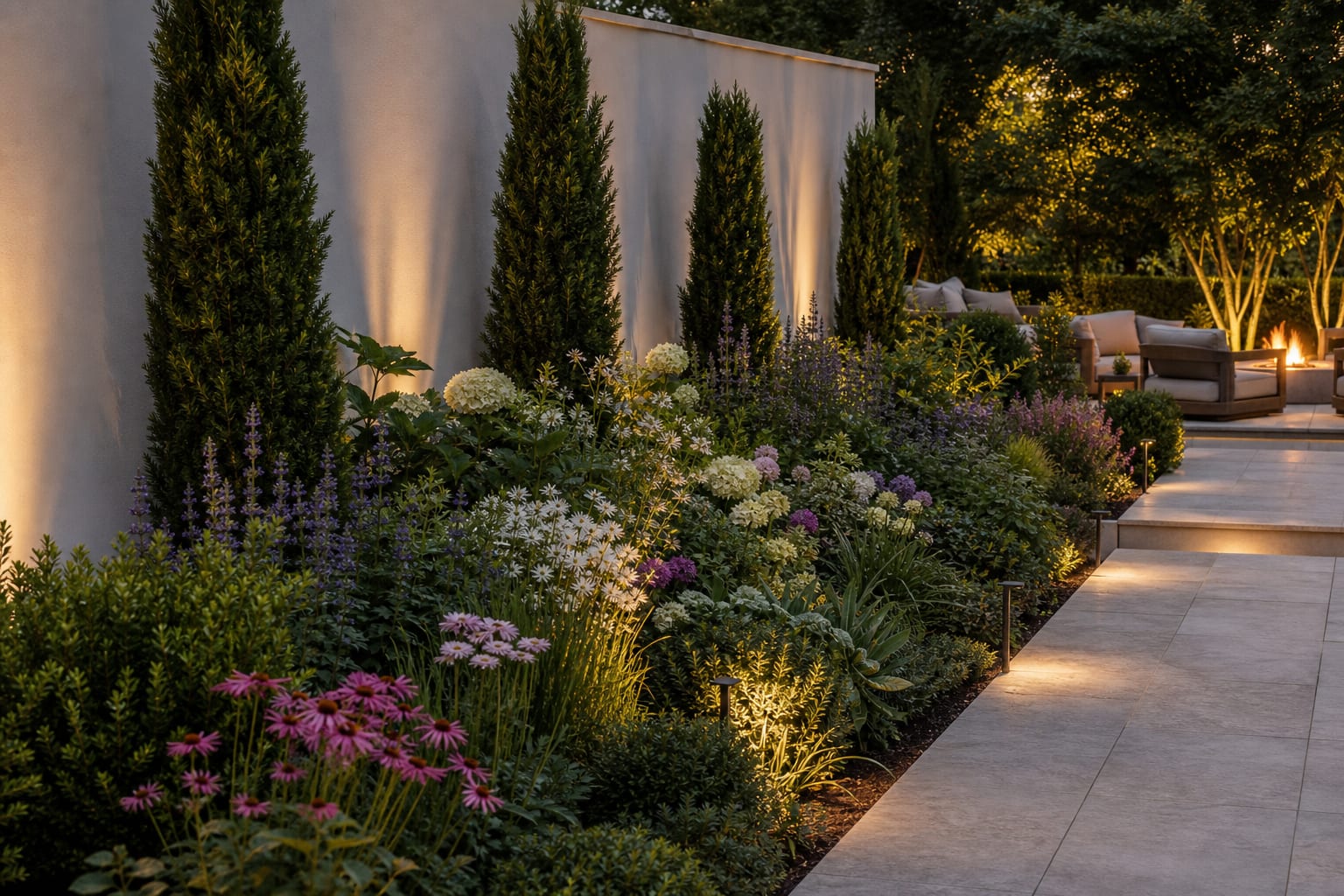
A structured border has a backbone, a middle layer, and a ground-level finish that still reads clearly out of peak flower. Many mixed borders fail here: the owner buys color, then wonders why the bed looks like a jumble by July. The eye needs repeated verticals, repeated mounds, and a defined front edge.
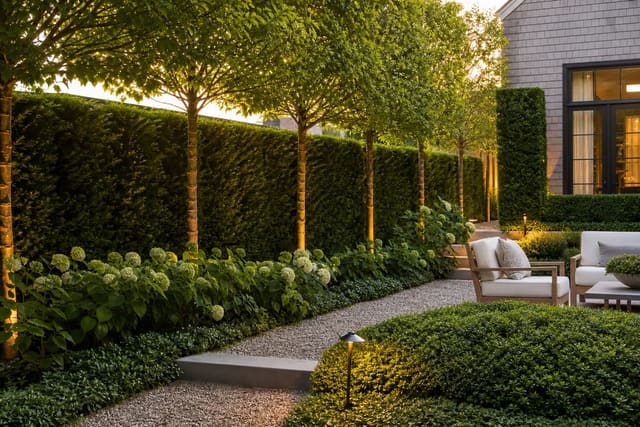
Treat the back layer as architecture: clipped evergreen balls, upright grasses, espaliered fruit, or a low hedge against a fence. If the boundary itself should work harder, check living fence and hedge ideas first — a hedge gives the border a wall to lean on, visually and physically.
| Border condition | Best structural move | Useful spec |
|---|---|---|
| Against a fence | Tall shrubs, climbers, or grasses at the back | Keep mature height 150-300mm below the fence top unless screening |
| Along a lawn | Repeated mid-height clumps with a crisp mowing edge | Leave a 100-150mm hard edge for wheels and shears |
| Beside a path | Softer plants that lean without blocking access | Keep 600mm paths clear, 900mm where two people pass |
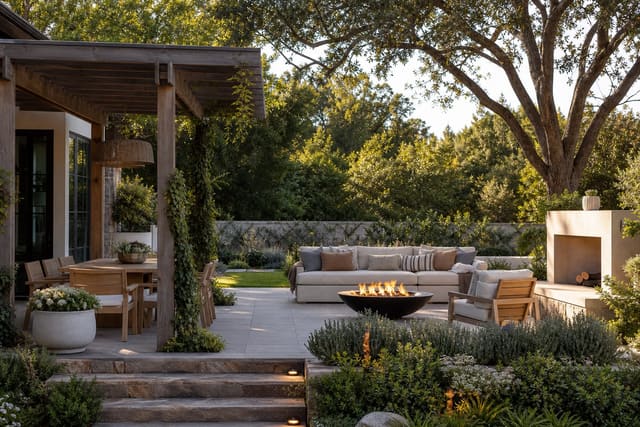
| Around a patio | Evergreen anchors plus seasonal perennials | Keep thorny or bee-heavy plants 450mm from seating |
What's the three-tier planting formula that works in real yards?
The three-tier border works because it accepts how plants grow: tall plants need room, medium plants make the rhythm, low plants hide the soil. It's strict enough for beginners and flexible enough for a naturalistic, Oudolf-style border.
- Back tier: Permanent structure that earns its space in winter — compact shrubs, upright grasses, obelisks with climbers, or a clipped hedge at 750mm-1.5m. Space woody plants by mature width, not pot size.
- Middle tier: The repeated melody, not a plant collection. Pick 3-7 perennial types at 450-900mm, repeat each in drifts of three or five, and leave 300-450mm between crowns.
- Front tier: Low geraniums, thyme, ajuga, heuchera, carex, or compact nepeta at 150-300mm to knit the edge together and cut down on weeding.
- Bulbs: A hidden fourth rhythm. Plant in groups of 7-15 between perennials for early color, and let later foliage hide the dying bulb leaves.
If the front edge is weak, borrow from ground cover ideas for difficult garden areas rather than leaving bare soil — a planted skirt looks settled, gaps look unfinished no matter how good the hero shrubs are.
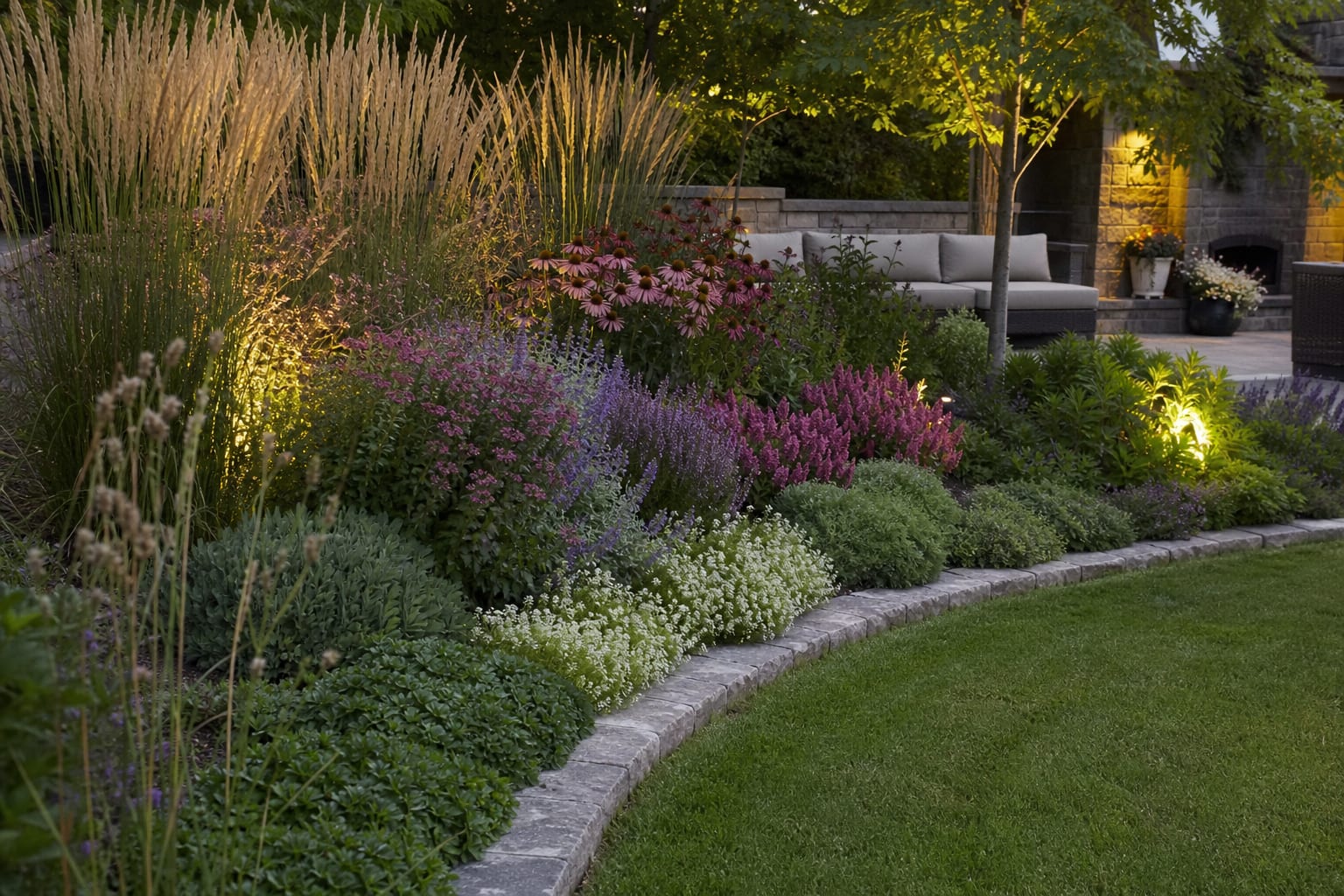
Test this on your own photo with ReDesign — keep the house edge, horizon line, hardscape, planting beds, and main path visible so the preview solves the space you actually have.
How should the border change at corners, fences, and paths?
A good border changes posture where the garden changes direction. Straight runs need rhythm, corners need weight, paths need restraint — plant every metre the same way and the border feels flat even with a good plant list.
At a corner, use a stronger anchor: a multi-stem shrub, a large pot, an obelisk, or three repeated evergreen mounds, aiming for a focal height around one-third to one-half the fence height. Repeat that anchor at the end of a long border so the line has a full stop instead of a fade-out.
Along paths, keep upright plants 150mm back from the edge and floppy perennials 300-450mm back — a romantic spill of lavender is charming until it steals 200mm of a narrow walkway after rain. Fence-side borders facing a road or noisy neighbor should lean on mass and density, borrowing from sound barrier garden design; one airy perennial won't do the work of layered evergreen and deciduous planting.
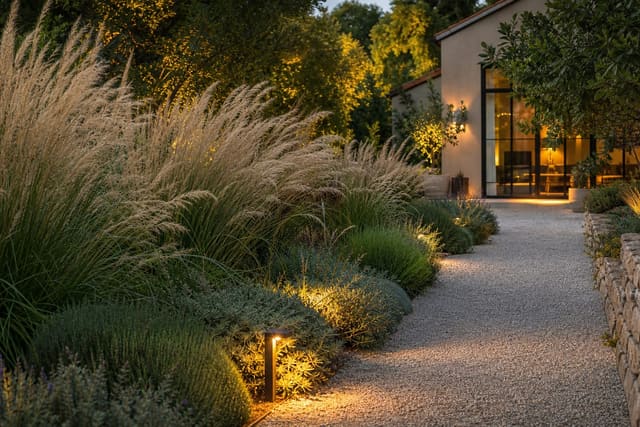
For evening use, keep lighting low and warm: 2700K spike lights aimed across grasses or onto shrub stems, fittings tucked behind the front tier, nothing blasting straight into a seating area.
Design-check shorthand: Depth before decoration. Repetition before variety. Maintenance before novelty.
What are the most common border planting mistakes?
Common mistakes come from impatience: buying for instant color, ignoring mature size, treating the edge as an afterthought.
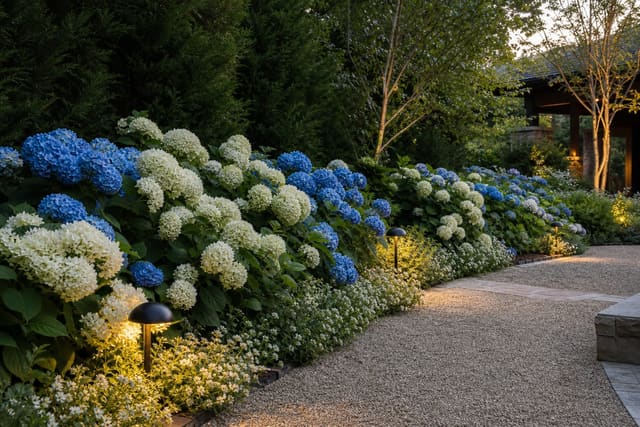
- One of everything. A single salvia, rose, grass, foxglove, and hydrangea reads as fragments; repeat fewer plants in groups of three or five instead.
- Too shallow a bed. A 300mm strip only holds edging plants, not a mixed border — widen to at least 900mm for height variation.
- Ignoring mature spread. A shrub that matures at 1.2m wide needs room now, not a squeeze because the nursery pot looked small.
- Bare soil. Uncovered ground invites weeds; use low ground cover, bulbs, and a 50mm mulch layer, kept away from woody stems.
- Summer-only flowers. Mix evergreen structure, seed heads, bark, grasses, and early bulbs so the edge holds shape in January too.
How can AI design help preview a border before you dig?
AI design lets you test the shape of an idea before lifting turf or buying forty plants. Upload a straight-on photo of the garden edge, then preview a wider bed, a darker hedge backdrop, a curved mowing strip, or a three-tier border from the same angle.
Use the preview as a composition check, not a plant guarantee — it can show whether the border needs more height at the fence, a stronger corner anchor, or a lower front tier, but you still need plants suited to your light, soil, and maintenance appetite. In a north-facing garden it may confirm pale foliage and evergreen form matter more than sun-hungry flowers; in a rental, it may show large containers and temporary edging can fake the effect without permanent digging.
Be specific: ask for a 1.2m-deep mixed border with evergreen structure at the back, mid-height perennials, low ground cover, a crisp lawn edge, and warm low-voltage lighting, then compare a straight run against a shallow curve. The better version makes lawn, fence, and planting read as one garden, not three strips.
Frequently Asked Questions
How wide should a planted border be?
3-4ft minimum for a credible three-layer border. Less than 3ft reads as a strip and forces a single-layer planting that can't carry visual weight.
How many plant species belong in a border?
Aim for 6-9 species total across a 20-30ft border, each repeated in groups of 3-5. Collections of 15+ species look fragmented from any distance.
What plants belong in the back of a border?
Structural perennials and grasses 4-6ft tall — joe-pye weed, miscanthus, panicum, hollyhocks — plus one or two compact shrubs as anchors for winter presence.
How do I keep a border blooming all season?
Layer at least one early (May-June), one mid (July-Aug), and one late (Sep-Oct) bloomer into every 8ft of border length. Foliage and structure carry the gaps between bloom windows.
Should a border have an edge?
Yes. A sharp spade line, steel edge, or low boxwood/mondo grass strip separates the bed from the lawn and noticeably lifts the perceived quality of the planting.
> Try this: Ready to see this on your own outdoor space? Open ReDesign and run the preview before you buy materials, plant, drill, or move furniture.
Three transformations to try
1. Three-layer perennial border 2. Cottage border with grasses and salvia 3. Front-yard border with boxwood edge