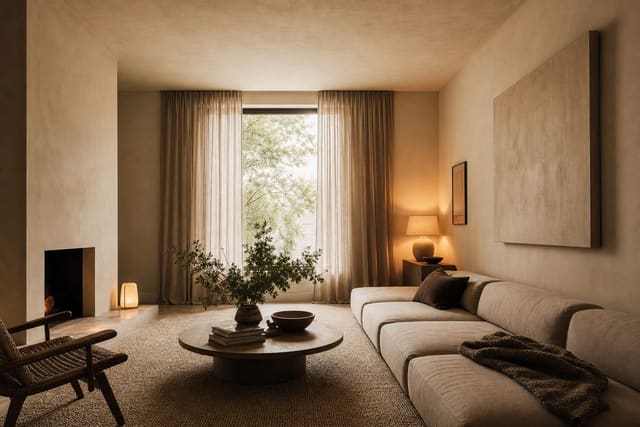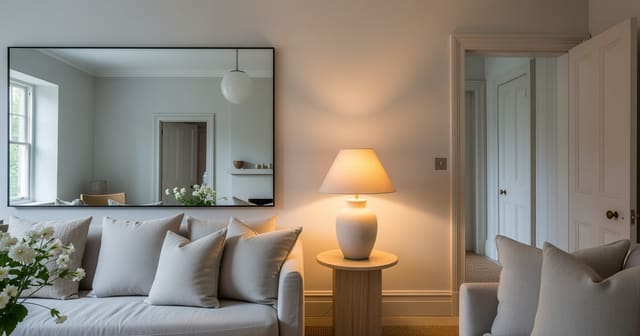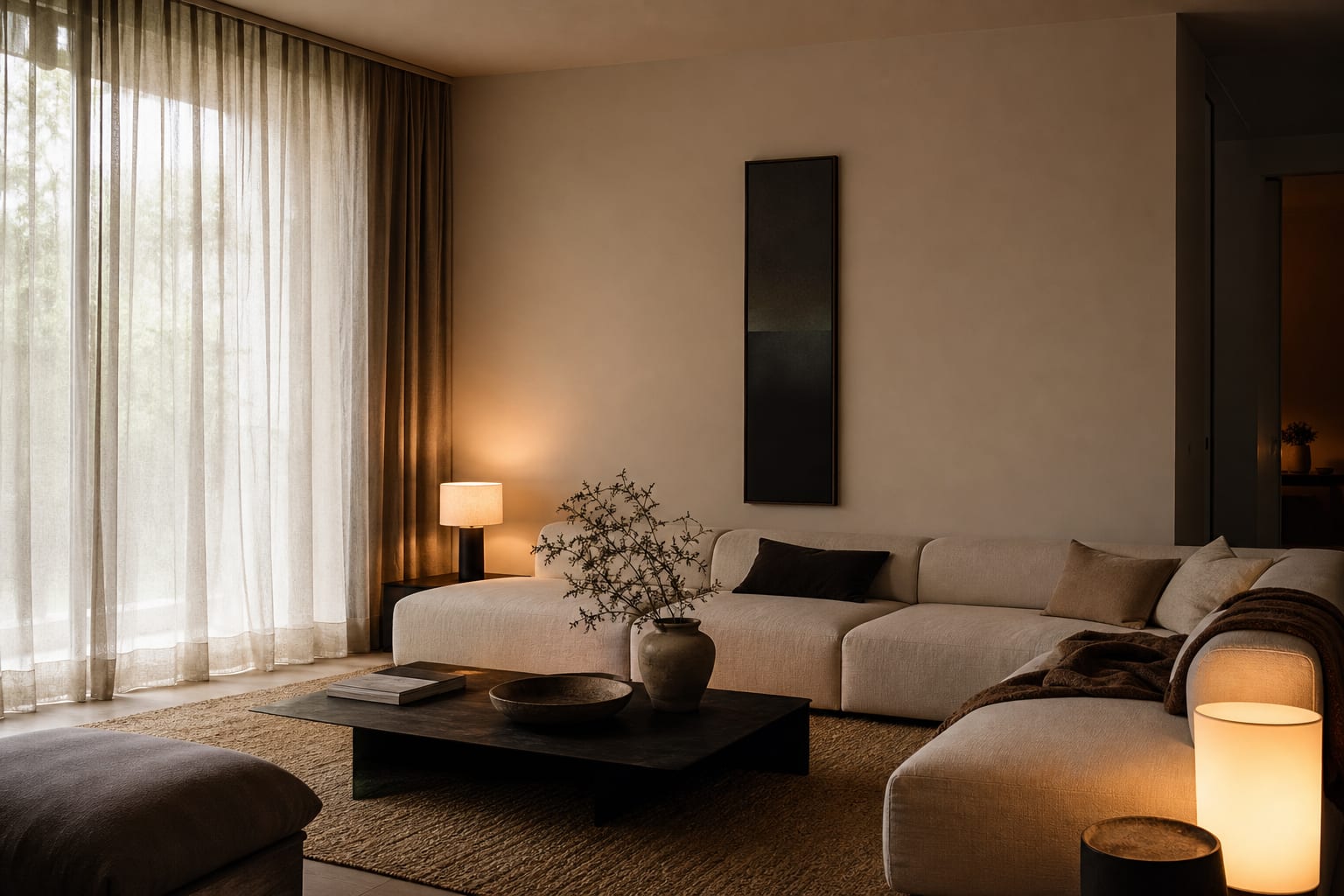
You make a room feel taller visually by mounting curtains near the ceiling, choosing furniture under 32 inches tall, matching wall and ceiling color, and adding vertical lines instead of horizontal ones. These reversible moves shift focus upward without structural work, and you can preview the effect on your own room before spending anything.
What Visual Tricks Make a Room Feel Taller?
A room feels taller when curtains mount at the ceiling, vertical lines pull the eye up, the ceiling stays lighter than the walls, and mirrors and lamps reinforce that verticality. Most squat rooms aren't doomed by architecture — they're dragged down by furniture, curtains, contrast, and clutter placed at the wrong height. The room should read as one continuous volume, not stacked horizontal bands.
Start with the largest visual weight in the room. A sofa with a 30-33 inch back, exposed legs, and a clean arm does more for perceived height than a bulky skirted one. In bedrooms, a 42-54 inch headboard stretches the wall without becoming a padded barricade. Avoid tall furniture that almost touches a low ceiling; a bookcase stopping 6 inches short only highlights the ceiling line.
Tall curtain folds, narrow sconces, reeded cabinet doors, a single vertical canvas, or a slim floor lamp all pull the eye up — pick two or three, not all of them. For the ceiling-specific version, pair this with low ceiling room design tricks.
Which Lines Should Move Up, Down, or Disappear?
Mount drapery 2-4 inches below the ceiling or crown line, leaving a small gap if the ceiling is very low. Extend the rod 8-12 inches beyond the window casing so fabric stacks off the glass, and let panels skim the floor with about 1/2 inch of clearance.
Keep the center of primary artwork around 57-60 inches from the floor rather than climbing it toward the ceiling. A single 24 x 48 inch piece does more than four small frames scattered high. Remove accidental horizontal stops — a dark picture rail, high-contrast crown, short rod, or squat console — that make the room feel sliced. Choose one long 72-84 inch console over a cluster of short pieces if the wall feels busy.
Test these moves on your own room photo before committing to rods or paint; keep the doorway, windows, and main furniture visible in the shot.
How Do Color, Mirrors, and Light Stretch the Walls?
Color should blur the ceiling edge, not spotlight it. A ceiling painted the same color as the walls, or one shade lighter in the same undertone, feels more generous than a bright white lid over warm walls. Soft warm white, pale mushroom, muted cream, and gentle greige are safer than hard contrast in a boxy room.
Mirrors help only when they reflect something useful — not a ceiling fan or a dark hallway. Hang one with its center around 58-62 inches from the floor, or lean a tall one to catch a window or vertical wall plane; see mirrors that amplify light for placement logic.
A single overhead disk flattens a short room because every shadow drops straight down. Use side lighting instead: table lamps, plug-in sconces, picture lights. Warm 2700K bulbs suit living rooms and bedrooms; 3000K works better in kitchens and offices. Avoid solving low light with gloss, which adds glare, not depth — see faking natural light in any room for pairing brightness with verticality.
Common Mistakes to Avoid
- Buying tiny furniture. Undersized pieces make the room look nervous; one properly scaled sofa beats six small ones.
- Hanging everything too high. Art far above the furniture zone abandons it instead of lifting it — keep art near furniture and let its shape lead the eye up.
- Stacking too many verticals. Stripes, fluting, ribbed lamps, and tall art competing at once become visual static; pick one dominant rhythm.
- Using heavy overhead fixtures. A flush mount dropping no more than 6-10 inches keeps head clearance intact in tight rooms.
- Skipping the rug. An undersized rug isolates furniture into low islands; front legs should sit on the rug by at least 6 inches, with the rug 12-24 inches wider than the sofa.
A 4-Trick Height Checklist
- Drapery rod set 6 to 12 inches above the window trim, floor-length linen.
- Wall and ceiling painted the same warm white at the same sheen.
- Furniture under 32 inches tall, coffee table under 16 inches.
- One vertical accent, like slatted wood or wainscoting, on the focal wall.
Use AI Design to Preview the Taller Room Before You Commit
Visual height comes from relationships — rod height, sofa profile, wall color, mirror angle, rug size, lamp placement — that are hard to judge from a shopping cart. Upload a straight photo of the room and test those moves together before buying custom curtains or repainting the ceiling.
Prompt with exact constraints: low-ceiling living room, sofa with 32 inch back, linen curtains 3 inches below the ceiling, 8' x 10' rug, matched wall-and-ceiling color, warm 2700K lamps, tall narrow art, no heavy pendant. Run a second version with curtains at the existing window height or a darker ceiling to see which choice is doing the real work.
For a bedroom, test a 48 inch headboard, 24 inch nightstands, sconces at 58-62 inches, floor-length curtains, and a rug extending 18 inches past the bed. For rentals, preview tension rods, plug-in sconces, and freestanding mirrors before making holes. Trust the version with fewer objects, softer contrast, and better side lighting — that's the one where the eye moves easily from floor to ceiling.
Frequently Asked Questions
Where should the curtain rod go to make a room feel taller?
Mount it 4-6 inches below the ceiling, or right at the ceiling line if the room is under 9 feet. The near-continuous drop from floor to ceiling pulls the eye upward and makes the window look taller.
Should the ceiling be lighter or darker than the walls?
Lighter. A pure white or warm white ceiling against slightly deeper walls reads taller; dark ceilings can drop perceived height by 6-12 inches.
Do vertical stripes really help?
Yes. Narrow vertical stripes, board-and-batten panels, or a vertical art arrangement draw the eye upward, while horizontal patterns flatten the room.
What furniture height makes a room feel taller?
Low and floor-based. Sofas under 32 inches, low coffee tables, and floor cushions leave wall space above for vertical elements to read; tall furniture closes off the wall.
Does AI preview these height moves?
Yes. Upload a room photo and the preview shows curtain placement, ceiling color, and vertical accents against your existing trim and floor before you buy anything.
> Try this: Ready to see this on your own room? Open ReDesign and run the preview.
Three transformations to try
1. Ceiling-mounted curtains making short windows tall 2. Light ceiling against deeper walls 3. Vertical board-and-batten height drive