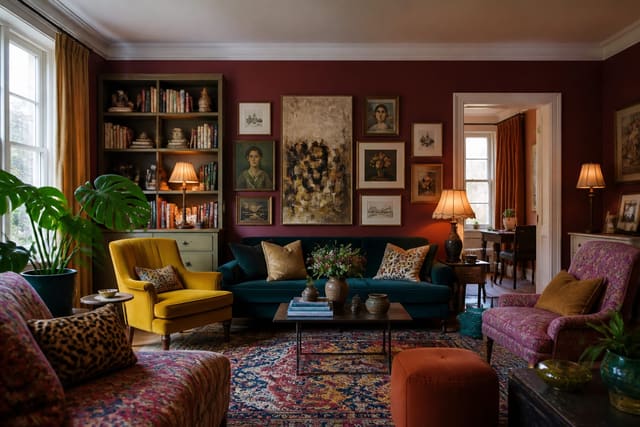
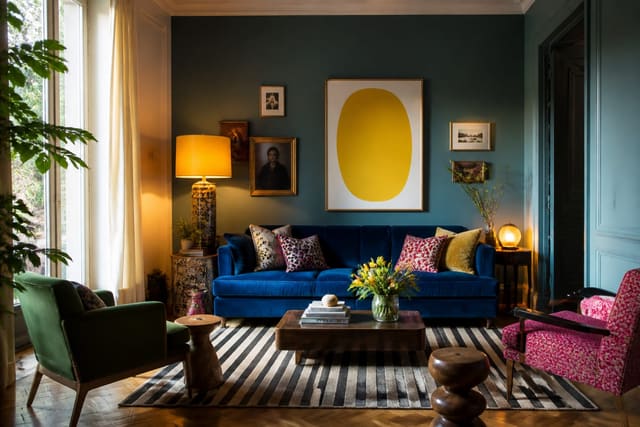
A maximalist color palette works when one dominant color covers about 60% of the room, with secondary and accent shades layered by an organizing rule (analogous, complementary, or triadic) and a saturation family: jewel tones, earth tones, or dopamine brights. A neutral anchor keeps the boldest combinations from feeling chaotic.
Start with one dominant color, not five
Maximalism gets mistaken for "more of everything," but the most successful rooms have one color doing most of the work, on walls, a large sofa, curtains, or a big rug. The 60-30-10 breakdown helps structure this:
- 60% dominant color: walls, large furniture, curtains, or a large rug
- 30% secondary color: upholstery, wallpaper, cabinetry, bedding, or accent chairs
- 10% accent color: art, cushions, lamps, vases, and objects
This doesn't need to be exact math. It just stops every shade from competing at the same volume; if emerald is your 60%, sapphire velvet, burgundy cushions, and brass lighting read as layered rather than random.
Even the boldest scheme needs one true neutral: black, warm white, natural wood, aged brass, stone, or woven fiber. The neutral doesn't dilute the maximalism, it gives stronger colors a place to breathe. For room-specific ideas, see Maximalist Living Room Ideas.
Choose a palette logic: analogous, complementary, or triadic
Real rooms are more complex than a flat color wheel, since materials, daylight, and finish all change how a color reads. Still, three relationships help build a palette that feels intentional.
- Analogous palettes use three neighboring colors (yellow-orange-red, or blue-blue/green-green). They feel harmonious even at high saturation, good for a bold but enveloping room.
- Complementary palettes use opposite colors, like blue and orange. They read as dynamic; let one color dominate and the opposite act as a punchy accent rather than splitting the room evenly.
- Triadic palettes use three evenly spaced colors (red, yellow, blue). Bold but demanding: pick one lead color, soften the other two, and repeat each shade more than once.
To test the logic: pick your dominant color first, decide if the room should feel harmonious, dramatic, or playful, then choose analogous, complementary, or triadic accordingly. Repeat every major color at least twice, and add a neutral before adding another accent. If you're still defining the overall style, start with What Is Maximalism?
Match saturation: jewel, earth, or dopamine palettes
Colors harmonize when they share a similar intensity, even across different hues. That's the fastest way to keep a bold palette from feeling chaotic.
| Palette | Core colors | Rough HSL range | Pairs with |
|---|---|---|---|
| Jewel tone | Emerald, sapphire, ruby, burgundy, amethyst | 60-100% saturation, 20-40% lightness | Black, dark wood, antique mirror, brass, warm white |
| Earth tone | Burnt orange, terracotta, ochre, deep brown, olive, forest green | 20-50% saturation, 30-60% lightness | Walnut, oak, rattan, leather, linen, stone |
| Dopamine | Bright yellow, coral, teal, electric blue, hot pink, lime | High saturation throughout | White walls, pale floors, chrome, black outlines |
Jewel tones are the classic maximalist choice: rich rather than sugary, they read as unified even when hues differ, because depth and saturation match. Treat the HSL figures as guidance, not a rulebook, since fabric and lighting shift the result.
Earth tones trade opulence for warmth and texture. Pattern can be generous here because the shared sun-baked undertones keep the room calm despite the layering.
Dopamine palettes are the most energetic and need the most visual rest. Concentrate the brights, a yellow sofa, coral art, teal shelving, against a white or neutral background, rather than spreading them evenly. See Dopamine Decor Ideas for more.
The key is committing to one family: jewel tones can layer heavily because they share depth, earth tones because their undertones relate, and dopamine brights when there's enough neutral space around them.
Bring the look home with Re-Design
Before repainting walls or buying a velvet sofa, test the palette in your actual room. Upload a photo to Re-Design and see it reimagined in jewel tones, earthy maximalism, or dopamine brights, accounting for the shadows, flooring, and furniture that change how color theory plays out in real life.
Frequently Asked Questions
What colors work for a maximalist home?
Jewel tones, earth tones, and dopamine brights all work: emerald, sapphire, burgundy, amethyst, terracotta, ochre, forest green, bright yellow, coral, teal, electric blue, and hot pink. Use one dominant color across about 60% of the room and add a neutral anchor for balance.
How many colors should be in a maximalist room?
Most rooms handle three to five main colors plus a neutral. The number matters less than structure: one color dominant, one supporting, and accents repeated intentionally keeps a bold room from feeling chaotic.
What is the safest maximalist palette to start with?
Jewel tones are the easiest entry point because they harmonize through shared saturation and depth. Emerald, sapphire, burgundy, and amethyst mix across walls, upholstery, art, and accessories while staying cohesive.
Can maximalism use neutral colors?
Yes, a neutral anchor is essential in most maximalist interiors. Black, warm white, natural wood, stone, aged brass, or woven textures give the eye a rest point and make saturated colors look deliberate rather than accidental.
Is the 60-30-10 rule required?
No, but it's a useful guide. Real rooms rarely divide color with exact math; use the rule to ensure one color leads, one supports, and the brightest accents stay controlled.