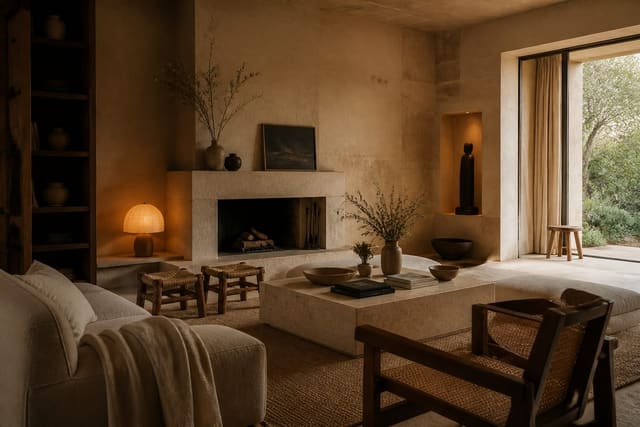
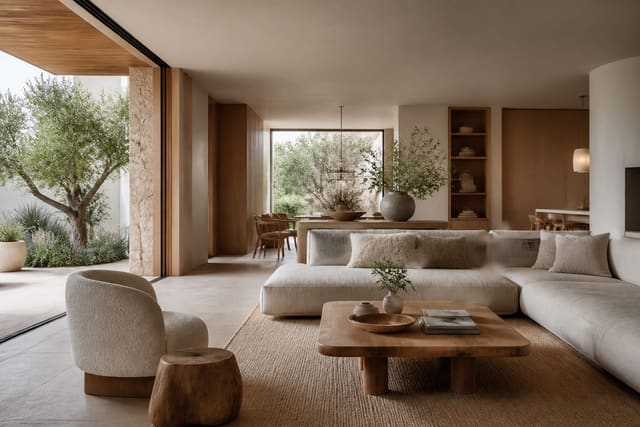
An organic modern bathroom pairs stone, wood, soft curves, and warm light to feel like a quiet spa rather than a decorated showroom. Achieving it means layering limestone or travertine tile, a teak or wood-tone vanity, matte fixtures, and one sculptural bathtub, while cutting the clutter and cold lighting that make most bathrooms feel clinical instead of composed.
What does an organic modern bathroom look like?
An organic modern bathroom looks calm and tactile: large stone surfaces, warm wood cabinetry, matte fixtures, and soft neutral colors with curved forms instead of sharp visual clutter. The palette runs warm white, sand, taupe, mushroom, limestone gray, and walnut brown. Interest comes from veining, grain, texture, and shadow rather than pattern or bright paint.
Stone and wood dominate this look because stone gives permanence and wood gives softness, with matte ceramic or aged brass fixtures added last. For the broader design vocabulary behind the style, see What Is Organic Modern; the bathroom is its most spa-like expression.
Which stone finish works best for the floor?
Skip high-gloss porcelain and busy decorative tile. Choose honed travertine, honed limestone, tumbled stone, or large-format matte stone-effect tile instead. Polished stone gets slick when wet, so honed or tumbled finishes matter for safety, and floors should target around 0.6+ COF (coefficient of friction) for wet-area grip; confirm the specific rating with your supplier.
Large-format tile, such as 24x48 or slab-look porcelain, reduces grout lines so the surface reads as continuous. This matters most in small bathrooms, where excess grout lines make a space feel busier.
Good stone directions:
- Honed travertine in ivory, walnut, or silver beige
- Limestone-look porcelain for lower maintenance
- Tumbled stone mosaics as a quiet accent only
- Slab shower walls with minimal grout
- Matte zellige-style tile used sparingly for hand-made texture
How do I make the bathtub the focal point?
A freestanding tub is the fastest way to make the room feel intentional rather than simply beige. Skip clawfoot, glossy acrylic, or sharply rectangular tubs. Choose stone resin, concrete, or mineral composite with a soft oval, egg-shaped, or asymmetrical form; matte white stone resin feels serene, while concrete reads heavier and more architectural.
Give the tub breathing room where possible, since one crammed against three walls loses its sculptural quality. If space is tight, a back-to-wall stone resin tub still creates the effect and is easier to clean around. Style it with restraint: one teak bath stool, one branch in a ceramic vessel, one folded towel.
Why does warm wood matter against cool stone?
Too much gray stone, matte black, and white can make the room feel more like a wellness clinic than a home. Warm wood is the fix, and a vanity is the most practical place to add it. Fluted oak, flat-panel walnut veneer, and teak tones create material tension against cool limestone or travertine, which makes the room feel designed rather than matched.
Solid wood near showers and wet rooms can warp without proper sealing and ventilation. In direct spray zones, sealed veneer or moisture-resistant MDF construction is often more stable than untreated solid wood. Teak is the exception: its natural oils and silica make it genuinely water-resistant, so it works well for shower benches, bath stools, and wet-area accessories.
For textiles, keep things earthy and tactile: ribbed cotton towels, waffle robes, and a textured stool cushion. The Bouclé Fabric Guide covers more texture options, though bouclé itself belongs outside splash zones.
What lighting fits an organic modern bathroom?
Recessed cans plus a cold LED mirror strip flatten even expensive stone. Pendant lights over or beside the vanity in aged brass, bronze, matte black, ceramic, or smoked glass work far better. Use a warm bulb around 2200K for a candlelit spa effect, or 2700K for more clarity when grooming; a dedicated, better color-rendering mirror light can handle task lighting separately.
Keep the bottom of a vanity pendant at least 75 inches from the floor to avoid head clearance issues. With low ceilings, use compact pendants, wall sconces, or flush-mounted fixtures instead.
A layered lighting plan might include:
- Two small pendants flanking the mirror
- A dimmable ceiling fixture in warm white
- A wet-rated shower downlight
- Low-level toe-kick lighting under a floating vanity
- A concealed LED strip under a stone niche shelf
Which organic modern bathroom ideas should I steal?
Use three or four of these moves rather than all of them at once:
- Run 24x48 limestone-look tile across the floor and up the shower walls.
- Choose a floating fluted oak vanity for shadow and warmth.
- Install honed travertine instead of polished marble for softer looks and better traction.
- Add a matte stone resin bathtub with a curved oval form as the focal point.
- Use aged brass or matte black pendants with warm 2200K bulbs.
- Swap chrome fixtures for brushed nickel, aged brass, or matte black.
- Add a teak shower bench instead of a plastic stool.
- Use a slab backsplash behind the vanity rather than small tile.
- Keep grout close to the tile color for one continuous plane.
- Choose a frameless shower screen to reduce visual interruption.
- Use one large mirror with rounded corners instead of a busy medicine cabinet wall.
- Bring in one organic branch, not five tiny plants.
For adjacent rooms, carry the same material story into the kitchen with Organic Modern Kitchen Ideas so finishes feel related.
How do I keep the palette restrained without going flat?
Vary undertones and textures while keeping contrast controlled: pair creamy limestone with medium oak, greige microcement with walnut, or travertine with aged brass. Avoid mixing too many competing stones, since travertine plus marble plus terrazzo plus pebble tile usually reads as confused. Let one stone lead and keep the rest quiet.
A simple palette:
- Walls: warm white plaster or limestone-look slab
- Floor: honed beige travertine or large-format porcelain
- Vanity: walnut veneer or fluted oak
- Fixtures: aged brass or matte black
- Tub: matte white stone resin
- Accessories: teak, ceramic, linen, cotton
Organic modern design gets weaker when every surface competes for attention.
Bring the look home with Re-Design
Unsure whether your bathroom should go warmer, darker, more stone-heavy, or more wood-forward before buying tile? Upload a photo to Re-Design and test an organic modern transformation in seconds, trying limestone walls, a walnut vanity, a freestanding stone tub, or a teak shower bench before committing to a remodel budget.
Frequently Asked Questions
What does an organic modern bathroom look like?
It looks like a calm spa built from layered natural materials: stone tile, warm wood cabinetry, matte fixtures, soft neutral colors, and sculptural shapes. Travertine or limestone, a teak or wood-tone vanity, warm pendant lighting, and fewer grout lines create the seamless, quiet feel that defines the style.
Is travertine good for bathroom floors?
Yes, if you choose the right finish and maintain it. Use honed or tumbled travertine rather than polished for better wet traction, look for products tested around 0.6+ COF, and seal it according to supplier guidance. Polished travertine can be too slick for safe bathroom flooring.
Can I use real wood in a bathroom vanity?
Yes, but be selective. Solid wood fronts can warp from moisture without proper sealing and ventilation. In direct spray zones, sealed veneer or moisture-resistant MDF is often more stable. Teak is an exception and works well for wet-area benches and stools due to its natural oils and silica.
What color temperature is best for an organic modern bathroom?
Warm light works best overall. Use 2200K for a soft, spa-like glow in pendants or ambient fixtures, and 2700K near mirrors when you need clearer task light for grooming. Dimmers let the bathroom shift between practical and relaxing as needed.
How do I make a small bathroom feel organic modern?
Use fewer materials and larger surfaces: large-format tile, a floating wood-tone vanity, a rounded mirror, warm sconces, and one stone or ceramic accessory. Avoid tiny patterned tile, high-contrast grout, and excess shelving, since seamlessness matters even more in a small space.