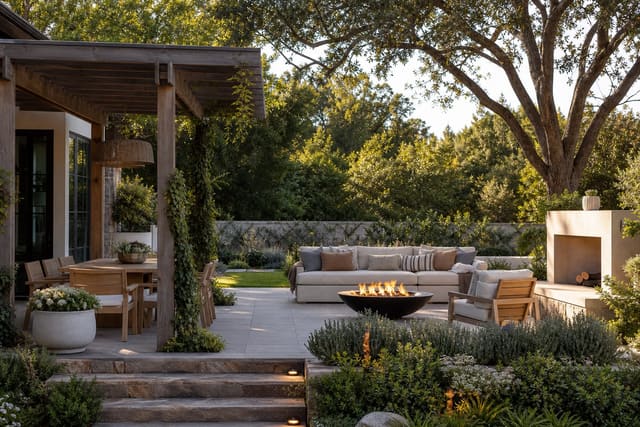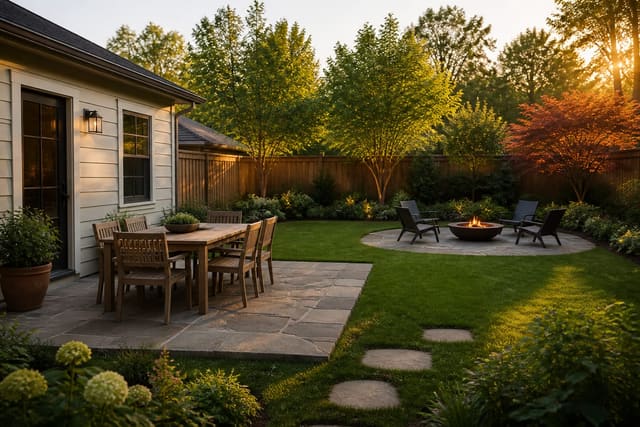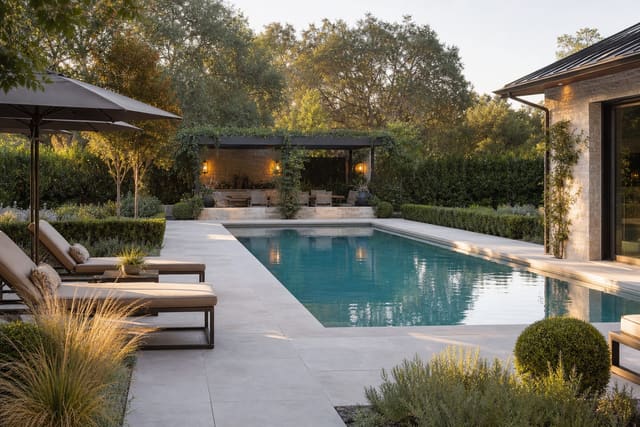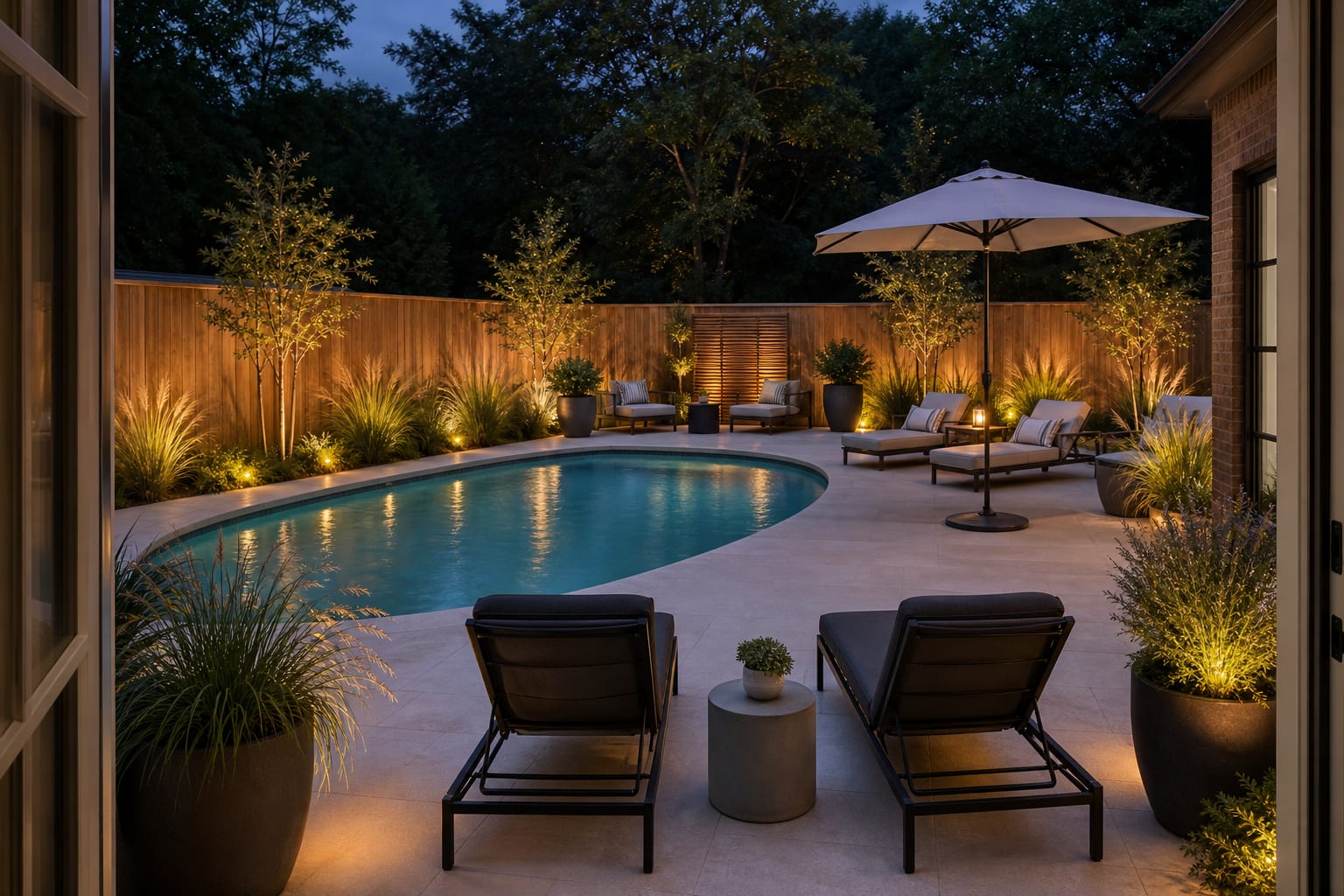
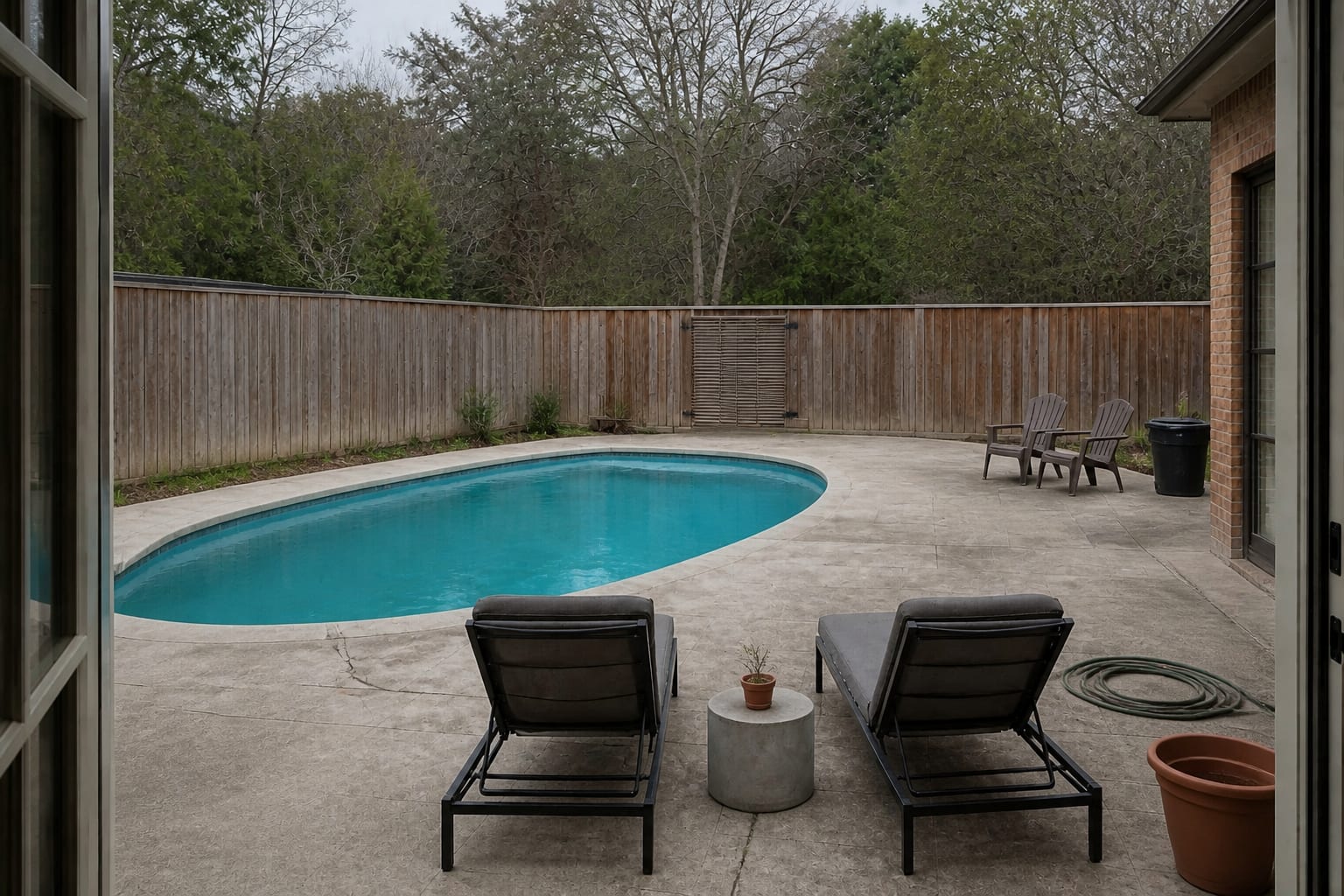
Good pool landscaping softens the coping into a 4-6ft planted band, keeps privacy screening at least 6ft off the water, and uses plants that tolerate chlorine splash and 4-6 hours of midday sun. The goal isn't a jungle around the water — it's a finished outdoor room with clear circulation, real shade, and a calm planted edge instead of bare concrete.
How do you landscape around a pool without making it fussy?
Soften hard edges with low-litter planting, add shade where people sit, keep at least 36in of clear circulation, and pick materials that stay comfortable underfoot. Start with the deck line — when coping, paving, beds, and furniture meet at random widths, the pool reads as a construction leftover rather than a designed space.
A strong pool landscape has three bands: the wet edge (slip-resistant, pale coping and paving), the usable room (loungers, tables, a clear walking path), and the garden frame (planting, screens, or walls that hold the water visually). Keep the wet edge quiet — 24-30in of clear paving is a bare minimum at the narrowest point, and 42-48in feels far better where people pass behind loungers. If the pool sits beside a patio, apply the same circulation-first logic from pool patio layout ideas before placing furniture.
Test this on your own photo with ReDesign before committing — keep the house edge, horizon line, hardscape, beds, and main path visible so the preview solves the actual space.
Which pool landscaping ideas actually change the space?
- Build a planted frame, not a plant collection. Repeat one backbone plant every 3-5ft along a fence or bed, then add lower texture in front. Compact pittosporum, dwarf yaupon, boxwood, or clumping grasses add privacy without shedding into the skimmer.
- Make the sunny side usable. A single 7ft umbrella leaves half a chaise in sun; for two loungers, use a 9-11ft umbrella or a shade sail set beyond the traffic path, covering the head and torso first.
- Use oversized planters where beds aren't possible. Containers at least 20-24in wide look proportional and hold enough soil volume. Three large pots of one shrub or grass beat twelve small ones that dry out by lunch.
- Create a dry seating pocket away from the splash zone. Set adult chairs 6-8ft back from the water, angled toward both pool and house — see patio design ideas for better circulation for placement logic.
- Choose plants for pool chemistry, not just color. Avoid thorny plants near paths, bee-heavy bloomers by towel hooks, and trees dropping pods, berries, or bark near the water.
- Light the route, not the whole yard. Path lights at 12-18in high, warm 2700K-3000K, shielded, mark steps and coping changes without turning the pool into a parking lot.
- Give dining its own surface. For a four-seat table, use a stable paved zone at least 10x10ft outside the wettest splash path — see Pool Patio Ideas: Decking, Tile, and Surround Materials for separating dining from dripping towels.
Common pool landscaping mistakes to avoid
- Planting for instant lushness, not cleanup. Brittle leaves, falling fruit, sticky flowers, and aggressive roots near plumbing cause ongoing maintenance — choose fewer, tougher plants and preserve equipment access.
- Crowding furniture against the coping. A chaise needs roughly 30in of width plus room to walk around it and fit a side table that won't tip into the water.
- Using dark paving in full sun. Dark porcelain, slate, and concrete get too hot underfoot, especially west-facing. Pale stone, textured concrete, or light pavers stay cooler.
- Treating privacy as fence-only. A tall fence with no depth still feels exposed. Layer a 6ft screen with mid-height shrubs and 24-36in grasses, plus a small tree set back from the water.
- Ignoring the night view from inside the house. One glaring floodlight flattens the scene — use dim, shielded fixtures on paths, steps, and a feature tree instead.
Use AI design to preview your pool area before you commit
Upload a straight-on photo of your pool from the door, deck, or main seating spot, then preview two or three directions: repeated grasses, large planters, a pergola or umbrella zone, or a clearer dining area. Be specific — ask for low-litter planting, 36-48in of clear circulation, pale slip-resistant paving, warm 2700K lighting, and shade over the loungers. If the preview feels crowded, remove elements before spending money; if it still feels bare, add a repeated edge plant, a taller privacy layer, or a shaded seating pocket.
Frequently Asked Questions
What plants survive next to a pool?
Ornamental grasses, drought-tolerant shrubs like Westringia or Pittosporum, and succulents tolerate chlorine splash and sun. Avoid thorny or fruit-dropping plants and anything with heavy leaf shed that clogs the skimmer.
How wide should the planted border around a pool be?
Aim for 4 to 6ft from the coping outward. This gives plants room without root pressure on the shell and creates a clean boundary; under 3ft, plants tend to overhang the water.
Should pool landscaping include shade?
Yes. A 12x14ft pergola or canopy on the long side extends comfortable hours from roughly 11am to 4pm. Mature trees can provide shade too but often drop debris and stain coping.
What separates the pool from the rest of the yard?
A planted privacy screen, a low garden wall (18-24in), or a code-compliant 48in safety fence. Most jurisdictions require a 48in barrier with self-closing gates around any in-ground pool.
Do pool landscape lights need to be GFCI protected?
Yes. Any 120V outlet, transformer, or low-voltage line within 20ft of the pool must be on a GFCI circuit per NEC 680 — non-negotiable for new installs and typically required at sale.
> Try this: Ready to see this on your own space? Open ReDesign and run the preview.
Three transformations to try
1. Pool with planted border and grass screen 2. Pool with pergola lounge and palms 3. Pool with stone coping and meadow planting