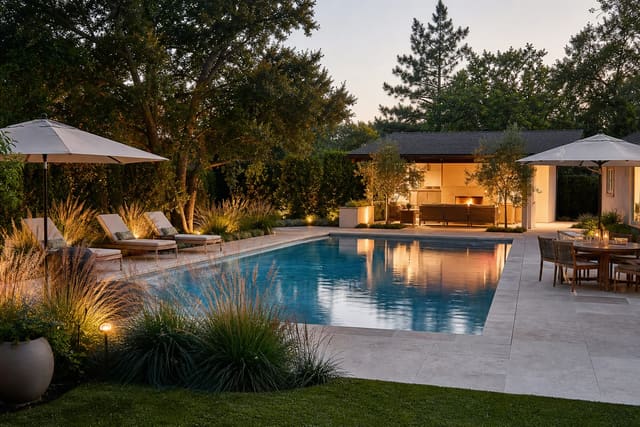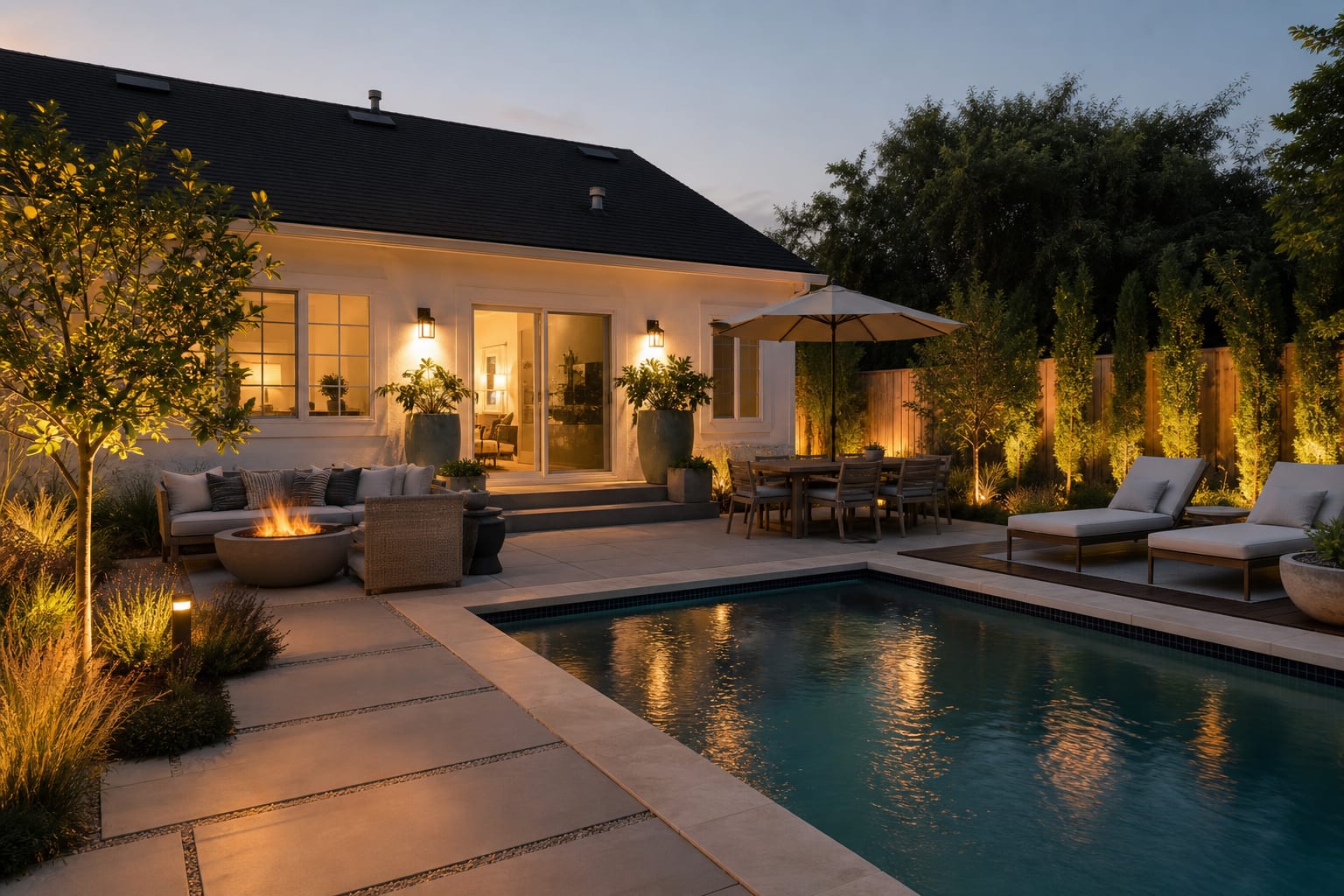
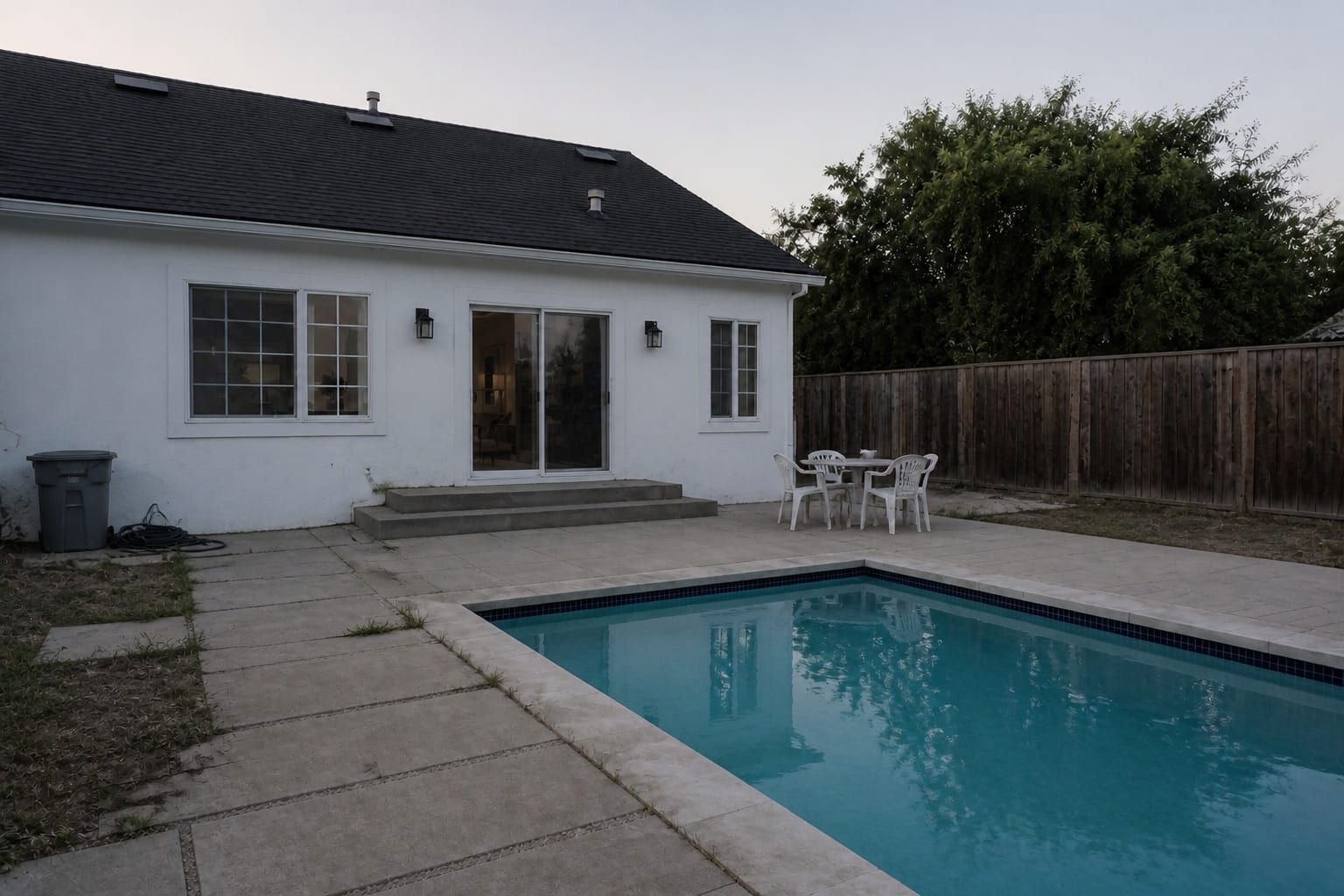
The best pool patio surround is a textured, light-toned material — porcelain paver or honed travertine — with coping that feels secure under wet bare feet. It needs to manage heat, slip, glare, chlorine splash, and furniture legs while sloping 1-2 percent to a perimeter drain, with at least 6ft of deck depth for loungers and 4ft for access traffic.
Which pool deck material belongs around the water?
Textured porcelain and honed travertine top the list because both resist water exposure and stay comfortable underfoot. Porcelain gives consistent color, tight joints, and stain resistance with low upkeep. Travertine reads warmer and more natural for a resort feel, but needs proper sealing.
Test samples outside at noon, wet, and barefoot before deciding — a charcoal paver that looks dramatic indoors can punish bare feet on a west-facing deck. Texture matters more than pattern: tumbled travertine, textured porcelain, broom-finished concrete, or sandblasted stone rated for wet exterior use. Keep at least 36 inches clear along tight pool edges, 48 inches where people pass behind loungers, and plan furniture with the same care used in pool landscaping around the yard.
Which pool patio ideas change the space fastest?
The fastest wins make the deck read as intentional: one paving material, a clean coping line, shade over the main lounge zone, and a single planted edge. Avoid stacking five materials that each looked good separately — a pool already brings enough movement and sparkle.
- One paving material, one grid. A 24x24-inch porcelain paver on a grid calms a small pool; a 12x24-inch running bond stretches a narrow side-yard pool visually.
- Coping as a border, not decoration. A 12-16 inch coping width frames the water; a coping color too far from the deck can outline the pool like marker.
- A dry lounge bay outside the splash line. Two chaises need roughly 7 feet of depth including chair length, a 24-inch side table, and a dry path.
- Shade where people pause. A 9-11 foot umbrella covers two loungers if the pole clears the traffic path; a cantilever umbrella suits rectangular pools with tight side clearance.
- Planters sized for the space, not the gaps. Containers 20-24 inches wide read intentional near water; small pots look temporary and dry out fast on reflective paving.
- Light level changes before lighting the whole pool. Low shielded 2700K-3000K fixtures mark steps and coping transitions without a commercial-courtyard feel.
Borrow layout cues from pool landscaping ideas that soften hard edges if the surround doubles as the main gathering area — low-litter, repeated planting kept clear of skimmers, drains, and walkways.
Test this on your own photo with ReDesign and keep the house edge, horizon line, hardscape, planting beds, and main path visible so the preview solves the space you actually have.
How should coping, tile, and decking work together?
Coping is the handshake between water and patio — it needs to feel good to sit on, grip, and step beside wet. Bullnose coping suits family pools since the rounded edge is forgiving against knees and forearms. Square coping with a small eased edge looks sharper for modern pools but shouldn't feel knife-edged underfoot.
Waterline tile should support the deck, not compete with it. A loud blue mosaic can overwhelm pale beige travertine; a soft green, white, or charcoal waterline adds depth against quiet gray porcelain without shouting. Keep grout close to the tile color for a calm sheet of water — high-contrast grout draws the eye to every joint.
| Material choice | Best use | Watch out for |
|---|---|---|
| Textured porcelain paver | Crisp, low-maintenance patios with consistent color | Choose an exterior wet-area texture, not an indoor finish |
| Honed or tumbled travertine | Warm natural decks where the stone performs well | Confirm sealing needs and freeze-thaw suitability |
| Broom-finished concrete | Budget remodels on an already-sound slab | Add control joints deliberately so cracks stay intentional |
| Light concrete pavers | Flexible repairs, softer pattern than poured concrete | Avoid tiny units that multiply joints near chair legs |
| Natural stone | Character-rich pools with regional stone nearby | Test heat, flaking, salt exposure, and slip before committing |
Where the patio meets a raised deck or upper terrace, keep railing visually light near water and coordinate its finish with coping and furniture; see the pool installation cost guide for how safety railing factors into budget.
Common pool patio mistakes to avoid
- Choosing dark surfaces for photos. Dark porcelain, slate, and stained concrete can be brutal on bare feet in full sun, especially west-facing. Go lighter or add shade instead.
- Using interior tile outside. Pool decks need exterior-rated texture and drainage for constant wet-dry cycles; if a tile isn't rated for wet outdoor floors, keep it off the edge.
- Over-decorating the coping. Contrasting bands and busy mosaic borders can visually shrink the water. A simple profile close to the deck tone looks more expensive.
- Ignoring chair legs and towel traffic. Thin chaise legs wobble on uneven stone and catch in tight joints — test actual furniture on the sample.
- Treating drainage as optional. A gentle 1/8 to 1/4 inch per foot slope moves water without tilting the deck visually; puddles near coping collect dirt and become slip hazards.
How AI design helps you see the pool patio fix
Upload a photo from the back door or the corner where the pool looks most exposed, then preview two or three surround schemes on the same angle: pale porcelain with square coping, travertine with rounded coping, and concrete pavers with a planted border.
Keep the prompt specific — light textured decking, 36-48 inches of circulation, shade over loungers, low-litter planting, warm low lighting, no glossy walking surfaces. If the preview looks chopped up, cut the number of materials; if the water still feels stranded, add coping contrast, repeated planters, or a better transition into the rest of the yard, following the same zoning logic as backyard zone planning.
Frequently Asked Questions
What pool patio material stays cool underfoot?
Travertine, light-colored porcelain pavers, and light-pigment broom-finish concrete stay cool because they reflect heat. Dark stone, dark pavers, and unfinished concrete can hit 130-140°F by noon, making them uncomfortable for bare feet.
How wide should a pool patio be?
Plan 6ft minimum on the long lounge side for chairs plus walking buffer, 4ft on the access side, and 8-10ft where seating or dining lives. Below 4ft, people tend to slip on the wet edge.
Should pool patios slope toward or away from the pool?
Slope away at 1-2 percent toward a perimeter strip drain or yard so splash doesn't pond on the deck. Sloping toward the pool instead funnels dirt into the water and reduces clarity.
Can I use wood decking around a pool?
Yes, with composite or thermally modified wood that resists chlorine and UV exposure. Raw cedar and pressure-treated wood tend to splinter and discolor within about 2 years near constant pool spray.
Do pool patios need expansion joints?
Yes — every 8 to 12ft on poured concrete, plus a continuous joint between coping and deck. This lets freeze-thaw cycles move without cracking the pavement at the pool edge.
> Try this: Ready to see this on your own space? Open ReDesign and run the preview.
Three transformations to try 1. Travertine pool deck with lounge chairs 2. Porcelain paver deck with dining set 3. Light-stained concrete pool deck