Two kids sharing a bedroom does not fail because the room is small. It fails because the room is treated like one bedroom with two beds in it instead of two personal zones inside one footprint. My opinion is blunt: the parents who survive shared rooms cleanest are the ones who give each kid a real "side," a real light, and a real place for their stuff, then let the middle of the room be neutral. Everything else — color choices, themes, decorative bunk beds — is downstream of that decision.
How do you design a shared bedroom for two kids?
Design a shared bedroom for two kids by giving each child a defined sleep zone, equal storage, a personal light, and one shared activity zone. The room needs a clear traffic lane, two distinct headboard walls or bed positions, and a neutral background that lets each kid personalize their own side. The most common mistake is decorating the room as one matched set; the second most common is letting the louder or older kid claim the better corner by default. Treat the room like a tiny duplex: shared structure, divided territory, equal access.
The four layouts that work for two kids in one room
The right layout depends on the room shape and the kids, not on what looks neat on Pinterest. Pick one based on the floor plan you actually have, not the one you wish you had.
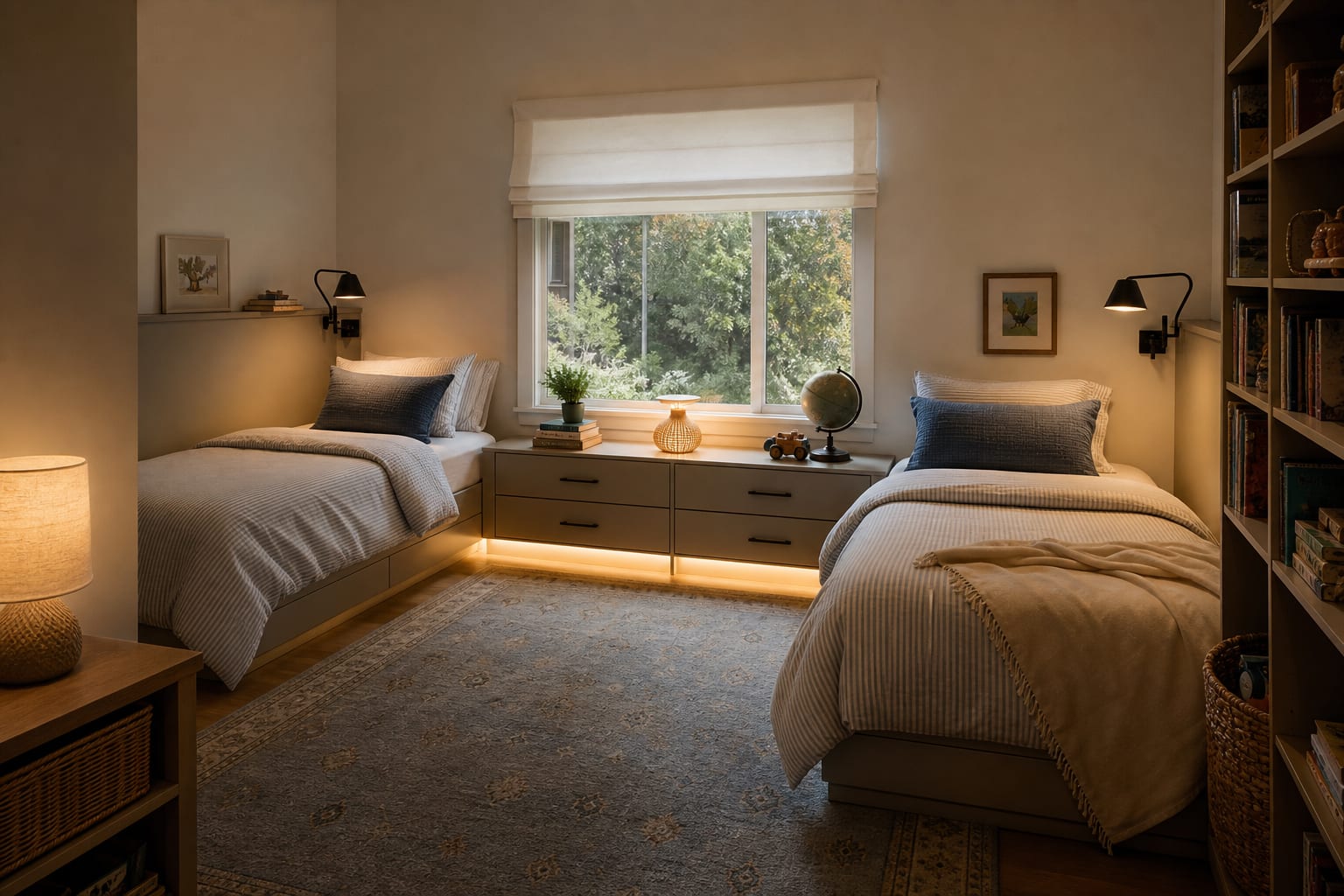
1. Twin beds on parallel walls
- Two twin beds along opposite long walls, headboards against the wall.
- A nightstand or wall sconce between each bed and the wall.
- A shared rug, dresser, or play zone in the center.
Why it works: maximum separation, equal sightlines, no kid stuck staring at the other from 30 inches away. Best in rooms at least 10 feet wide.
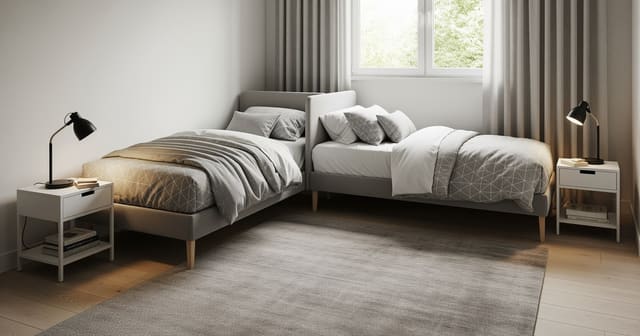
2. L-shape in the corner
- One twin bed along the long wall, a second along the perpendicular wall, headboards meeting in a corner.
- A shared corner shelf, lamp, or nightstand at the meeting point.
Why it works: opens the longest unbroken floor for play and storage. Best in roughly square rooms where parallel-wall placement would crowd a window or door.
3. Bunk beds with a real separator
- Bunk bed against one wall, with the head and foot panels acting as low partial walls.
- A curtain, half-height bookcase, or hanging banner per bunk for visual privacy.
- A dresser, desk, or reading chair on the opposite wall.
Why it works: doubles the floor and gives each kid a more enclosed sleep cave. Only worth it if the ceiling is at least 8 feet and the bottom bunk is not your child who hates the closed-in feeling.
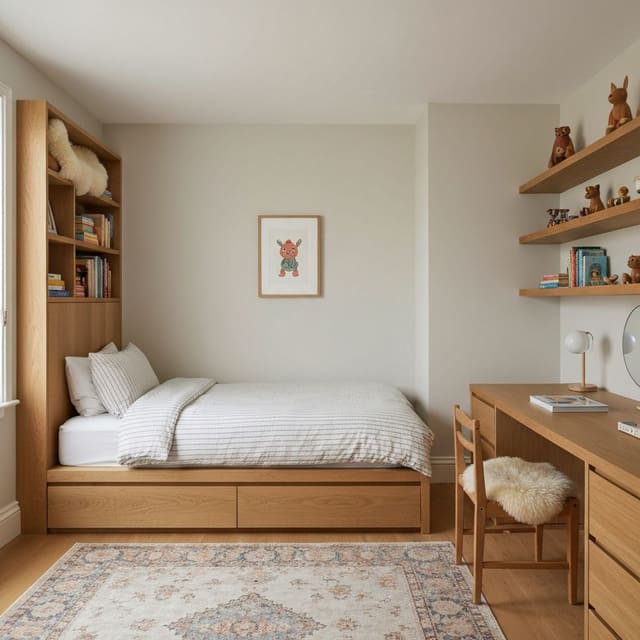
4. Bed in nook with desk across
- One bed tucked into an alcove or against the short wall with a curtain.
- The second bed perpendicular, with a shared desk or art table across from both.
Why it works: handles age gaps where one kid needs a study surface and the other still wants a pillow fort. Best when one kid is at least 8 and one is younger.
If you have not landed on a bed configuration yet, run the math first with the twin bed bedroom layout options before you commit to bunks. Many shared rooms work better with two twins than with a bunk that no one volunteers to sleep under.
Storage, lighting, and the fairness question
The most common shared-room argument is not about decor. It is about who has the bigger drawer, the better lamp, or the closer access to outlets. Solve it on paper first.
Give each kid the same drawer count, the same hanging length, and the same shelf width. A 6-drawer dresser split 3 and 3, two identical wardrobes, or two color-coded baskets per shelf is calmer than one big shared piece. Label storage at the kid's reading level, not yours — even a 4-year-old can put pajamas in a labeled bin if the label includes a picture.
Each kid needs personal light. A small wall sconce, a clip-on reading lamp, or a USB-rechargeable bedside lamp prevents the "I want to read, my sibling wants to sleep" argument from becoming nightly. Use warm 2700K bulbs in the 200–400 lumen range at the bed; the overhead light is for play and getting dressed, not bedtime. If the room is too dim overall, treat it before designing zones — single-window bedroom lighting covers the basics.
Outlets matter more than parents expect. Each bed should have at least one accessible outlet within 3 feet of the headboard. If the room is older and short on outlets, add one good-quality surge protector per side, mount it to the wall or back of the dresser so cords cannot wrap around a child's neck, and route phone or speaker cords through cord channels rather than across the floor.
For decoration, the safest rule is to keep ceiling, walls, trim, and floor neutral and let each kid personalize a 30 by 40 inch area above their own bed or desk. A magnetic board, a pinboard, or a row of picture ledges per child gives them a "wall" they can change without a renovation.
Privacy, age gaps, and the room growing up
The two hardest variables are privacy and time. A 4-year-old and a 7-year-old can share a room comfortably for years. A 10-year-old and a 13-year-old usually need more separation than a single beanbag can provide.
For privacy without a wall, the simplest moves are bed curtains on bunks, a tall bookcase used as a half-divider, a ceiling-mounted curtain track between zones, or a folding screen the older child can set up at night. None of these need to be permanent. The room can keep its layout while the privacy needs scale up.
Plan for the room to outgrow its current setup. Bunk beds that split into two twins, modular storage that detaches and rolls, and beds that accept under-bed storage drawers will save a second furniture purchase in two or three years. Skip themed wallpaper with characters that one kid will hate in a year; theme the bedding, the pinboard, and the curtains instead.
If one kid still needs an early bedtime and the other has homework, the room needs a "quiet zone" that is not the bed. A small desk lamp with a tight beam, a corner reading chair with a focused sconce, or a closet-converted homework nook can buy hours of peace. The conversion logic is similar to a walk-in closet to mini home office, scaled down for a 7th grader.
Common shared-bedroom mistakes
- Decorating the room as a matched set so neither kid feels ownership.
- Pushing both beds against the same wall with a tiny gap between them; the kid in the back becomes a permanent climbing obstacle.
- Buying one big shared dresser; nobody knows whose drawer is whose by the third week.
- Skipping personal reading lights and relying on a single overhead fixture.
- Putting the bunk ladder where one kid has to walk through the other's zone to climb up.
- Choosing a strong wall color or wallpaper without involving both kids; one of them will quietly hate it.
- Forgetting cord safety on phone chargers, white noise machines, or string lights.
Use AI design to preview the shared bedroom layout
Shared bedrooms are a layout problem, not a styling problem, and layout problems are exactly where AI design earns its keep. Photograph the empty or near-empty room from the doorway, including the window, closet door, and any heating vents. Then run preview versions with parallel twin beds, an L-shape, a bunk with a curtain, and a bed-in-nook plus desk. Compare the walking lane, the storage placement, and the light reach in each version.
When you brief the preview, be specific: shared bedroom for two kids ages 6 and 9, two twin beds along opposite walls, a 6 foot dresser between the beds against the window wall, one wall sconce per bed, a 5 by 7 rug in the middle, and a neutral white-and-warm-wood palette. Then run a second version with bunks and a folding screen. The differences will show up immediately, and you will know which layout to actually buy before any furniture arrives.
Transform your space in seconds. No design experience needed. Try Re-Design Free