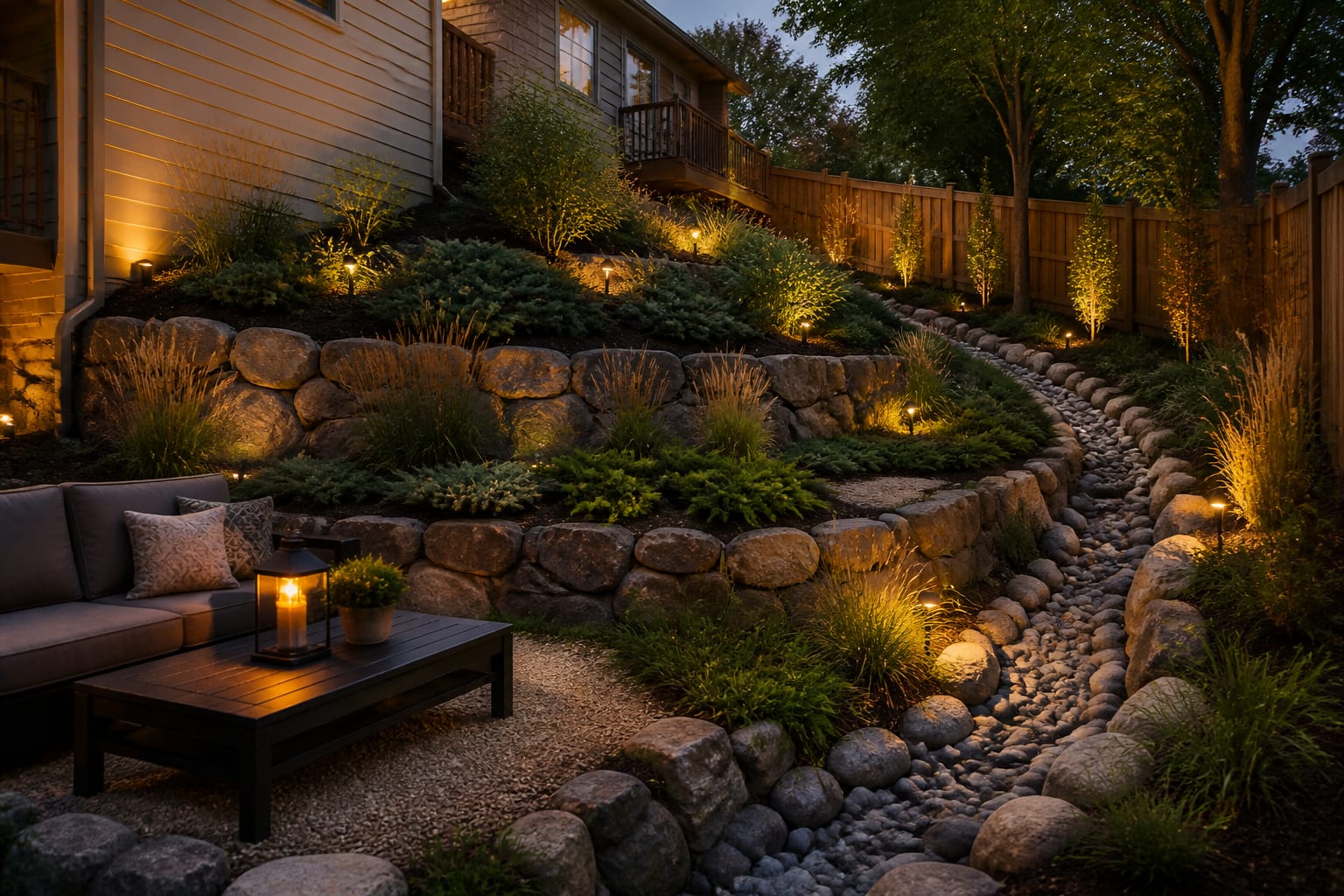
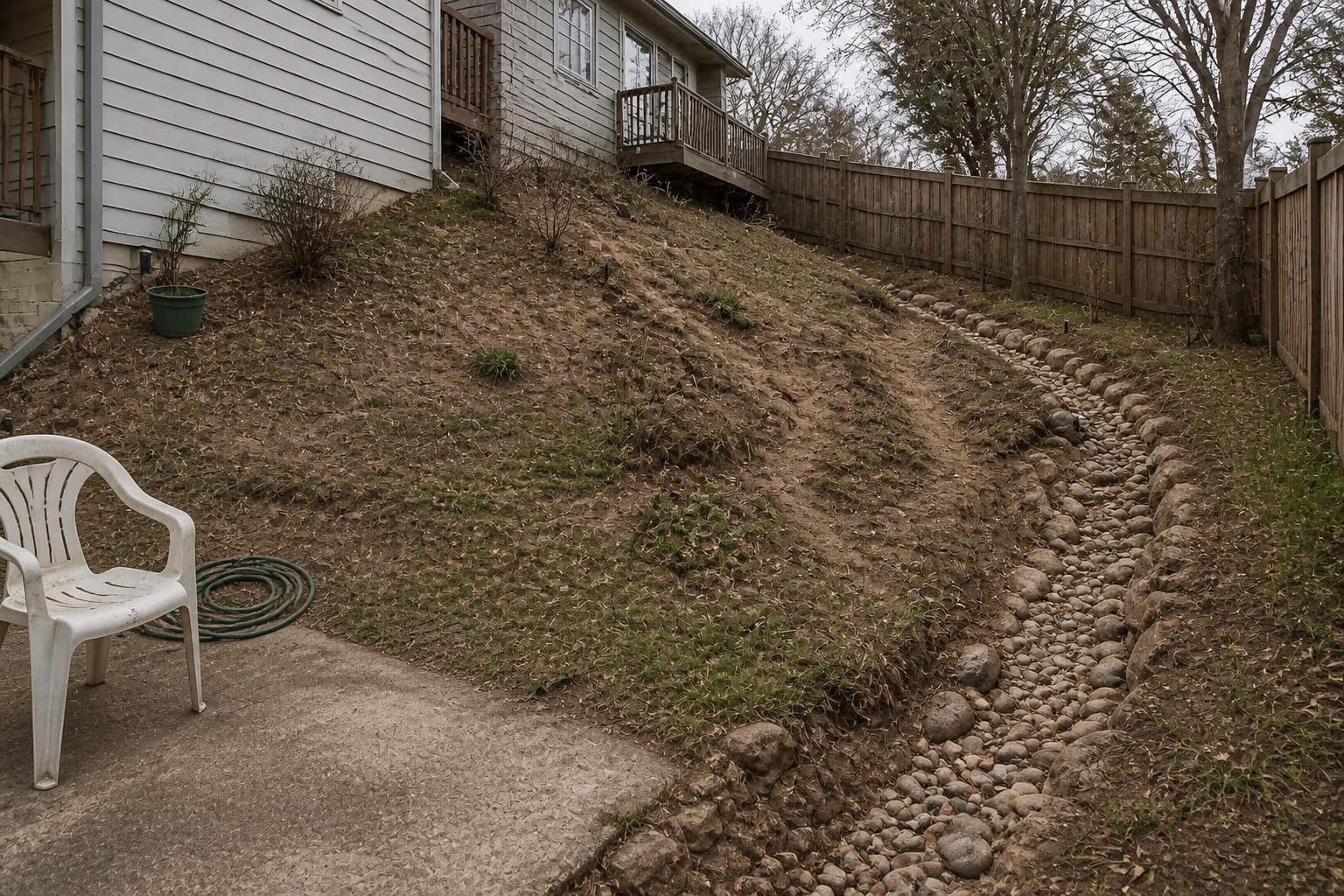
Sloped yard landscape design starts with measuring the grade, then matching the fix to it: gentle slopes (3:1 or flatter) just need deep-rooted plants, moderate slopes benefit from terracing, and only steep drops need a full retaining wall. Most homeowners over-build with a tall wall when low terraces and groundcover would cost a third as much and look better.
How Do You Read a Slope Before Landscaping It?
Stretch a level string from the top of the slope to a stake at the bottom, then measure the horizontal run and vertical drop. A 12-foot run over a 4-foot drop is a 3:1 grade, gentle enough to mow and plant; a 6-foot run over that same drop is 1.5:1, steep and slide-prone.
The ratio tells you whether plants alone will hold the soil or whether you need to physically break up the slope. On gentle grades, roots and mulch do the work; on steep grades, water moves too fast and carries soil with it, so you need shorter level runs. The same zoning logic in these low-maintenance landscaping ideas applies: decide what each band of the slope is for before you plant or build it.
Walk the slope after a hard rain and note where water pools or cuts channels — those mark where a swale, French drain, or dry creek bed needs to go. Skip this step and any wall you build will eventually get undermined by water it was never designed to handle.
Terracing vs. Retaining Walls: Which Do You Need?
Terracing breaks a long slope into a staircase of level beds, each held by a low wall or planted edge. It's the default for any drop you can split into runs under 3 feet, since three short walls are cheaper and safer than one tall one, and each terrace catches its own rainfall instead of shedding moisture downhill.
A single tall wall makes sense when you need flat, usable ground fast, like a patio carved into a hillside. Cost climbs steeply with height: a dry-stacked block wall runs roughly $15 to $30 per square foot of face, and past 4 feet most jurisdictions require an engineered design, drainage gravel, and a permit.
| Factor | Terracing | Retaining Wall |
|---|---|---|
| Height of drop | Best for splitting drops over 3 ft into steps | Best for a single tall drop |
| Use of space | Planting beds | Flat patio or play area |
| Drainage | Each terrace sheds its own runoff | Needs gravel backfill and weep path above 2 ft |
| Cost | $3–$8 per sq ft (planted, timber-edged) | $15–$30 per sq ft (built) |
| Maintenance | Regular weeding | Periodic inspection for bulging or cracks |
Where the slope backs onto a neighbor, terracing also buys screening height, since each level can carry a different height of planting. The layered approach in these backyard privacy landscaping ideas gets you privacy and erosion control from one move.
What Plants Stop Erosion on a Slope?
Plants are the cheapest erosion control available, and on grades up to 3:1 they often do the whole job. The trick is root depth, not leaf cover: deep-rooted natives like creeping juniper, fragrant sumac, or switchgrass send roots 12 to 24 inches down and knit the soil into a mat, while shallow turf grass peels off a steep bank in the first heavy storm.
Plant in a triangular, staggered pattern so water has to weave between plants instead of running down a clear channel. Mulch 3 inches deep, and pin a biodegradable erosion-control blanket over bare soil for the first season — it's often the difference between plants taking hold and washing out before they root.
What Mistakes Ruin a Sloped Yard Project?
- Building a wall over 4 feet without an engineer or permit. These fail slowly, then all at once; terrace it or call a pro instead.
- Skipping drainage behind the wall. No gravel backfill and weep holes means hydrostatic pressure builds until the wall leans or cracks; every wall over 2 feet needs drainage from day one.
- Planting shallow turf on a steep bank. It will not hold, and you'll be reseeding mud by spring.
- Regrading toward the foundation. Keep water moving away from the house, and never bury a downspout outlet where it dumps onto the slope and carves a gully.
Can AI Design Tools Help Plan a Sloped Yard?
A slope is hard to picture finished because you're staring at a problem, not a plan. Re-Design closes that gap: upload a photo of your hillside and the AI tool re-renders it as terraced beds, a low boulder wall, or a planted bank so you can compare approaches before renting an excavator.
Try a few variations of the same shot: ask for stepped timber terraces with groundcover, then ask for a seat-height retaining wall with a flat lawn above it. Comparing them side by side shows which layout fits how you actually want to use the yard, before you commit concrete to a plan you'd second-guess in the dirt.
Frequently Asked Questions
What is the cheapest way to landscape a sloped yard?
Planting deep-rooted groundcover directly into the slope is cheapest, running roughly $3 to $8 per square foot versus $15 to $30 for a built retaining wall. It works on grades up to about 3:1; steeper slopes need terracing or structure to keep soil from washing out.
How steep can a slope be before I need a retaining wall?
Grades gentler than 3:1 can usually be held with deep-rooted plants alone. Between 3:1 and 2:1, terracing into short level steps is often enough. Anything steeper than 2:1, or any drop over 3 feet you can't terrace, typically calls for a retaining wall.
Do I need a permit to build a retaining wall?
Most jurisdictions require a permit and engineered design once a wall exceeds 4 feet. Below that, many DIY walls don't need engineering, but you should still add gravel backfill and drainage for any wall over 2 feet to prevent pressure buildup.
What plants are best for erosion control on a hill?
Deep-rooted natives like creeping juniper, fragrant sumac, and switchgrass work best because their roots reach 12 to 24 inches down and hold soil together. Shallow-rooted turf grass is a poor choice on slopes since it peels away in heavy rain.
Should I terrace my whole slope or just build one wall?
Terrace any drop you can split into runs under 3 feet each; it's cheaper, safer, and each terrace manages its own drainage. Reserve a single tall wall for cases where you need one continuous flat area, like a patio, and are willing to pay for an engineered design.