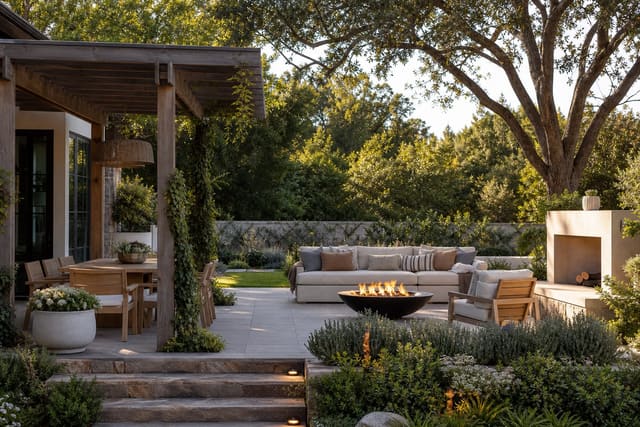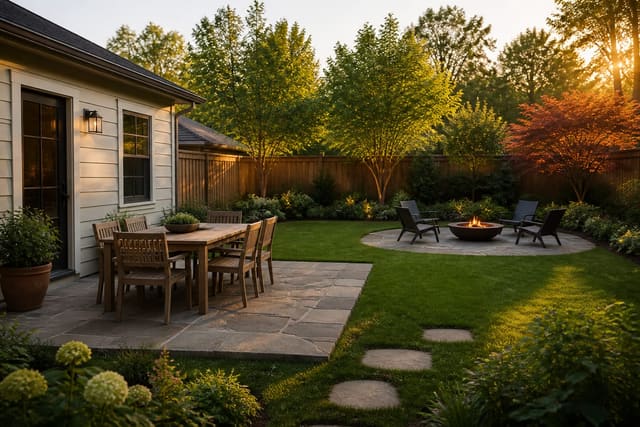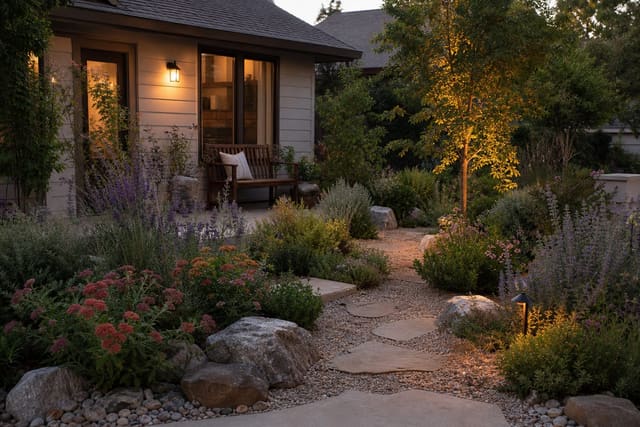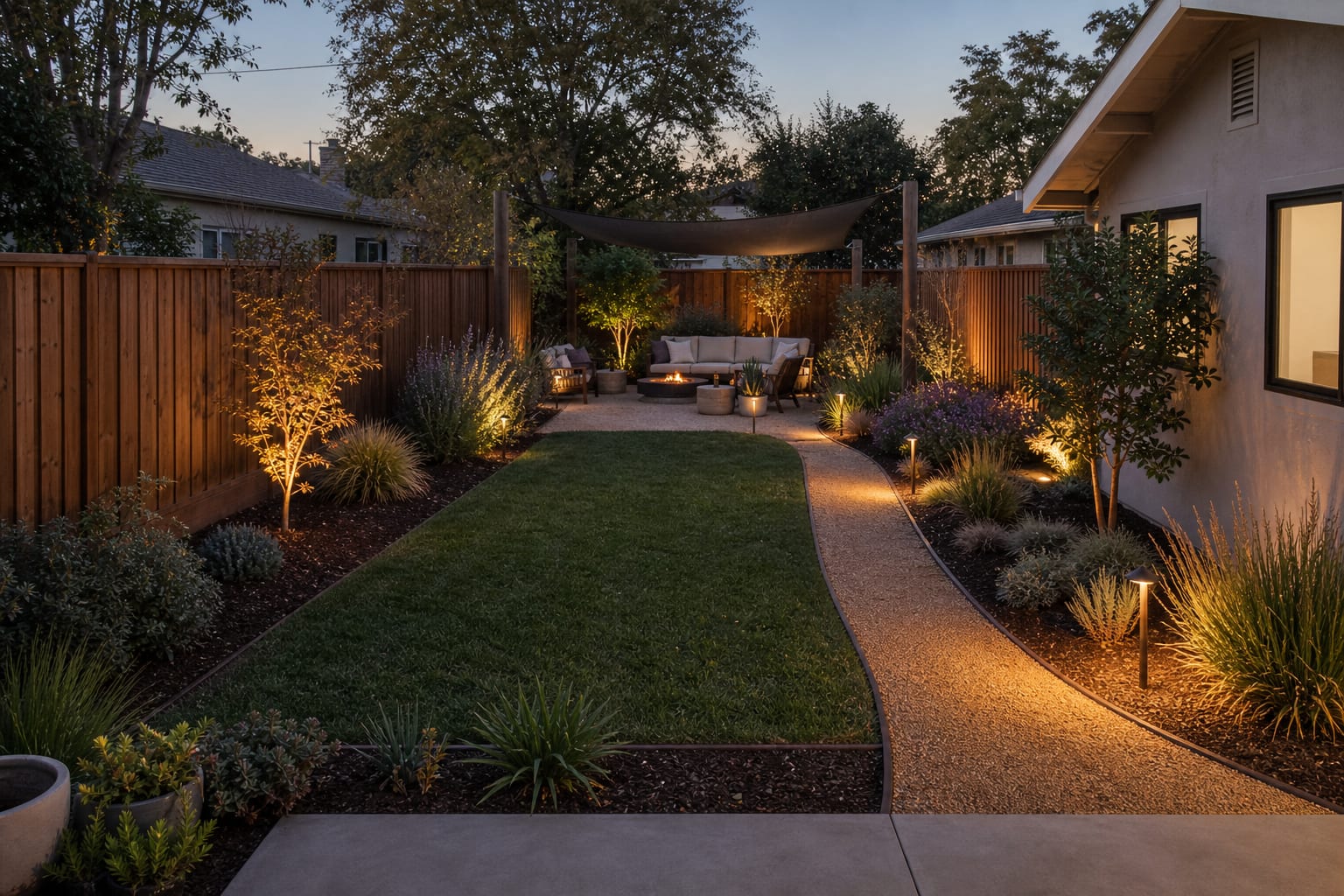
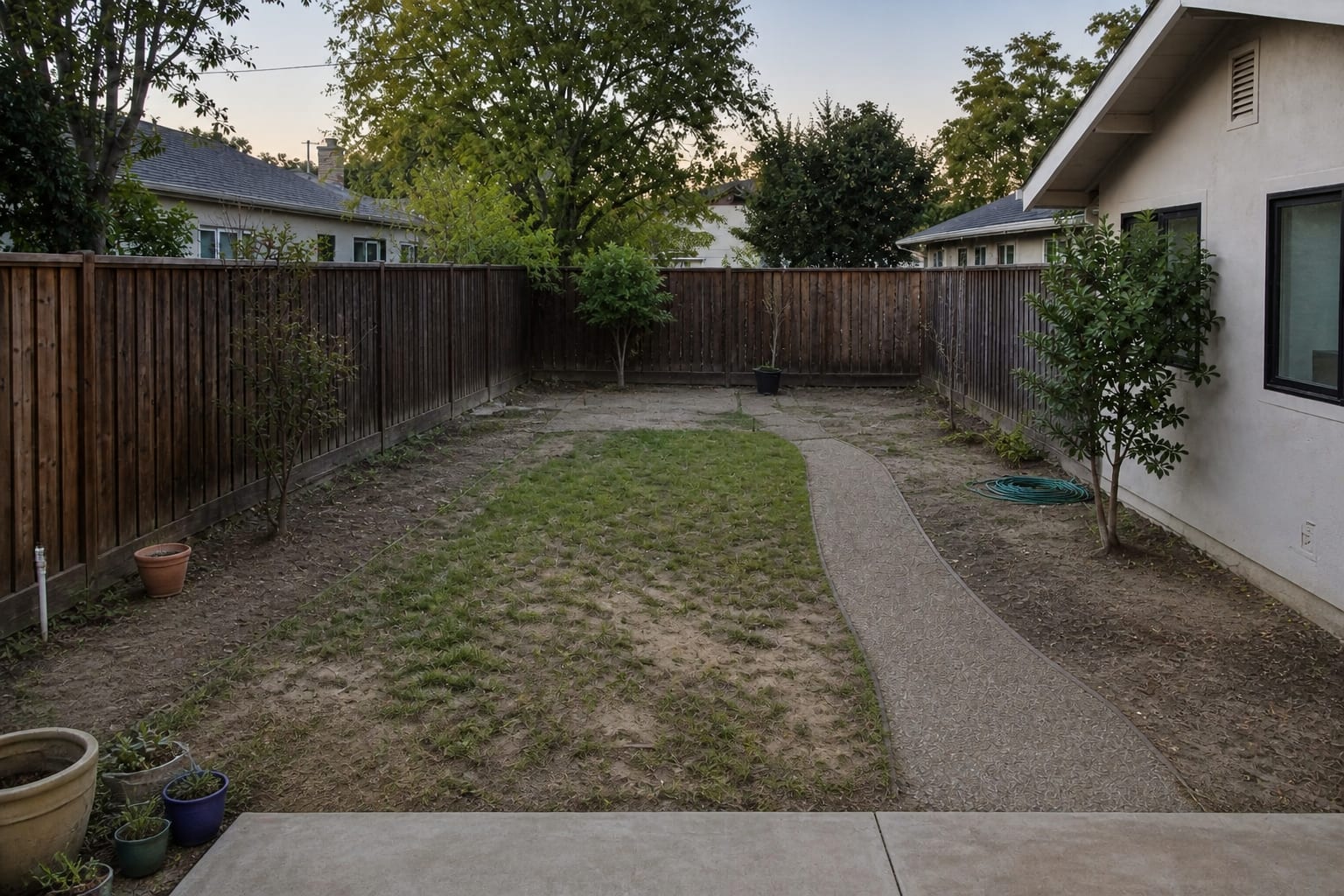
Low maintenance landscaping ideas work by cutting lawn size, matching plants to your site so irrigation ends after year two, blanketing beds with 2 to 3 inches of mulch, and grouping plants by water need. The result isn't a yard with no plants, it's one with fewer bad decisions built into the layout before you shop.
What makes a backyard feel low-maintenance instead of neglected?
A backyard feels low-maintenance when the structure looks intentional even on a week you do nothing. That means clear bed edges, durable surfaces, a smaller plant palette, and enough evergreen or woody structure to carry the garden past peak bloom.
Straighten bed lines: a curve that changes direction every 2 feet is hard to mow and busy to look at. Make beds 4 to 6 feet deep along a fence so shrubs have room to mature; a 24 inch strip usually becomes a weed trap with mulch on top.
Match surfaces to your life. Compacted gravel with steel edging handles chairs and boots better than a narrow grass strip, and large pavers set with 3 to 4 inch gravel or thyme joints soften a path without demanding perfect turf. Plan any privacy screening early, since trenching before mulch is easier than retrofitting later.
Discipline the plant palette: one evergreen anchor, one deciduous shrub, one ornamental grass, and two or three repeated perennials. In dry climates lean on drought tolerant plants with silver or waxy foliage and deep roots; in wetter climates pick plants that tolerate winter soil rather than lavender in soggy clay.
Which low-maintenance landscaping ideas actually reduce work?
Use these where they solve a real problem, not as scattered decoration.
- Swap failing lawn strips for gravel. Narrow grass beside fences and driveways rarely earns the mowing; use gravel at least 3 inches deep over fabric, edged with steel, brick, or stone.
- Build one generous path. Make a main path 36 inches wide, or space stepping stones about 24 inches on center, instead of several apologetic routes.
- Mass plant shrubs. Shrubs do more visual work than annuals for less weekly care; buy varieties that mature to the height you want instead of pruning a 6 foot plant down to 3 feet forever.
- Groundcover under trees. Thin shaded turf needs constant patching; plant a shade-suited groundcover in prepared soil with mulch and temporary irrigation for one season.
- Turn an unused side panel into a gravel court. A level, sturdy-bordered surface can replace lawn nobody loves; the same logic scales down from sloped-yard terracing.
- Add one flexible screen or wall. A 6 foot fence softened with three repeated shrubs or a vine panel hides bins and utilities and lowers the urge to keep buying filler plants.
Test this on your own photo with ReDesign; keep the house edge, horizon, hardscape, beds, and main path visible so the preview solves the space you actually have.
Common low-maintenance landscaping mistakes to avoid
- All hardscape, no planting. Gravel and pavers alone feel hot and flat; keep at least one layered planted edge and a tree or large shrub for height.
- Ignoring mature size. Small starter plants are fine, but space them for their full-grown width, not their nursery pot.
- Skipping weed prep. Remove perennial weeds and loosen compacted soil before installing anything; add weed barrier only under non-planted gravel, then mulch beds after a deep watering.
- Mixing thirsty and dry plants. Rosemary and hydrangea in the same bed fight each other; group by irrigation zone, sun, and soil so easy plants aren't punished by needy ones.
- Blocking access. Leave 18 to 24 inches behind deep beds to reach a fence, gate, hose bib, or utility box.
Use AI to preview your backyard before you commit
AI design lets you compare structure before spending on plants, gravel, edging, or furniture. Upload a daylight photo showing the back door, fence line, lawn, and awkward utility areas, then test versions with less lawn, deeper beds, gravel paths, and repeated drought tolerant plants.
Keep the camera angle identical between previews so scale problems show up: a path pinching below 30 inches, a seating area with no shade, or a bed too shallow to hide the fence. If you want outdoor screenings, compare layouts using AI backyard design so seating, cords, and path lights don't collide with new shrubs.
How do you phase a low-maintenance yard without redoing work?
Start with permanent lines: drainage, circulation, bed depth, lawn size, and irrigation zones. Plants move easily; a patio, path, or buried drip line does not.
| High-work habit | Lower-maintenance replacement | Useful spec |
|---|---|---|
| Lawn in every leftover strip | Compact lawn only where used | Keep mower turns broad, edges simple |
| Annual color across large beds | Perennials, shrubs, pots near doors | Keep seasonal pots within hose reach |
| Hand-watering mixed plants | Separate drip and lawn zones | Keep dry plants out of wet beds |
| Thin mulch over bare soil | Mulch or gravel with a real edge | Use 2 to 3 inches after weeding |
Phase one makes the yard functional: fix puddles, set the path, shrink the lawn, install edging. Phase two plants the backbone of shrubs, grasses, trees, and groundcovers matched to sun and soil. Phase three adds the light layer: pots, cushions, a fire bowl, or seasonal flowers where you'll actually see them.
If budget is tight, finish one area completely rather than starting five. A 12 by 14 foot gravel seating area with two deep planted edges reads as finished; five half-started beds do not. Low maintenance means fewer choices that demand your weekends back, not less thinking upfront.
Frequently Asked Questions
How many hours per month does a low-maintenance yard actually take?
A correctly designed low-maintenance yard runs 2 to 4 hours per month after year 2, mostly edging, light pruning, and refreshing mulch annually, versus 8 to 16 hours for a typical lawn-and-bed yard.
What plants are truly low maintenance?
Native grasses, drought-tolerant perennials (Salvia, Echinacea, Russian Sage), and shrub anchors matched to your zone need no irrigation past establishment. Avoid annuals, hybrid teas, and zone-pushed exotics that need constant babying.
Is gravel mulch better than bark mulch?
Gravel lasts indefinitely but locks in heat and favors different weeds; bark composts in 2 to 4 years but suits a wider plant palette. Pick by climate and the plants you want, not by which feels more low-maintenance.
How do I reduce mowing without going all-gravel?
Replace lawn corners with planted groundcover (Sedum, Liriope, Carex pensylvanica) and keep only the 600 to 1,200 sq ft of lawn you actually use. Smaller mown areas cut total mow time by 50 to 70 percent.
What irrigation works in a low-maintenance landscape?
Drip irrigation on a timer for beds plus a single sprinkler zone for the remaining lawn covers most yards. Install once, run twice weekly in summer, and the system pays for itself in saved time and water.
> Try this: Ready to see this on your own space? Open ReDesign and run the preview.
Three transformations to try
1. Native meadow front replacing lawn 2. Gravel garden with drift planting 3. Mulched perennial bed with reduced lawn