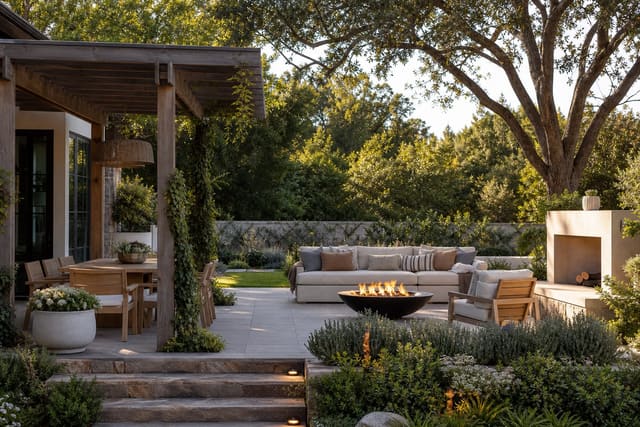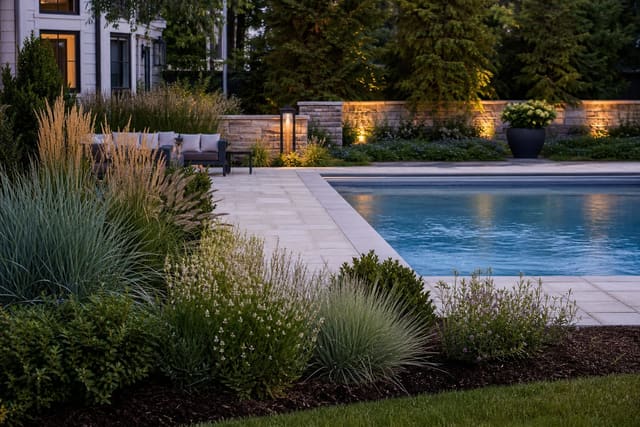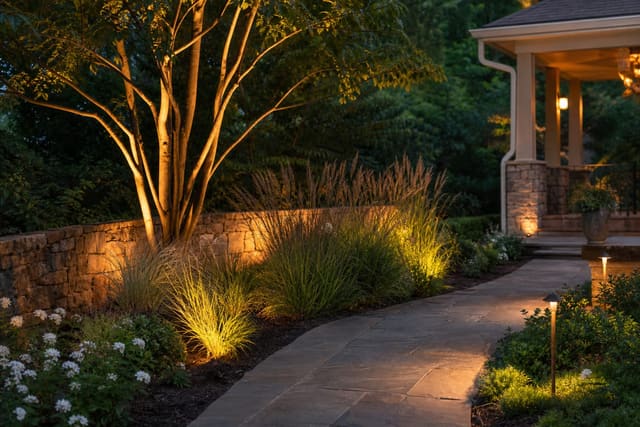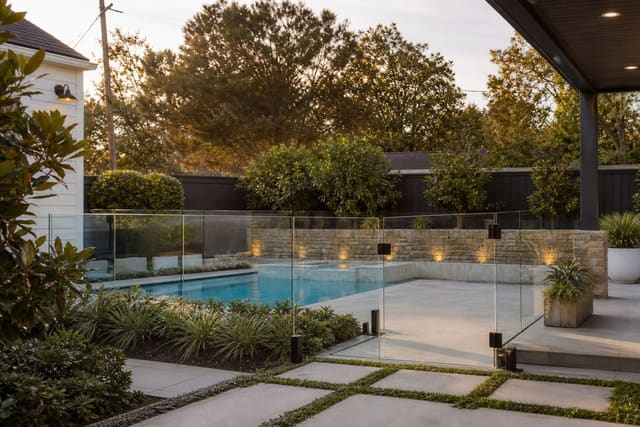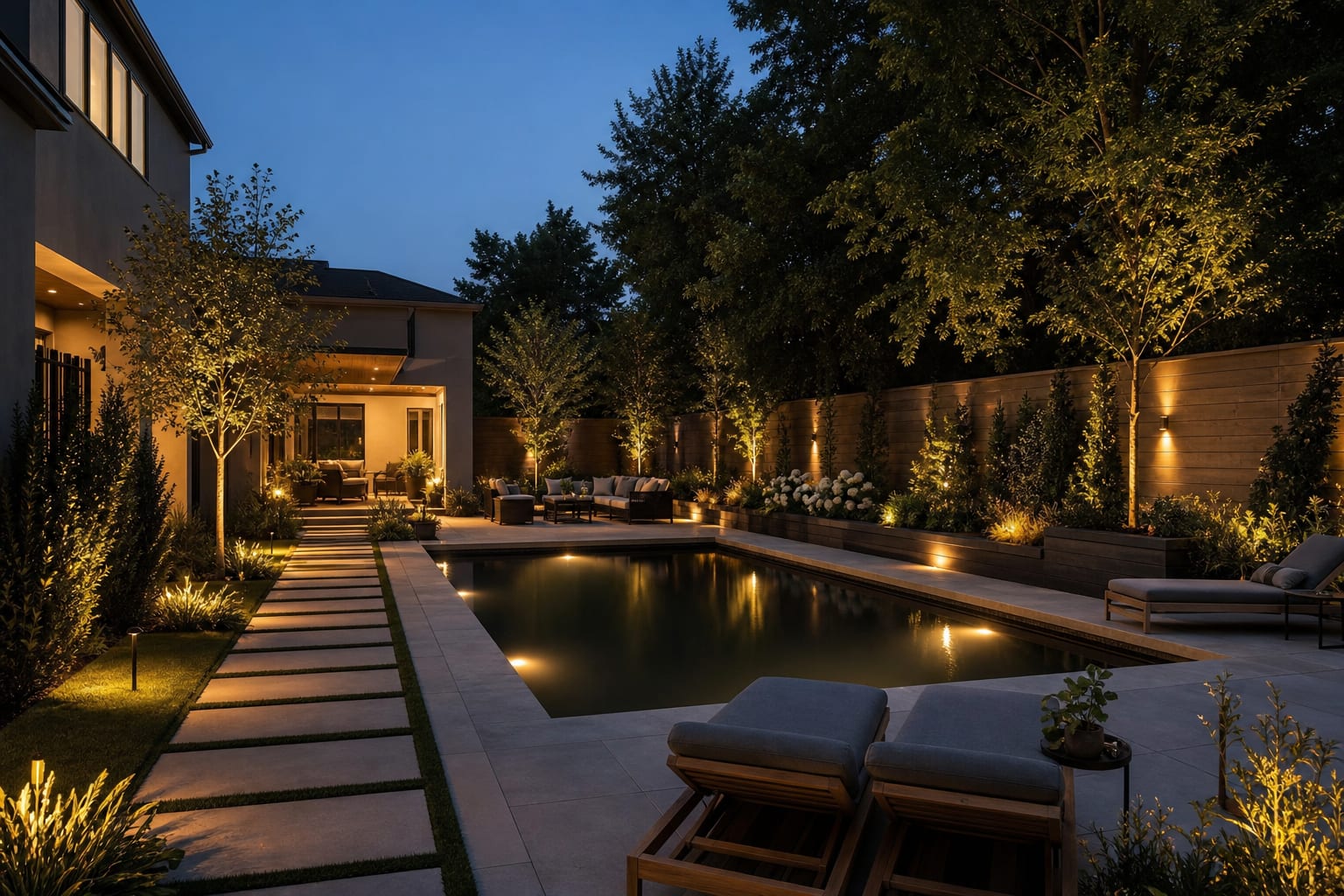
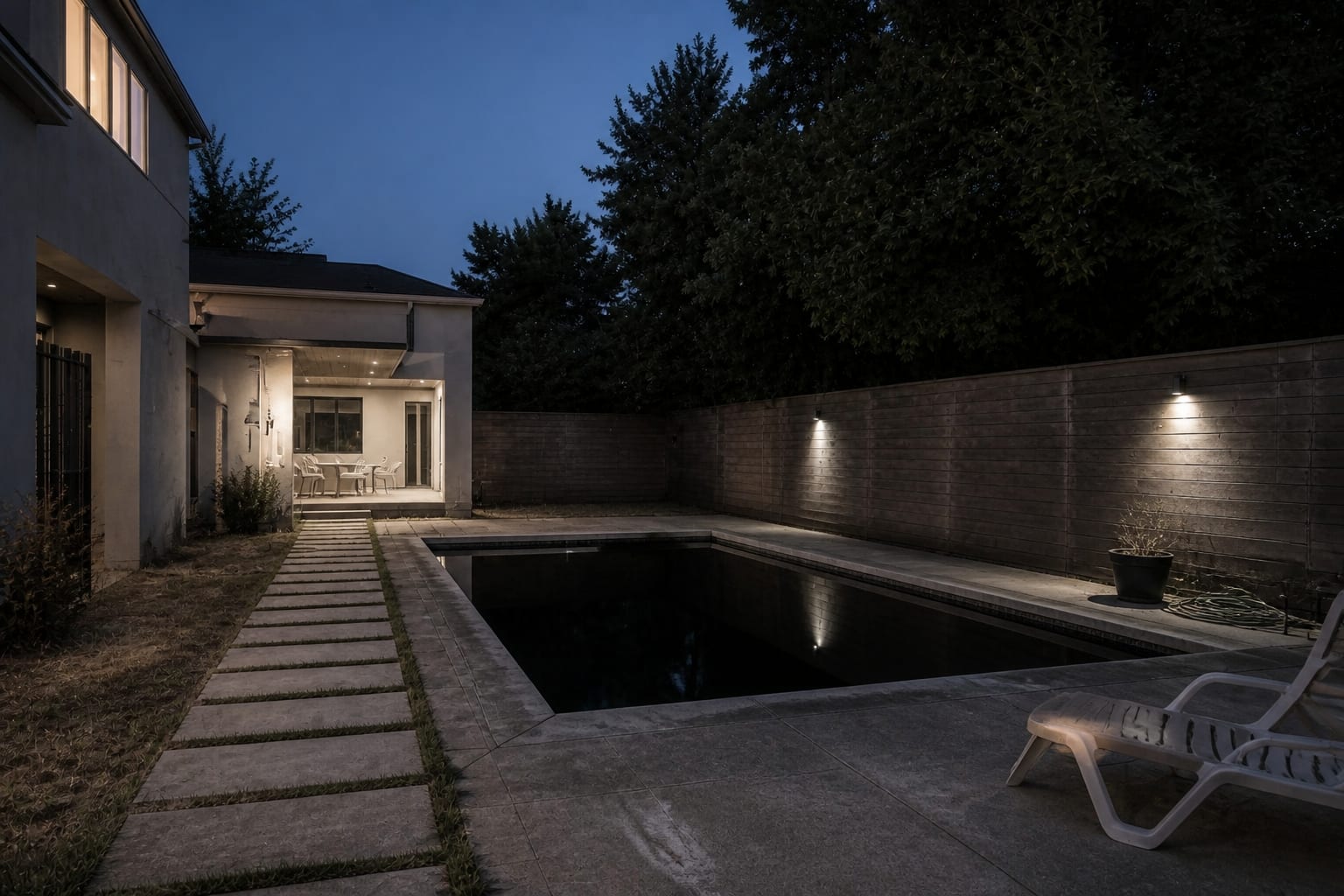
The best pool lighting layers three things: underwater LEDs on warm white or color-changing fixtures for the basin, low perimeter or step lights at 2700K for safe edges, and shielded landscape uplighting on surrounding plants — never one bright wall floodlight. Start with the water, then the coping, then the planting and paths, so the backyard feels safe and calm after dark rather than like a stage set.
How do I light a pool without making it feel harsh?
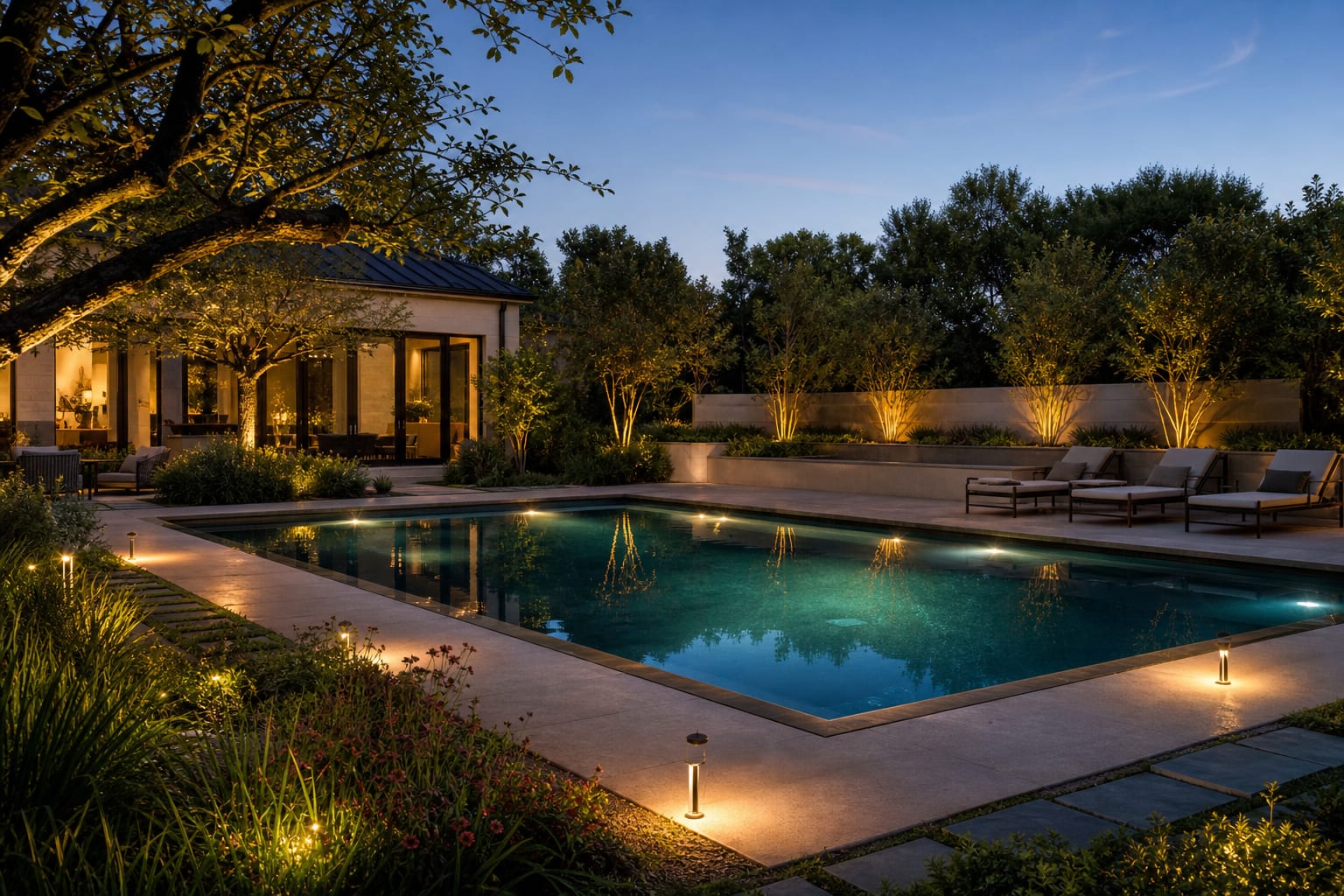
Light an outdoor pool by layering underwater lights, perimeter lighting, and landscape lighting so the water, edges, steps, planting, and walking routes are all visible without glare. Start with where people move: steps, tanning ledges, coping, gates, outdoor showers, and the path back to the house. Once those are safe, add atmosphere with trees, walls, and waterline texture.
Underwater lighting should glow evenly across the basin rather than create one bright spot at the deep end. A simple rectangular pool may need just two lights on the long wall; an L-shaped pool or one with a baja shelf often needs separate fixtures per zone. Aim lights away from the main seating area so nobody stares into a lamp while relaxing.
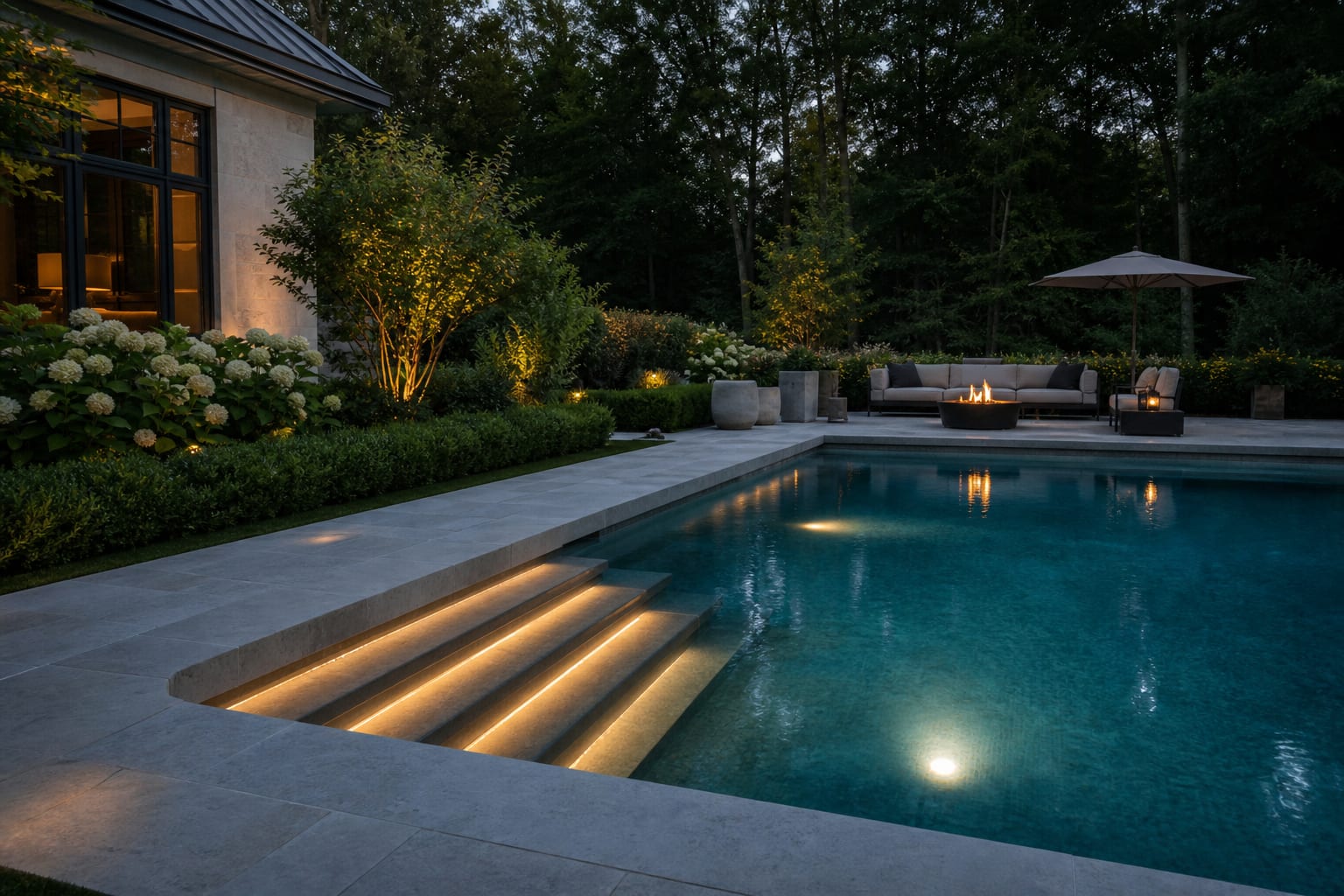
Perimeter lighting sits lower than most homeowners expect — fixtures 12 to 24 inches tall guide movement without turning the deck into a parking lot. Use recessed riser lights or under-cap lights at steps so the first tread is unmistakable. Near a pool fence, coordinate gate lighting with latch height so guests can find and operate it after dark.
Water first or deck first: which layer do I fix first?
The most expensive lighting mistake is choosing fixtures before deciding what the darkness is hiding. If the pool itself looks black, start underwater. If the water glows but the deck edge vanishes, fix perimeter lighting first. If the pool reads clearly but the yard feels flat, spend on landscape lighting.
- Underwater pool lights: choose when the basin looks black or swimmers can't read the steps. Use warm white for everyday use; save saturated color modes for parties, since strong blue can make stone and food look strange.
- Perimeter lighting: choose when coping, paths, or furniture create trip points. Keep fixtures 18 to 30 inches back from the water and shield the heads so beams land on the walking surface, not into faces.
- Landscape lighting: choose when the pool feels like a bright rectangle floating in a dark yard. Uplight one or two trees or wash a hedge softly for depth beyond the waterline.
- Task lighting: add near the grill, bar, or towel zone where people gather. A poolside bar needs enough light to pour a drink or read a label without glaring across the whole pool.
| Lighting layer | Best use | Useful spec |
|---|---|---|
| Underwater lights | Basin, steps, baja shelf, spa spillover | Warm white LEDs around 2700K to 3000K for everyday use |
| Perimeter lights | Coping edge, paths, gates, level changes | Low shielded fixtures about 12 to 24 inches tall |
| Step lights | Raised spa, deck stairs, sunken lounge | Mark every tread or change in level |
| Tree and planting lights | Depth, backdrop, privacy planting | Aim from below or across foliage, not toward the pool |
| Wall lights | Outdoor shower, equipment path, service door | Use wet-rated or damp-rated fixtures based on exposure |
Pool finish and deck material change the approach. Glossy tile reflects points of light, so use diffused or shielded sources near the waterline; matte stone can handle light grazing but still needs soft edges.
Test this on your own photo with ReDesign before choosing a final direction — keep the house edge, horizon, hardscape, planting beds, and main path visible so the preview solves your actual space.
What makes pool landscape lighting look intentional?
Good landscape lighting makes the yard feel deeper, not busier. Light fewer things better: one sculptural tree, a clipped hedge, a textured wall, the shower path, and the planting framing the far side of the pool. Fixtures sprinkled everywhere usually look cheaper than a few precise beams.
Start at the far edge of the pool, since that's the view from the house. Grasses, podocarpus, clusia, boxwood, or palms make a soft backdrop when light skims the leaves. Keep uplights at least 12 inches from trunks so the beam can open, and for palms, aim at the trunk and lower canopy rather than the crown.
Planting also hides hardware, but leave 12 to 18 inches of clearance so lenses aren't swallowed by growth. If the border feels bare, borrow structure from pool landscaping plant ideas before adding more fixtures — lighting can't fix a bed with no height or screening.
Deck material matters too. Light stone like travertine or limestone reflects generously and needs restrained warmth; dark porcelain or slate needs careful edge marking since it disappears after rain. Near saltwater pools, chlorine and coastal air make fixture finish a real choice — bronze, brass, powder-coated aluminum, and marine-grade stainless each age differently.
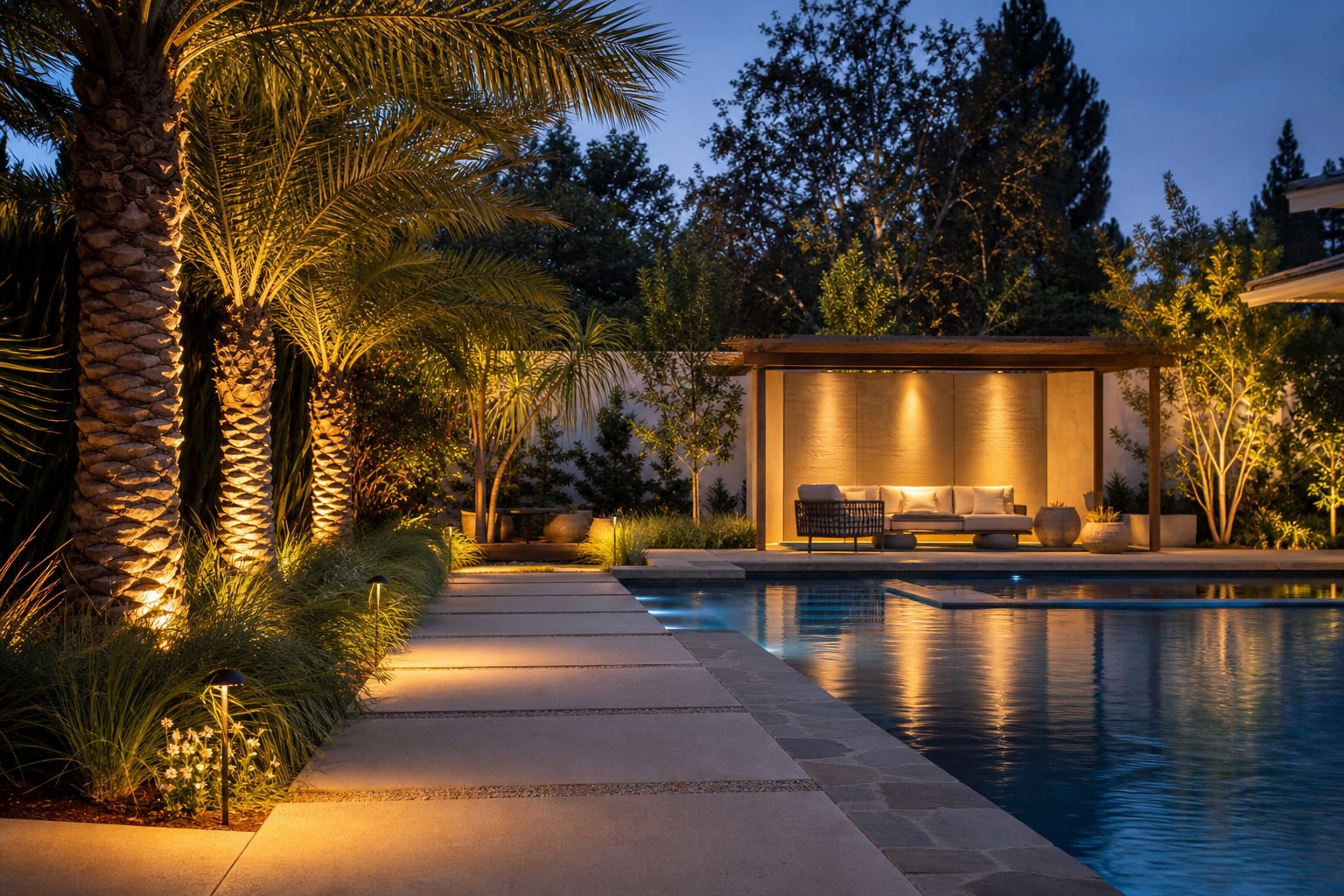
What pool lighting mistakes make a backyard feel unsafe or tacky?
- One harsh wall floodlight. It glares near the house, leaves the far coping dark, and turns the water into a mirror. Replace it with underwater glow, low edge markers, and one shielded tree or wall light for depth.
- Decorative rather than functional spacing. A perfect row every 4 feet feels fussy while dark gaps near turns are unsafe. Place lights where the body needs information: steps, corners, gates, and exit routes.
- Choosing color as the main feature. Color-changing lights are fun occasionally, but warm white is what makes tile, water, and faces look natural every day.
- Ignoring reflection. Check every fixture from seated eye height, from the kitchen, and from the far pool edge before finalizing aim.
- Forgetting service access. Equipment paths, chemical storage, and side gates need light too, and transformers and controls should stay accessible for maintenance.
Can AI design tools help preview pool lighting before I buy?
Pool lighting is hard to judge from product photos since the real result depends on your water color, coping, fence, planting, and house windows. Upload a dusk photo and preview two or three plans: one with stronger underwater glow, one with more perimeter markers, one where landscape lighting carries the atmosphere.
Keep the prompt specific: same pool shape, same fence line, warm 2700K to 3000K lighting, visible fixture locations, clear 36-inch walking routes, and no invented pergola or patio unless you plan to build one. A useful preview shows conflicts early — a path light landing in a lounge zone, a palm uplight pointing at the water, or a pool fence that disappears at night.
Frequently Asked Questions
Should pool lights be white or color-changing?
Warm white or 3000K reads inviting and timeless; color-changing fixtures work for parties on a dedicated scene, but default to white so the water looks clean and natural every day.
How many underwater pool lights do I need?
Plan on one large 100W-equivalent LED per 12-15 linear feet of pool wall, with at least one per pool half. One center light on a 30ft pool leaves half the basin dim.
Are pool lights safe to install?
Yes, when low-voltage 12V or 24V fixtures run on a GFCI-protected dedicated circuit. 120V niche lights require a licensed electrician and proper bonding to the pool's grounding grid.
What lights belong around the pool deck?
Use low shielded path lights 2-3ft from the coping for circulation, recessed step lights at the deep-end transition, and uplights on at least two planting anchors to soften the deck edge.
Why are pool floodlights a bad idea?
A high wall flood washes the water surface flat, keeps the underwater layer from reading, throws glare toward neighbors, and turns swimmers into silhouettes instead of visible people.
> Try this: Ready to see this on your own outdoor space? Open ReDesign and run the preview before you buy materials, plant, drill, or move furniture.
Three transformations to try
1. Warm white underwater plus coping step lights