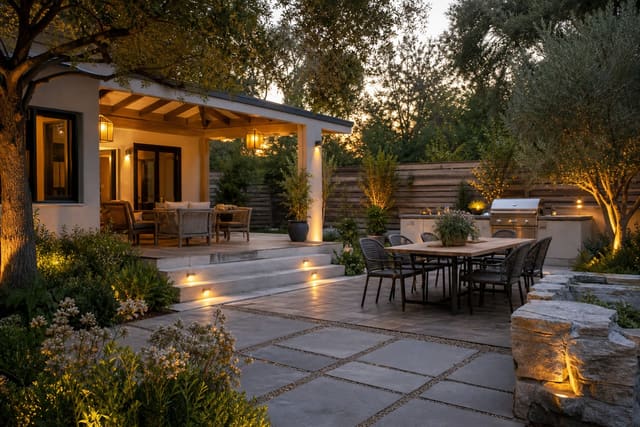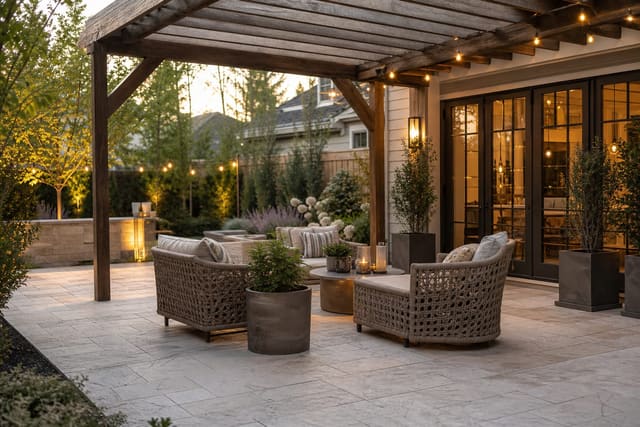
A backyard entertainment hub combines weather-rated AV — outdoor televisions, built-in landscape speakers, and projector walls — with covered lounge seating and a fire feature to turn the yard into the household's primary media and gathering space for game days, movie nights, and everyday use.
Can you put a regular TV outside?
No — a regular indoor television will degrade quickly in an outdoor environment and is not covered by manufacturer warranties for outdoor use. Outdoor-rated televisions are engineered with sealed electronics to block moisture and insects, anti-glare or high-brightness panels designed to be readable in ambient sunlight, and temperature-rated components that handle cold nights and hot afternoons. They run $1,500 to $8,000 depending on screen size and brightness rating. Some homeowners use an indoor TV under a very deep, protected overhang in mild climates, but this is a compromise, not a solution — and it typically voids the warranty.
For a protected, partially enclosed space like a screen porch or outdoor room with a roof and walls on three sides, a consumer television rated for indoor use may work with the addition of a ventilated weather-protection enclosure; these enclosures are a separate product category available from specialty AV suppliers.
How much does an outdoor TV cost?
Outdoor televisions span a wide range based on size, brightness (measured in nits), and brand positioning:
| Tier | Typical Price Range | Brightness / Notes | |---|---|---| | Entry outdoor TV (43–55 in.) | $1,500 – $2,500 | 400–700 nits; best in shaded, covered spaces | | Mid-range outdoor TV (55–65 in.) | $2,500 – $4,500 | 700–1,500 nits; usable in partial shade | | Full-sun / high-brightness (65–85 in.) | $4,500 – $8,000 | 1,500–4,000+ nits; direct-sun rated | | Weatherproof enclosure for indoor TV | $300 – $800 | Extends indoor set life in covered spaces |
These ranges reflect the outdoor TV market as described in the brief. Installation costs — mounting, weatherproof HDMI runs, power circuits — are additional.
TV or projector for the backyard?
Projectors and outdoor TVs serve different use cases, and the right answer depends on your environment, budget, and timing of use:
| Factor | Outdoor TV | Projector + Screen | |---|---|---| | Usable in daylight | Yes (high-brightness models) | Difficult — washed out without deep shade | | Image size | Up to ~85 in. typical | 100–150 in. relatively easy | | Upfront cost | $1,500–$8,000 | Often less for equivalent screen area | | Rain exposure | Weatherproof unit handles it | Projector needs enclosure or bring-in | | Installation complexity | Mount + power circuit | Power + screen + projector mount + throw distance | | Best for | All-day sports viewing, always-on | Evening movie nights, occasional use |
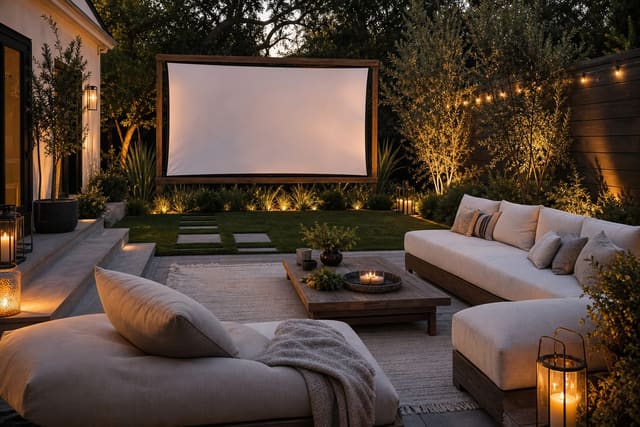
For households that want the hub running during afternoon games, an outdoor TV is the practical choice. For households primarily interested in a movie-night experience after dark, a projector-and-screen setup — possibly combined with a retractable screen on a pergola — is a lower-cost way to achieve a cinematic image size.
How do you set up outdoor speakers?
Outdoor speaker systems fall into three categories: landscape speakers (in-ground stake or in-ground flush-mount), architectural speakers (ceiling or soffit-mount under a covered structure), and decorative rock or planter speakers that blend into the landscaping. All three require outdoor-rated speaker wire run in conduit to a weatherproof amplifier or AV receiver located in a protected space — typically an outdoor AV cabinet or an interior equipment closet.
The key planning decisions are: - Zones. A well-designed system divides the yard into two to four zones (patio, pool area, lawn, dining) each independently controllable in volume. Zone wiring requires running separate speaker runs during installation. - Amplifier placement. The amplifier or AV receiver needs to be in a temperature-stable, dry location. Outdoor-rated rack enclosures exist, but many installers route audio to an indoor equipment closet and run speaker wire to the yard. - Streaming source. Most landscape speaker systems today pair with a network audio player or streaming amplifier that connects via Wi-Fi or Ethernet, eliminating the need for a physical source device at the AV cabinet.
Landscape speaker systems distribute audio more evenly across the space than any soundbar or portable speaker option, and the sound blends into the environment rather than originating from a visible point source.
What does backyard AV and conduit planning involve?
The hidden cost and complexity of an outdoor entertainment hub is the rough-in: the electrical and low-voltage work that must happen before paving or building the covered structure. Dedicated circuits for the TV, projector, landscape amplifier, string lights, and any motorized shade devices need to be planned and rough-in-permitted before the concrete or pavers go down. The same applies to conduit for HDMI runs, speaker wire, and network cable.
Practical checklist for the rough-in phase: - One dedicated 20-amp circuit for the display - Weatherproof HDMI conduit run from interior source to display location - Separate low-voltage conduit for speaker wire zones - Network cable (Cat6) to the AV cabinet location - Weatherproof outlet boxes at seating height and at the equipment cabinet - A junction point for string lights or overhead lighting
Running conduit after concrete is poured or decking is installed is possible but expensive — trenching or core drilling adds labor cost that dwarfs the original rough-in cost.
How do you design the layout for sports viewing?
Sports viewing imposes specific geometry. The display should be at seated eye level (bottom of screen approximately 24–30 inches above the seat surface) or slightly higher if guests will stand and move during games. Viewing distance for comfortable legibility is roughly 1.5 to 2.5 times the screen diagonal — a 65-inch screen is comfortable from about 8 to 14 feet. For a backyard layout hosting a crowd, orient the primary lounge seating in a gentle arc facing the display, with secondary seating (bar stools at a counter, Adirondack chairs) arranged within the viewing cone rather than behind the primary seats.
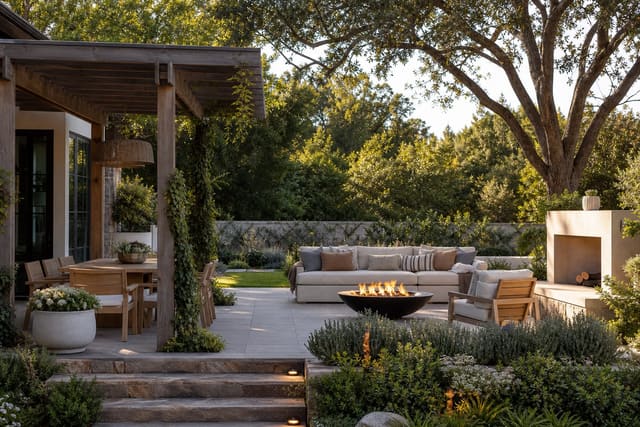
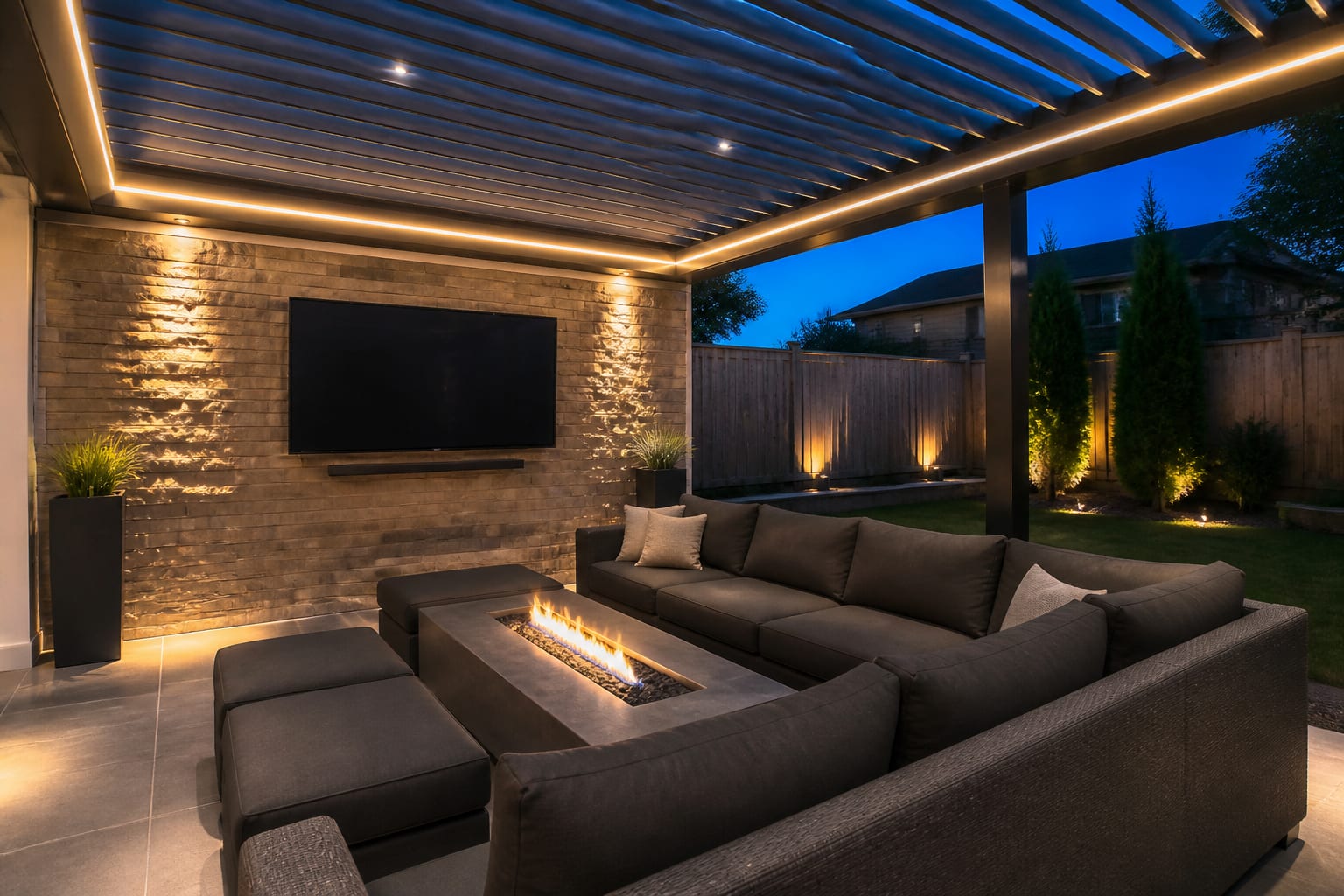
A fire feature — fire pit table or linear burner — placed in the center of the seating arc completes the hub: it provides warmth on cool evenings, a gathering anchor, and ambient light that reduces the contrast between the display and the surrounding darkness.
How do you incorporate a fire feature into a backyard entertainment hub?
A fire feature — fire pit table, linear gas burner, or wood-burning bowl — serves three functions in an outdoor entertainment hub: it provides warmth that extends the usable season, it creates an ambient light source that softens the contrast between the display and the surrounding dark, and it gives the seating arrangement a focal point independent of the screen. Without a second focal point, a backyard entertainment layout becomes a theater — all attention pointed at the TV. Adding a fire feature in the center of the seating arc or at the side of the space creates a more social, multi-directional environment.
The most functional placement for a fire pit table in an entertainment hub is at the center of a U-shaped or arc-shaped seating arrangement, positioned so that all seats have both a sightline to the screen and proximity to the fire. Rectangular fire pit tables with a long burner parallel to the sofa are popular because they serve both the primary sofa and secondary lounge chairs without anyone sitting behind the flames.
Gas fire features are strongly preferred for entertainment hub installations over wood-burning options: they turn on with a switch, produce no smoke that could drift across the screen or into guests' eyes, and require no ash cleanup. Propane tank or natural gas line supply is a planning decision that should be coordinated with the AV rough-in.
How can you preview a backyard entertainment hub before you build?
Before committing to a covered structure, AV rough-in, and furniture, render your actual backyard in a few configurations. Upload a photo of your yard to Re-Design and try covered patio backyard sports lounge with outdoor TV and lounge seating around fire pit to see a game-day layout. For the movie-night version, try outdoor movie projector wall pergola with retractable screen and string lights at night. If you're focused on the audio layout, a prompt like backyard entertainment hub with in-ground landscape speakers and dining area helps visualize speaker placement relative to seating.
Seeing your actual yard — not a stock photo — in a fully dressed entertainment hub configuration is the fastest way to pressure-test the layout before rough-in begins.
Frequently Asked Questions
What is the difference between an outdoor TV and a regular TV?
Outdoor TVs are purpose-built with sealed electronics that block moisture and insects, high-brightness panels for ambient-light readability, and temperature-rated components. Regular indoor televisions are not designed for humidity, temperature swings, or insects and will degrade quickly in an outdoor environment. Outdoor TVs run $1,500 to $8,000 depending on screen size and brightness rating.
Do outdoor TVs work in direct sunlight?
High-brightness outdoor TVs rated at 1,500 nits or above are designed for direct-sun or partial-sun environments and will be readable in most conditions. Standard outdoor TVs in the $1,500–$2,500 range perform best under a covered structure or in shade. Screen placement and orientation relative to the sun matters as much as the nit rating.
How do you protect outdoor AV equipment in winter?
Outdoor-rated TVs are designed to handle a broad temperature range, but storing removable components indoors during extended freeze periods extends life. Soundbars and portable equipment should be brought inside. In-ground landscape speaker systems and buried conduit are generally left in place year-round. Consult manufacturer specs for minimum operating temperature before assuming equipment is rated for your climate.
How far should the TV be from outdoor seating?
A comfortable viewing distance is approximately 1.5 to 2.5 times the screen diagonal. For a 65-inch TV, that means roughly 8 to 14 feet from the screen to the primary seating row — a range that fits comfortably in most covered patio layouts.
Do you need a permit for outdoor AV electrical work?
Any new circuit or electrical rough-in typically requires a permit in most jurisdictions. Low-voltage speaker wire and HDMI conduit generally do not require a separate permit but must be run in conduit outdoors per code in many areas. Confirm with your local building department before trenching.