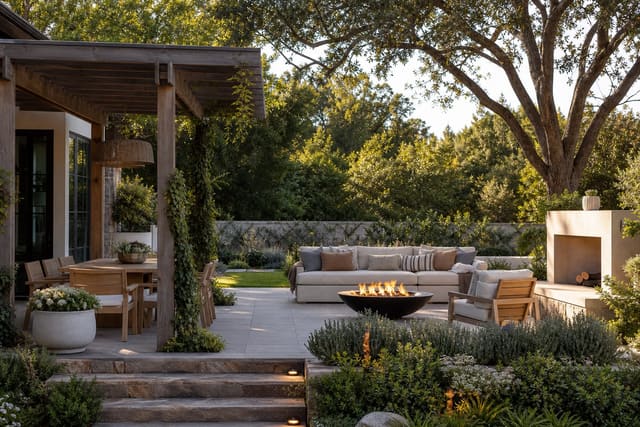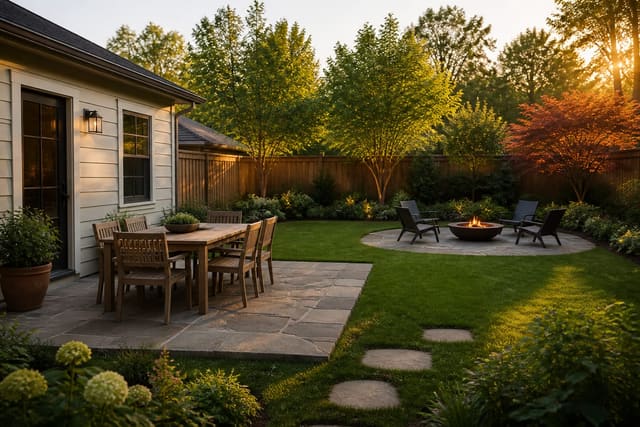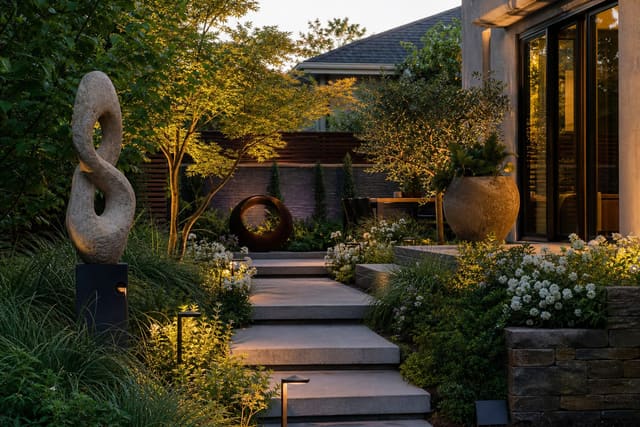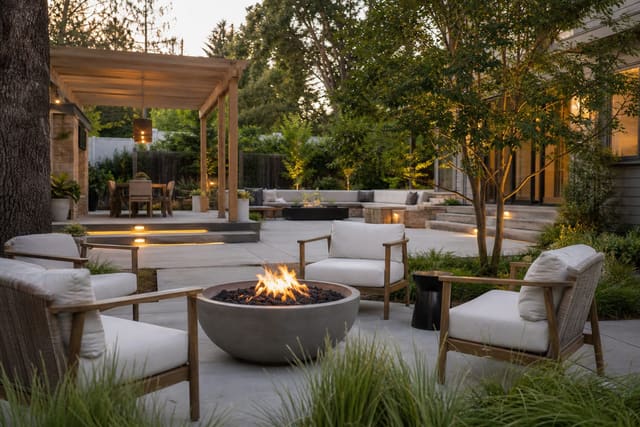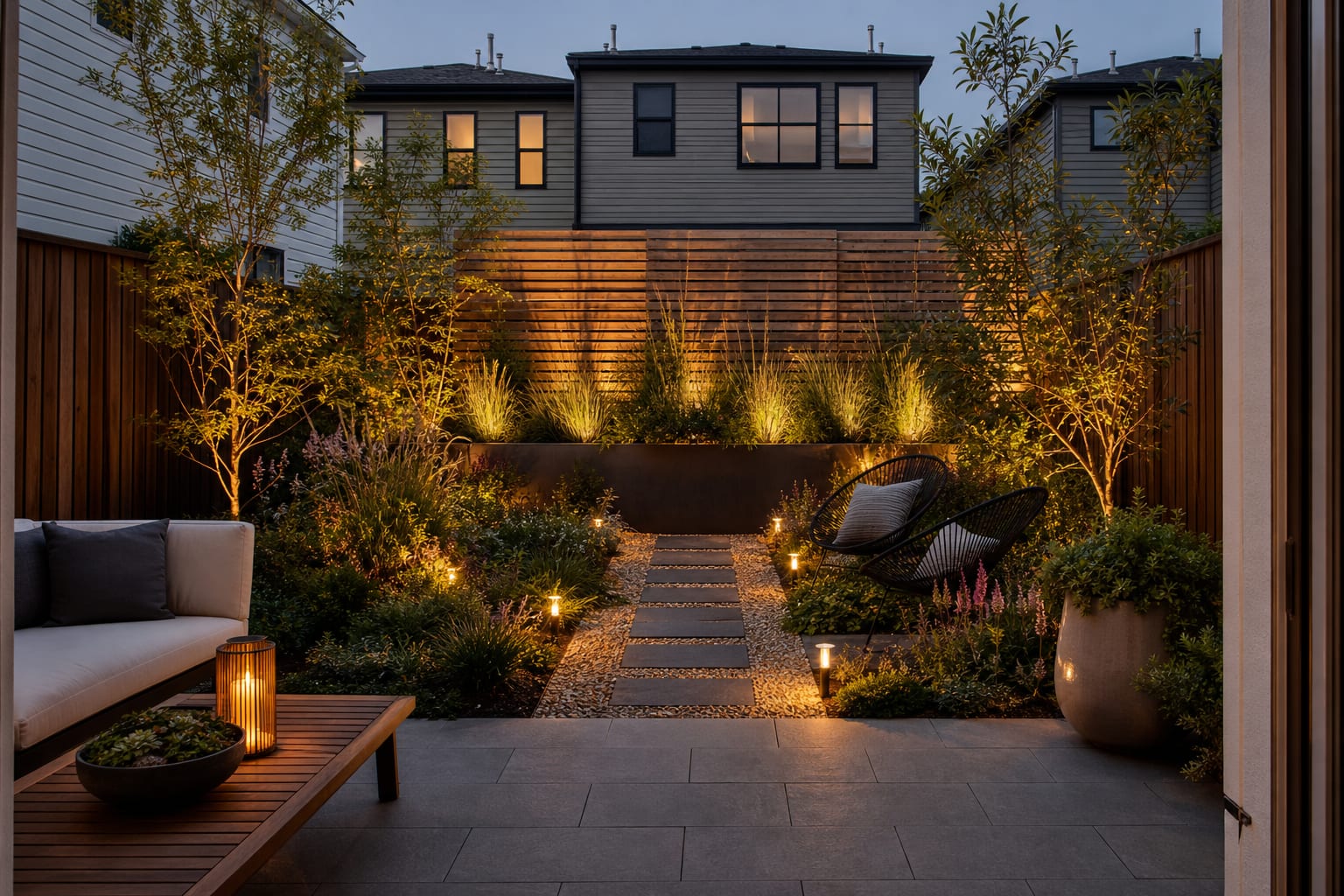
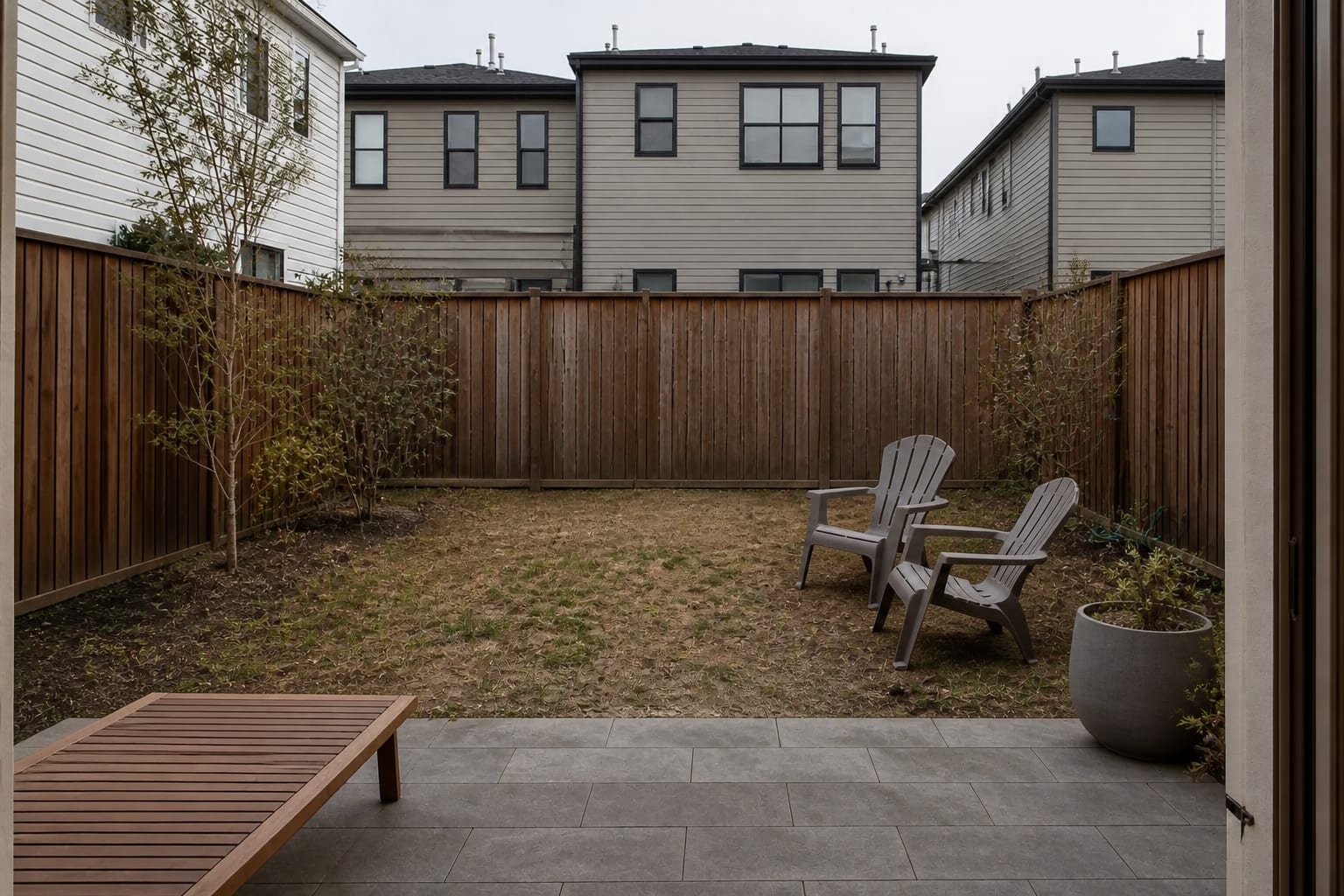
A backyard looks designed when one feature — a wall, planted urn, sculptural tree, water feature, or fire element — sits at the end of the main sight line from the patio door, backed by layered planting and a path that leads the eye there. Pick one feature worth the attention, place it on a natural sightline, and support it with lighting and planting so the eye knows exactly where to land.
What makes a backyard focal point feel intentional?
A focal point feels intentional when it has enough scale to command the view and enough support to look placed, not dropped. It can be natural, built, or movable, but it must answer one question: where should someone look first?
Start at the main viewing position — kitchen sink, sliding door, dining table, or first patio step. Look straight ahead for 10 seconds. If your eye bounces from fence to grill to shed, the yard has no hierarchy.
Scale is the first filter. A 30" pot with a Japanese maple can anchor a 20' x 25' yard, but the same pot disappears in a 60' deep yard unless it sits on a plinth or belongs to a larger bed. For built pieces, think in outdoor-room proportions: a feature wall needs at least 5' of width, pergola posts should feel heavier than indoor furniture legs, and a fire bowl needs at least 36" of clearance behind the chairs.
Contrast matters too. A pale limestone wall pops against deep green planting; a dark steel fire bowl reads crisp against gravel or pale pavers. Contrast doesn't mean loud color — it means the focal point looks visually different from its background.
| Focal point type | Best use | Minimum scale that reads outdoors |
|---|---|---|
| Living feature | Softens fences, patios, and hard corners | 6'–8' tree, 3' shrub mass, or 5' planted bed |
| Built feature | Adds architecture where the yard has none | 5'–8' wide wall, screen, arbor, or fireplace face |
| Movable feature | Helps renters and phased projects | 30"–42" planter, large fire bowl, or outdoor sculpture |
Which backyard focal point idea fits your yard?
The right idea depends on what the yard lacks: height, destination, privacy, warmth, or a view worth framing.
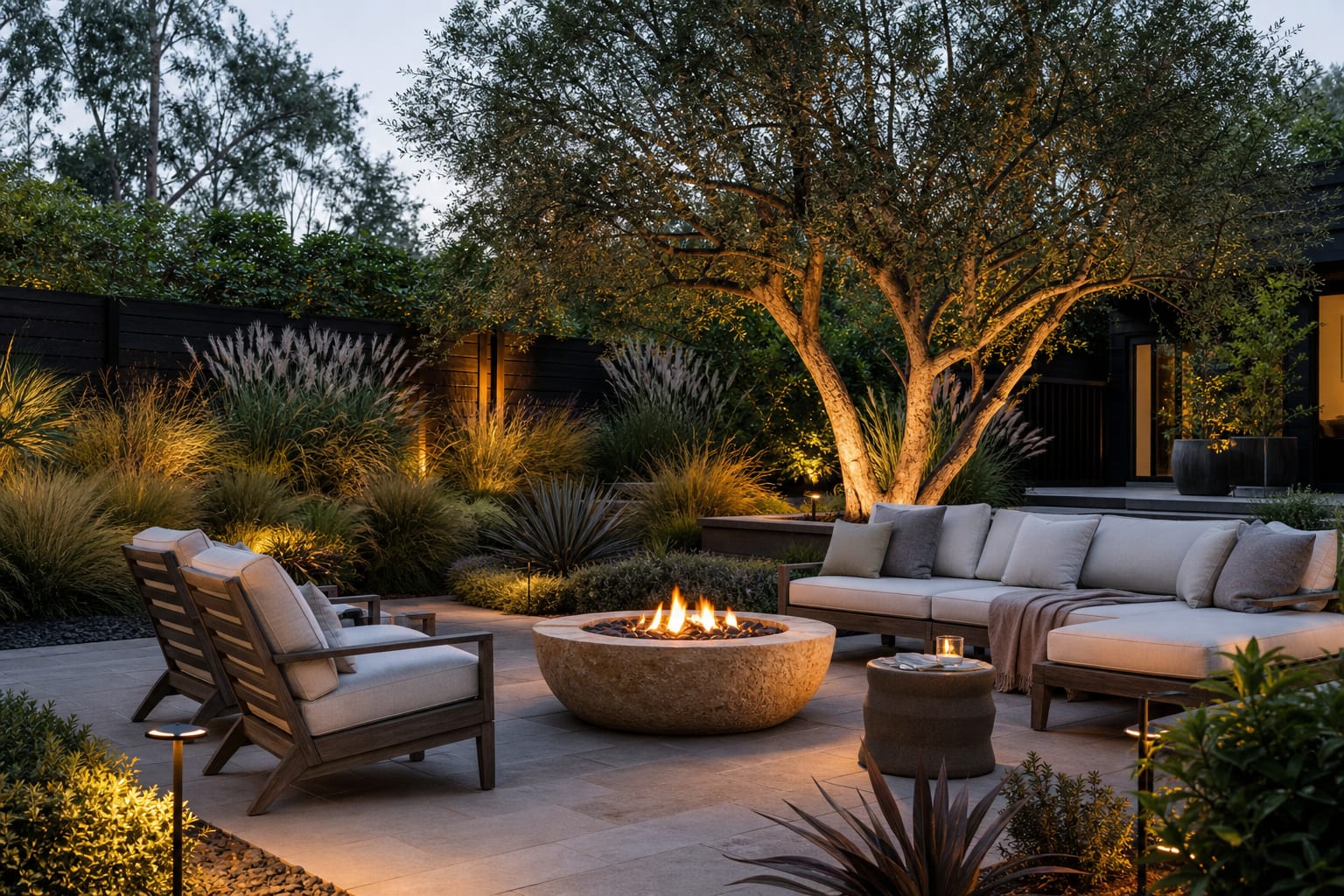
- Frame a specimen tree as the hero. Choose one tree with distinctive shape and give it a clean bed at least 5' across. A multi-stem serviceberry, olive, crepe myrtle, or Japanese maple beats a tiny ornamental lost in lawn, especially uplit at night.
- Build a low feature wall at the back fence. A 5'–7' wide slatted cedar, stucco, brick, or stone panel turns a plain fence into a deliberate focal point. Set it 12"–18" in front of the fence and repeat one patio material so it belongs to the house.
- Make the fire area the visual anchor. Arrange seating as a destination, not chairs shoved against the house. Leave 30"–36" between chairs and the fire bowl, use a pad at least 10' across, and see fire pit seating area ideas if your setup feels like loose chairs circling hardware.
- Use an arbor or pergola to mark a path's end. A 7'–8' tall arbor adds height to a flat yard and creates a threshold. Train climbing jasmine, roses, or clematis on one side only, keeping the frame visible.
- Turn a narrow side view into a garden moment. A small fountain, tall pot, or vertical trellis at the end of a side passage becomes the first visual anchor. See side yard ideas that create a destination — narrow spaces need a clear end point or they read as leftover access lanes.
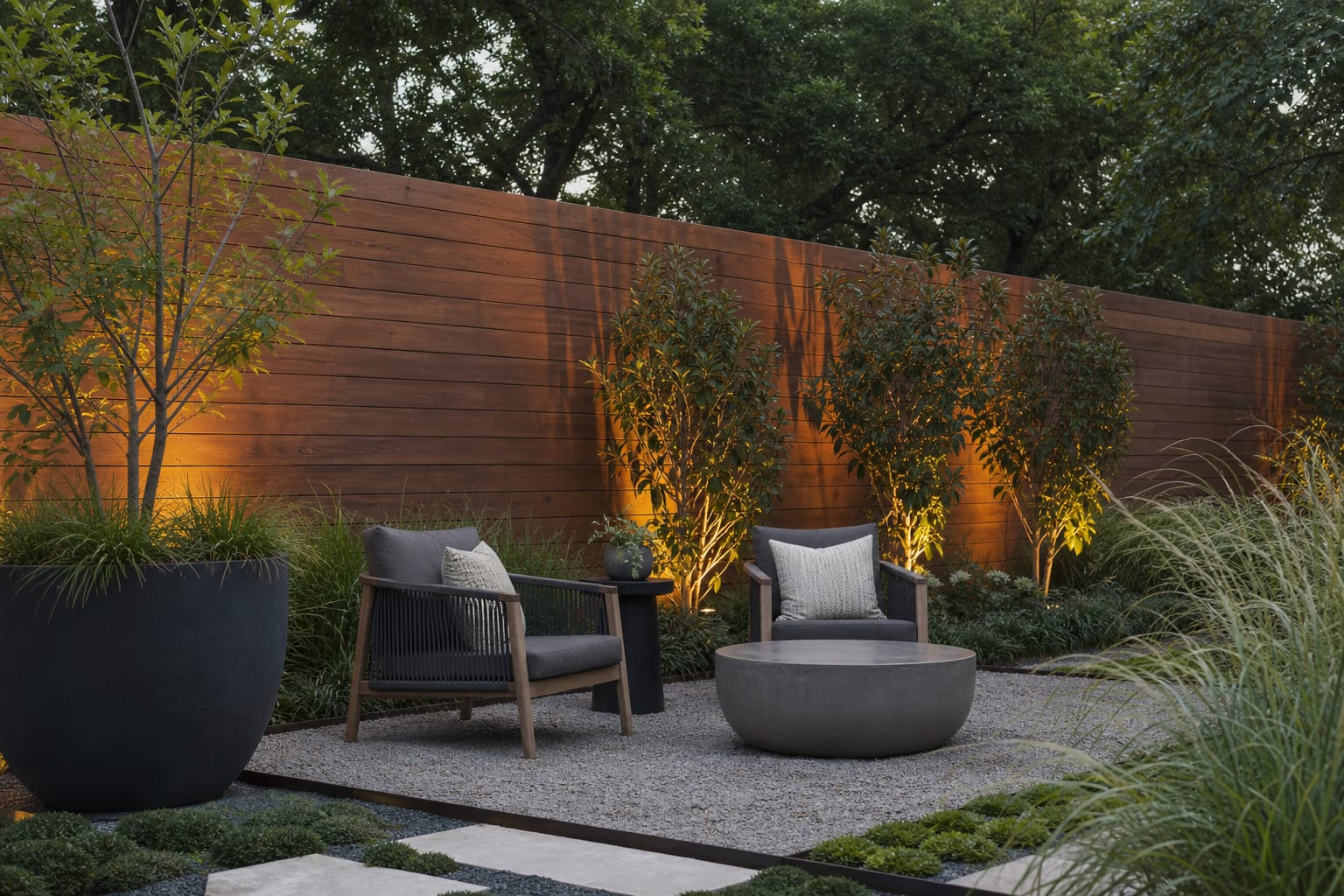
Test this on your own photo with ReDesign — keep the house edge, horizon line, hardscape, planting beds, and main path visible so the preview solves the space you actually have.
Common backyard focal point mistakes
Most failed focal points aren't ugly — they're too small, too lonely, or placed where nobody looks. Fixing these is usually cheaper than buying a dramatic new object.
- Undersized for the viewing distance. A tabletop fountain charms up close but vanishes from 25' away; choose real mass — a 36" planter, 6' screen, or tree canopy that crosses the fence line.
- Too many accents competing. An umbrella, birdbath, grill, string lights, and a fence mural can all fight for attention. Give the chosen anchor the strongest color, height, or lighting, and quiet the rest.
- Seating ignores the focal point. Chairs facing the house or each other make even a good feature feel irrelevant. Angle at least two seats toward the anchor and keep the walking route 36" wide.
- No foreground. A tree or fountain alone in mulch looks stranded. Add a 24" band of gravel, a low hedge, or three repeating grasses to guide the eye.
- Lighting treated as decoration, not direction. Patio string lights are pleasant but don't highlight the feature. Use warm 2700K–3000K landscape lighting on the anchor itself.
Small backyards need stricter editing — combine beauty and use, like a bench built into a planter or a compact fire bowl on a crisp pad. The same discipline that helps narrow backyard ideas feel wider applies here: one strong end view beats scattered small features.
Use AI design to preview the anchor before you build
A 6' trellis, black fire bowl, or pale stucco wall can look perfect online and feel heavy, tiny, or misplaced against your actual fence and patio. AI preview solves this before you buy materials.
Upload a straight-on photo from the main viewing spot and test one change at a time: the tree first, then the wall, then lighting and planting as support. That sequence keeps the design honest, showing whether the anchor fixes the yard or just adds another object.
Photograph in even daylight at standing eye level, including the full fence line or patio edge. For deep yards, add a second shot from the seating area looking back toward the house.
How should the rest of the yard support the focal point?
Once the anchor is chosen, paths, planting, furniture, and lighting should all point toward the same story.
Use a path when the focal point sits away from the patio — 30" is fine for a garden stroll, 36" is better for everyday traffic. Gravel, stepping stones, brick, or concrete all work if the path leads to or slowly reveals the feature.
Planting should build depth, not hide the anchor. Put tall plants behind or beside the feature, mid-height shrubs at 24"–36", and low groundcover or gravel in front. Repetition reads as designed; six unrelated plants read as leftovers.
Furniture should respect sightlines. Rotate a sofa or switch to lower chairs if it blocks the view from the house; screen the grill with a 4' planting mass if it's the first thing visible. A designed yard keeps practical pieces present but visually quiet.
Frequently Asked Questions
What makes a good backyard focal point?
A good focal point has vertical scale — 4 to 8 feet tall against a flat yard — visual contrast with surrounding planting, and a clear sight line from the most-used vantage point, typically the patio door or kitchen window.
Where should a backyard focal point be placed?
Place it at the far end of the longest sight line from the main vantage point. An off-center diagonal placement reads more designed than a centered one, which tends to feel formal and predictable.
Can a yard have more than one focal point?
Yes, in larger yards: one primary focal point visible from the patio and a secondary one visible from a side path or dining zone. More than two competing focal points fragment the design.
What's an inexpensive focal point that still works?
A large planted urn or olive tree in a cedar planter, a single weathered-steel sculpture, or a feature wall built from stained 1x6 boards all cost under $500 and outperform scattered shrubs.
Does a focal point need a path leading to it?
Yes. Without a path, the viewer never approaches the focal point and the yard reads as a stage set. A stepping-stone or gravel path turns the focal point into an actual destination.
> Try this: Ready to see this on your own outdoor space? Open ReDesign and run the preview before you buy materials, plant, drill, or move furniture.
Three transformations to try
1. Feature wall focal point with planted base 2. Sculptural tree as backyard focal point 3. Water feature focal point from patio