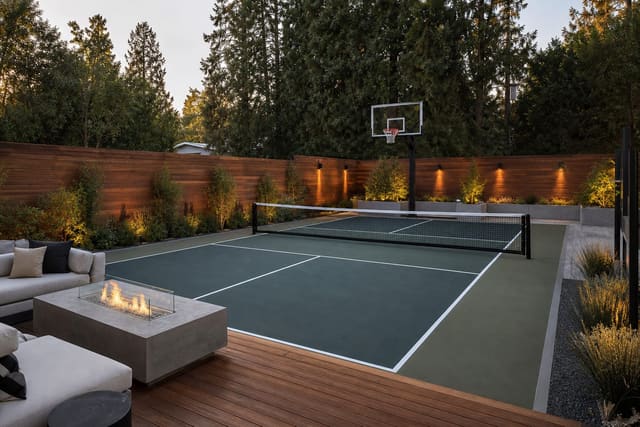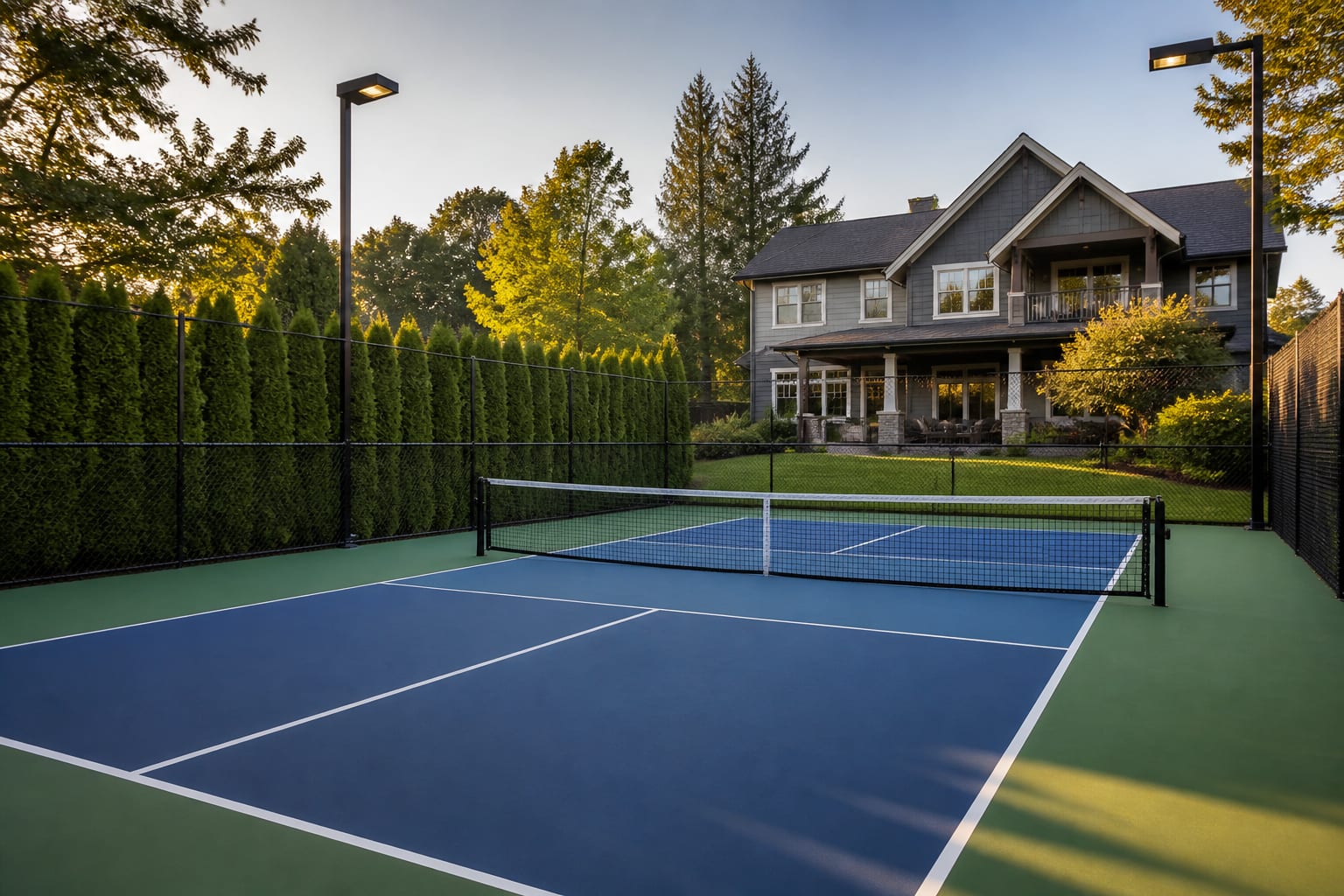
A backyard pickleball court is a 20 × 44 ft playing surface — total recommended pad 30 × 60 ft — finished in acrylic-coated concrete or modular sport tiles, giving families a dedicated space for the fastest-growing racket sport in the country. Installed costs run $15,000–$45,000 for a purpose-built court or $5,000–$10,000 when converting an existing slab.
How much space does a backyard pickleball court need?
The official pickleball court measures 20 ft wide by 44 ft long — roughly the same footprint as a doubles tennis court divided in half. That gives you the playing surface, but the USA Pickleball Association recommends a total pad of 30 × 60 ft so players can retreat safely behind the baseline without hitting a fence or wall. That full pad is 1,800 square feet, which is a roughly 40 × 45 ft cleared rectangle once you account for a slightly non-square layout.
If you are converting a driveway or side yard, measure the usable rectangle carefully before getting excited. Many standard two-car driveways are only 20–24 ft wide — just barely court-width — but fall short of the 44 ft depth. In that case, either accept a slightly abbreviated out-of-bounds zone or orient the court lengthwise along the driveway approach.
Court dimensions at a glance
| Zone | Width | Length | |------|-------|--------| | Official playing surface | 20 ft | 44 ft | | Recommended total pad | 30 ft | 60 ft | | Minimum squeeze layout | 24 ft | 54 ft | | Net height (center) | — | 34 in | | Net height (posts) | — | 36 in |
How much does a backyard pickleball court cost?
A purpose-built backyard pickleball court costs $15,000–$45,000 installed, while converting an existing slab or driveway drops that range to $5,000–$10,000. The wide spread reflects surface material, fencing, lighting, and regional labor rates.
Cost breakdown by tier
| Tier | What's included | Estimated cost | |------|----------------|----------------| | Slab conversion — tiles only | Existing concrete, modular sport tiles, net | $5,000–$10,000 | | Mid-range built court | New concrete pad, acrylic color coat, boundary lines, net posts | $15,000–$25,000 | | Full-featured court | Above + perimeter fencing, rebound netting, LED lighting, drainage | $25,000–$45,000 | | Premium / multi-sport | Above + multi-sport striping, windscreen, seating area | $35,000–$50,000+ |
The biggest single cost driver after the base slab is fencing. A full perimeter of 10 ft chain-link or powder-coated steel adds meaningful cost but prevents ball loss and gives the court a finished, contained look. LED court lighting — designed to minimize spill onto neighboring properties — is increasingly requested and adds to the upper end of the range.
What is the best surface for a backyard pickleball court?
Acrylic-coated concrete is the gold standard for backyard pickleball courts because it delivers the true, consistent bounce the sport demands and lasts decades with minimal maintenance. Modular sport tiles are the practical alternative for homeowners who want faster installation, a softer joint-friendly feel underfoot, or the ability to reuse the surface if they move.
Concrete + acrylic vs. modular sport tiles
| Factor | Concrete + acrylic coat | Modular sport tiles | |--------|------------------------|---------------------| | Ball bounce consistency | Excellent | Very good | | Installation time | 1–2 weeks (cure time) | 1–3 days | | Typical lifespan | 15–25 years | 10–20 years | | Joint impact | Hard — harder on knees | Cushioned — easier on joints | | Portability | Permanent | Can be removed and reused | | Best for | Long-term, serious play | Conversions, rentals, flexibility |
For driveway conversions, modular tiles are often the practical winner: they sit directly on existing concrete, require no grading or curing, and can be pulled up if your plans change. Dedicated new builds almost always use concrete-and-acrylic for its superior playing feel and resale appeal.
Can you convert a driveway into a pickleball court?
Yes — a structurally sound driveway can absolutely become a pickleball court, and it is the most affordable path at $5,000–$10,000. The key requirements are that the existing slab is level (or can be ground flat), free of major cracks, and large enough to accommodate at minimum a 20 × 44 ft court.
Start by pressure-washing and inspecting the slab for heaving, drainage pooling, or structural cracks wider than a quarter-inch. Minor surface cracks can be patched and then covered with sport tiles. Drainage is critical: standing water warps modular tiles and creates slip hazards, so re-slope or add channel drains as needed before any surface goes down.
Remember that converting a driveway to a court typically means losing vehicular parking. Factor this into the decision — some homeowners offset by adding a parking pad elsewhere on the property.
Do backyard pickleball courts require permits?
Most municipalities require at least a building permit for a pickleball court because the paved surface is classified as an accessory structure or hardscape improvement. Typical requirements include minimum setbacks from property lines (often 5–10 ft), total impervious-surface limits, and in many neighborhoods, HOA approval.
Call your local building department early. Questions to ask: Does a surface above a certain square footage trigger a permit? Are there noise ordinances relevant to recreational use? Do lights require a separate electrical permit? Getting answers before design saves expensive revisions.
How do you handle pickleball court noise with neighbors?
Paddle noise — the sharp, high-frequency crack of ball on paddle — is the most common complaint from neighbors and a legitimate design consideration. The sound travels surprisingly far in open yards and can exceed permitted daytime noise levels in some residential zones.
Practical mitigations include:
- Acoustic fencing or masonry walls on the neighbor-facing sides of the court. A 6–8 ft solid fence significantly reduces high-frequency crack transmission compared to open chain-link.
- Strategic vegetation buffers. Dense plantings of tall arborvitae or bamboo hedging add a secondary acoustic layer and visual privacy.
- Court orientation. Position the court so play direction runs parallel to the shared property line rather than perpendicular — fewer balls and less shout travel toward neighbors.
- Low-noise paddle options. Softer-core paddles reduce impact noise by a meaningful margin for casual play.
- Playing hours. Agreeing on reasonable playing windows — for example, no play before 9 a.m. or after 8 p.m. — prevents most neighbor friction before it starts.
Building these considerations into the initial design is far cheaper than retrofitting acoustic panels after complaints arise.
It is also worth thinking about scheduling discipline from day one. Recreational pickleball typically generates the most noise when games are competitive and players call shots loudly. Communities that thrive with private courts often establish informal house rules: no music amplification during play, players keep voices at conversation level during warm-up, and weekend morning games begin no earlier than a mutually agreed hour. These social agreements cost nothing and prevent the kind of escalating neighbor friction that can result in formal complaints or even municipal noise enforcement.
What extras make a backyard court worth the investment?
Fencing, lighting, and multi-sport striping transform a basic slab into a full outdoor recreation hub. Rebound netting behind the baselines keeps balls in play during solo drills and reduces the retrieve-the-ball fatigue that discourages practice. LED sports lighting designed for residential courts illuminates the full surface without excessive spill onto neighboring properties, extending playable hours into evenings.
Multi-sport striping is a smart value add: for minimal incremental cost at the painting stage, you can overlay basketball free-throw markings, badminton court lines, or shuffleboard lanes on the same pad. The court becomes an intergenerational family feature rather than a single-sport investment — which is exactly what Zillow notes when it flags pickleball courts as a breakout listing feature.
How can you preview a pickleball court in your backyard before you build?
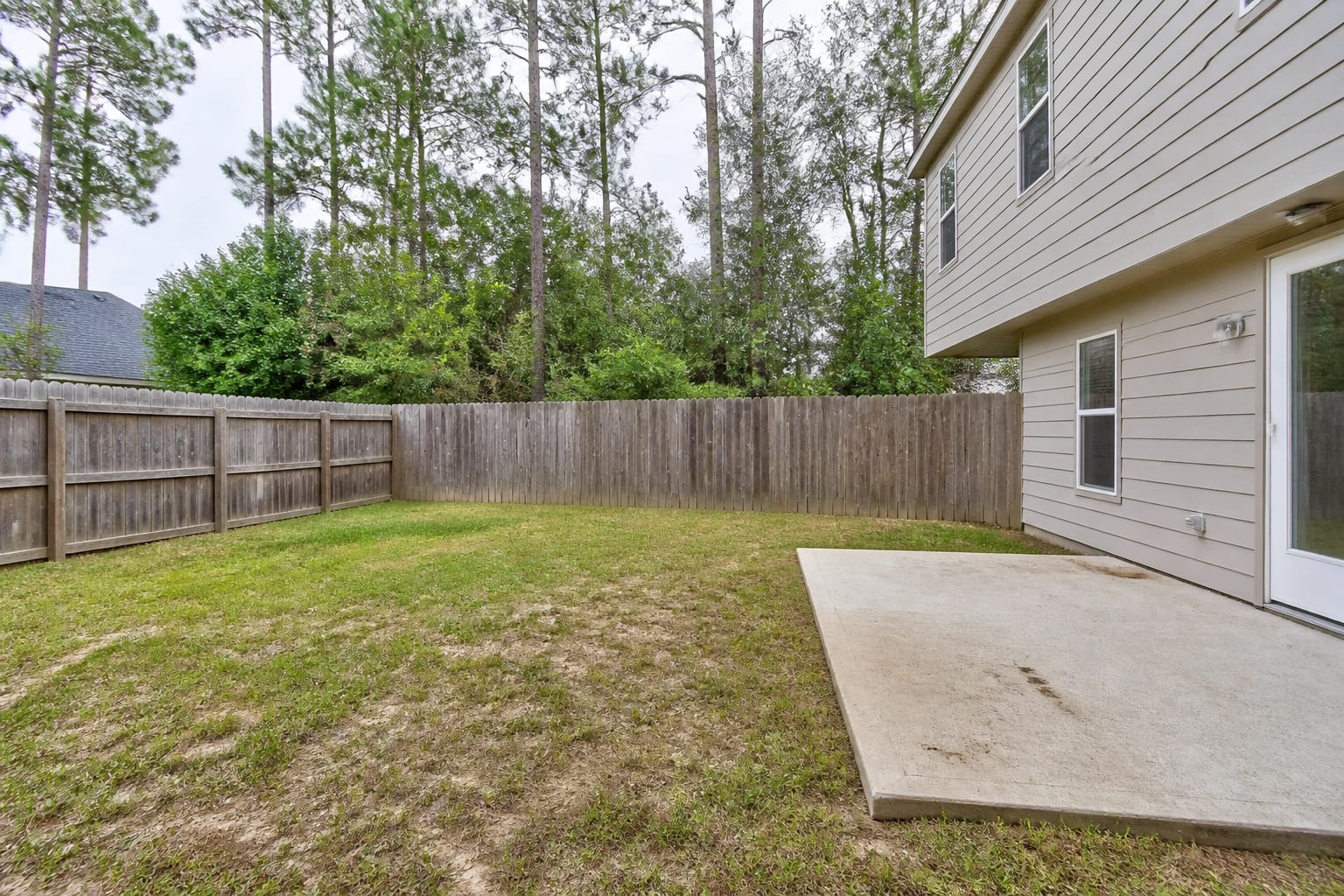
The number-one pre-purchase anxiety for most homeowners is whether the court will actually fit — and whether it will dominate the yard visually. Re-design.app answers both questions with a photorealistic render before you spend a dollar on concrete.
Upload a photo of your backyard and try one of these directions:
- Preview a full 30×60 ft court with blue-green acrylic surface and perimeter fencing
- See a driveway converted to a sport-tile pickleball court
- Visualize a multi-sport court with basketball and pickleball striping
The render shows you exactly how much yard remains, how the color palette reads against your house, and whether fencing will feel enclosing or open — all before any permitting or grading begins.
Frequently Asked Questions
How much does a backyard pickleball court cost?
A purpose-built backyard pickleball court costs $15,000–$45,000 fully installed with fencing, surface, and net. Converting an existing driveway or concrete slab with modular sport tiles runs $5,000–$10,000. Lighting, acoustic fencing, and multi-sport striping add to the upper end of either range.
What is the minimum backyard size for a pickleball court?
The official court is 20 × 44 ft, but the USA Pickleball-recommended total pad is 30 × 60 ft to allow safe out-of-bounds space. In a tight yard you can fit a functional layout in roughly 24 × 54 ft, though players will be close to the fence on baseline shots.
Do pickleball courts need a permit?
In most municipalities, yes. Courts are typically classified as hardscape or accessory structures and trigger setback, impervious-surface, and sometimes lighting permits. Check with your local building department and HOA before breaking ground.
Are pickleball courts loud for neighbors?
Paddle-on-ball noise is a documented neighbor concern — the high-frequency crack travels farther than most people expect. Solid acoustic fencing, vegetation buffers, court orientation, and low-noise paddle choices are the main mitigations. Agreeing on playing hours with adjacent neighbors before installation prevents most complaints.
Can you build a pickleball court on grass?
Grass is not a suitable base for a permanent court because it compresses unevenly and creates unpredictable ball bounce. You need a flat, compacted hard surface — concrete, asphalt, or compacted stone base under modular tiles. Some temporary pop-up tile systems can sit on firm, level grass for casual play, but they are not a substitute for a proper installation.