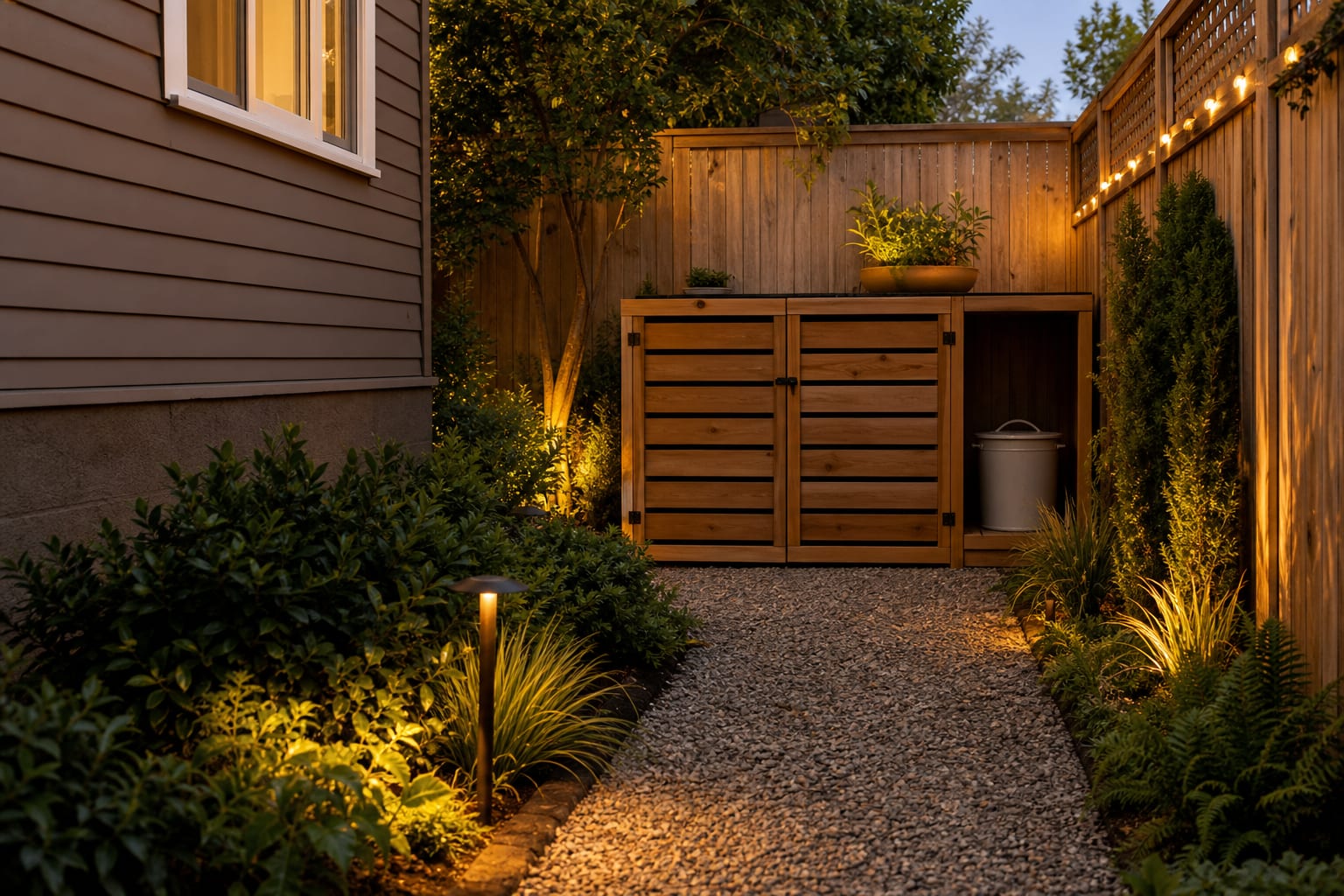
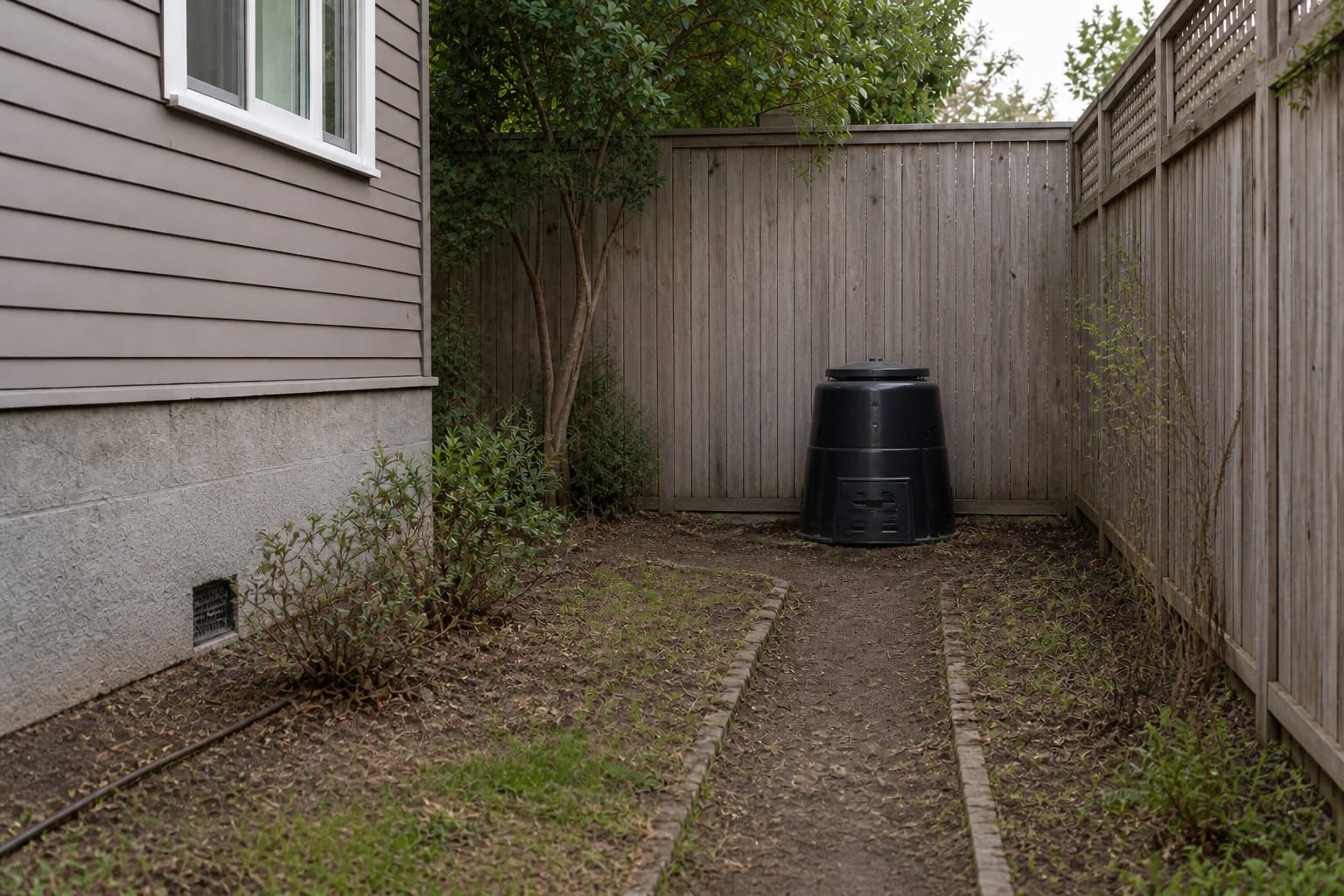
The best compost garden ideas put two or three timber-frame bays behind a slatted screen on a gravel pad, close to the vegetable beds but downwind of the patio, with a covered tool nook and a 3ft access strip for turning. Treat the bin as a service area with design standards, not a guilty corner behind the garage.
How do you hide a compost bin in a garden?
Hide a compost bin by placing it behind planting or a built screen, matching the enclosure to nearby materials, and leaving a clear 24 to 36 inch route so scraps, leaves, and finished compost move without a fight. A screen that looks discreet but requires stepping through wet borders will sit neglected by November.
Check sightlines from the kitchen sink, patio doors, main path, and any upstairs window first. The best spot sits just outside the main view, not at the farthest boundary, often behind a shed corner, along a side path, or at the back of a productive border where tools already live.
Keep the footprint honest: a single bin needs about 30 by 30 inches; a two-bay timber system runs 5 to 7 feet wide; a hot-composting bay works best near 3 feet by 3 feet by 3 feet. Leave 18 to 24 inches in front of the door for turning without scraping your knuckles.
Which compost bin design fits your garden?
Match the bin to how much material you generate, how visible the spot is, and how often you're willing to turn it.
| Compost setup | Best garden situation | Design spec to copy |
|---|---|---|
| Single lidded bin | Small gardens, rentals, low leaf volume | Set it on pavers or compacted gravel with 6 inches of free space around the base for airflow and cleaning. |
| Two-bay timber system | Vegetable gardens and regular lawn clippings | Build bays about 30 to 36 inches deep with removable front slats so finished compost is not trapped. |
| Three-bay compost area | Larger gardens with leaves, pruning, and food scraps | Use three 3 foot bays for active compost, resting compost, and finished material, with a 36 inch working strip in front. |
| Tumbler composter | Courtyards or paved service yards | Leave enough side clearance for the drum to rotate fully, and keep the handle reachable without stepping into planting. |
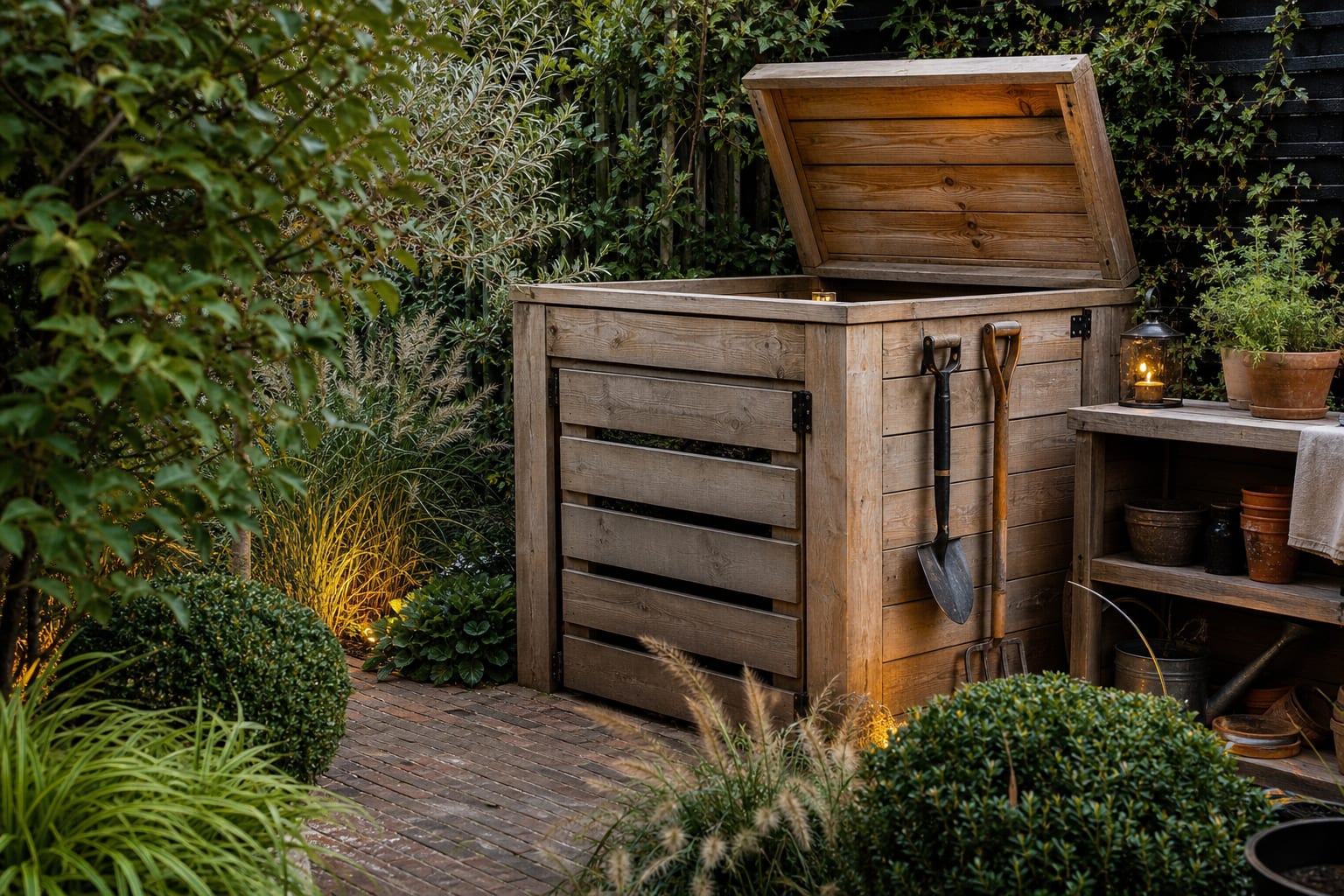
Timber is usually easiest to make attractive since the slat rhythm can echo fences or deck boards. Use 1/2 to 1 inch gaps for airflow; solid walls trap moisture and slow the process. Line inside corners with hardware cloth only if rodents are a concern.
Metal suits contemporary gardens with black windows or steel edging already in place. Choose a matte black or weathered galvanized finish with perforated panels for ventilation, not shiny thin panels that dent and glare.
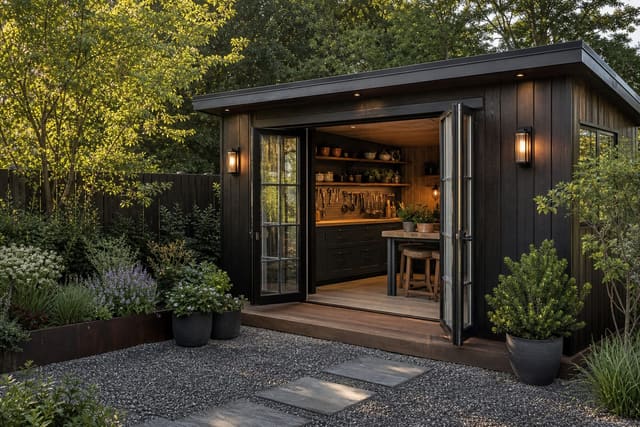
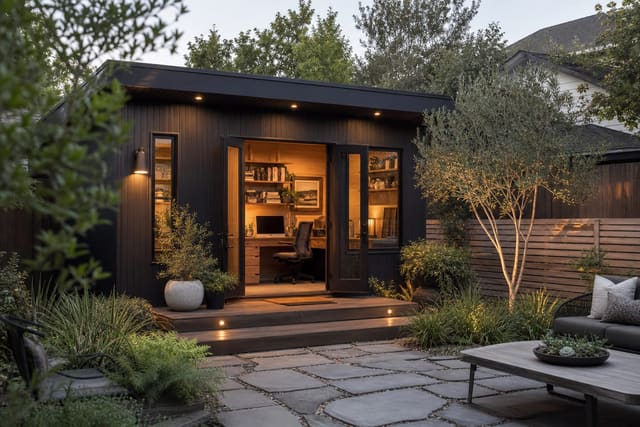
If the garden already has a shed or work table, cluster the compost area there. One practical object looks stranded alone, while a small working zone with paths and planting feels intentional, the same logic behind backyard office shed ideas that anchor a yard.
Test this on your own photo with ReDesign before choosing a direction. Keep the house edge, horizon line, hardscape, planting beds, and main path visible so the preview solves the space you actually have.
What planting and screening make compost feel intentional?
One tall shrub as disguise fails once the lid hits branches and the path disappears under wet foliage. Layer instead: evergreen for winter, airy texture, and a low working edge that stays visible.
- Build a slatted timber screen 4 to 5 feet high on the public side, running slats the same direction as nearby fencing.
- Plant an evergreen backbone 18 to 30 inches in front using compact box alternatives, dwarf pittosporum, euonymus, rosemary, or clipped yew.
- Add loose grasses or perennials 18 to 36 inches tall beside the path, not blocking the bin door.
- Lay a gravel or brick path at least 24 inches wide, widened to 36 inches where a wheelbarrow needs to pass.
- Add a 12 inch tool shelf or hook rail within arm's reach for a scrap bucket.
If the rest of the garden is meadowy, borrow from naturalistic planting design ideas: repeated grasses, umbel-shaped flowers, and seed heads blur the utility edge instead of a clipped green wall dropped into a wild border.
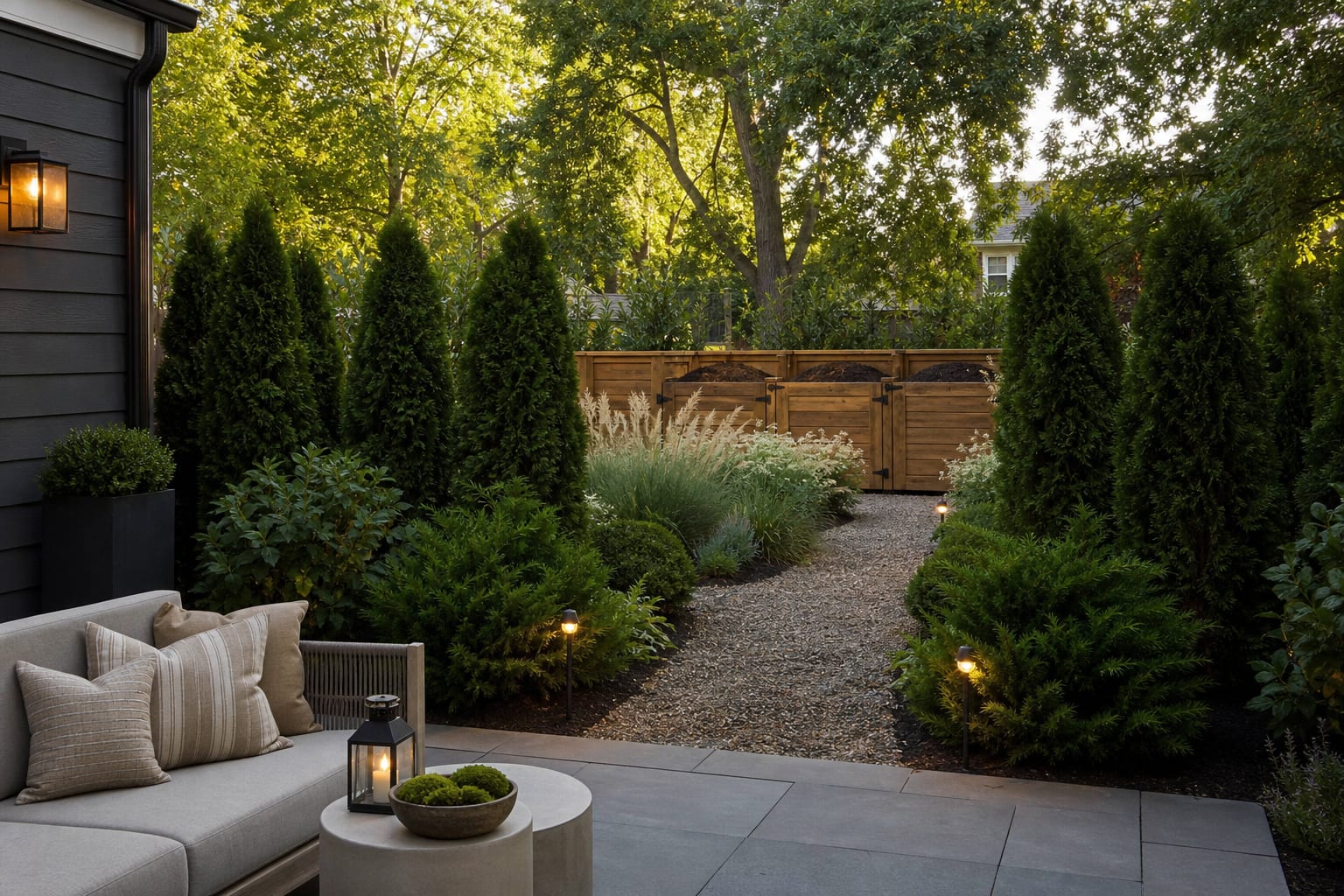
Skip theatrical lighting. A low, warm 2700K to 3000K fixture on the path is enough if scraps go out after dark; shield it away from the bin opening, per garden lighting design ideas.
Common compost garden mistakes
- Too far from the house. An 80-foot walk across slick winter grass kills the habit; move the bin closer to a hard path or add stepping stones at 24 inch centers.
- Sealed too tight. Compost needs air, and wrapping it in a solid box invites odor and makes turning harder. Use open slats, perforated metal, or woven willow.
- No exit plan. Choose a bin with a removable front panel or wide hatch big enough for a garden fork, and keep the landing area firm.
- Too close to seating. Turning days and flies are real even in a well-run bin, so keep a planted buffer between compost and any place people linger.
- Mismatched screening. A white vinyl panel beside brick and weathered timber draws more attention, not less. Repeat one existing material and let planting soften the rest.
Use AI design to preview your compost garden before you commit
Upload a straight photo of the corner, then test a timber two-bay composter, a slim black metal screen, and a planted willow hurdle from the same angle. Keep the prompt practical: a 36 inch gravel path, evergreen screening, a lidded bin, and wheelbarrow clearance. The preview won't judge your carbon-to-nitrogen ratio, but it will show whether the bin blocks the patio view or looks calmer shifted a few feet behind the shed line.
Frequently Asked Questions
How big should a compost area be?
Two to three 3x3x3ft bays work best for active turn-over composting: one bay receives fresh material, the next cures, and the third is ready to use. Below that footprint, the pile lacks the mass to heat up and the process slows considerably.
Where should compost bins be located?
Within 30 to 40 feet of the kitchen door for daily scrap drops, downwind of the patio and dining zones, and ideally within reach of a hose for moisture management. Closer and more convenient always beats farther and tidier.
How do I hide the compost bin?
Use a 5 to 6 foot slatted timber screen set 4 inches off the wall, add climbers like clematis or honeysuckle in front, and set the bin on a gravel pad. Done this way, the bin reads as a designed back-of-house feature rather than clutter.
Does compost smell?
Properly balanced compost, roughly 3 parts brown carbon to 1 part green nitrogen with weekly turning, doesn't smell beyond a fresh-earth note. An ammonia smell signals excess greens or insufficient air, and more turning or added dry material fixes it.
Tumblers or open bins?
Open timber bins suit serious gardeners with regular pruning waste; they hold more volume and produce richer compost. Tumblers suit kitchen-scrap-only users in tight urban gardens where space and easy rotation matter more than volume.
> Try this: Ready to see this on your own outdoor space? Open ReDesign and run the preview before you buy materials, plant, drill, or move furniture.
Three transformations to try
1. Three-bay timber compost with slatted screen 2. Compost area beside vegetable beds 3. Compost with tool nook and gravel pad