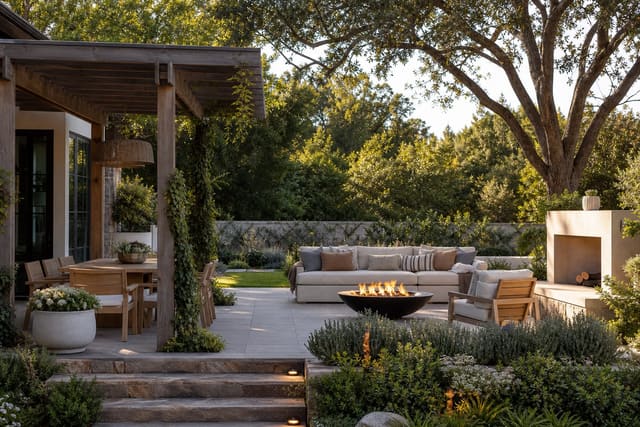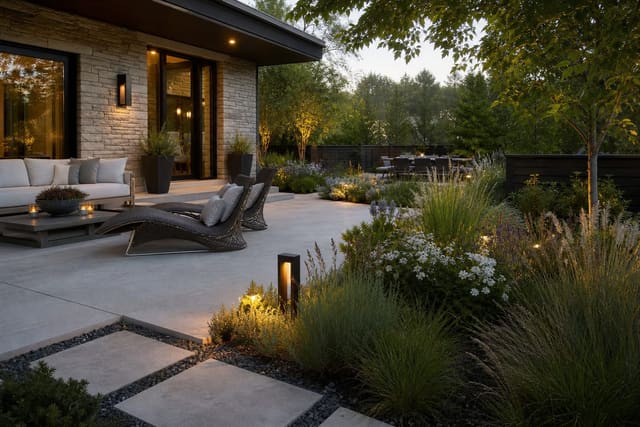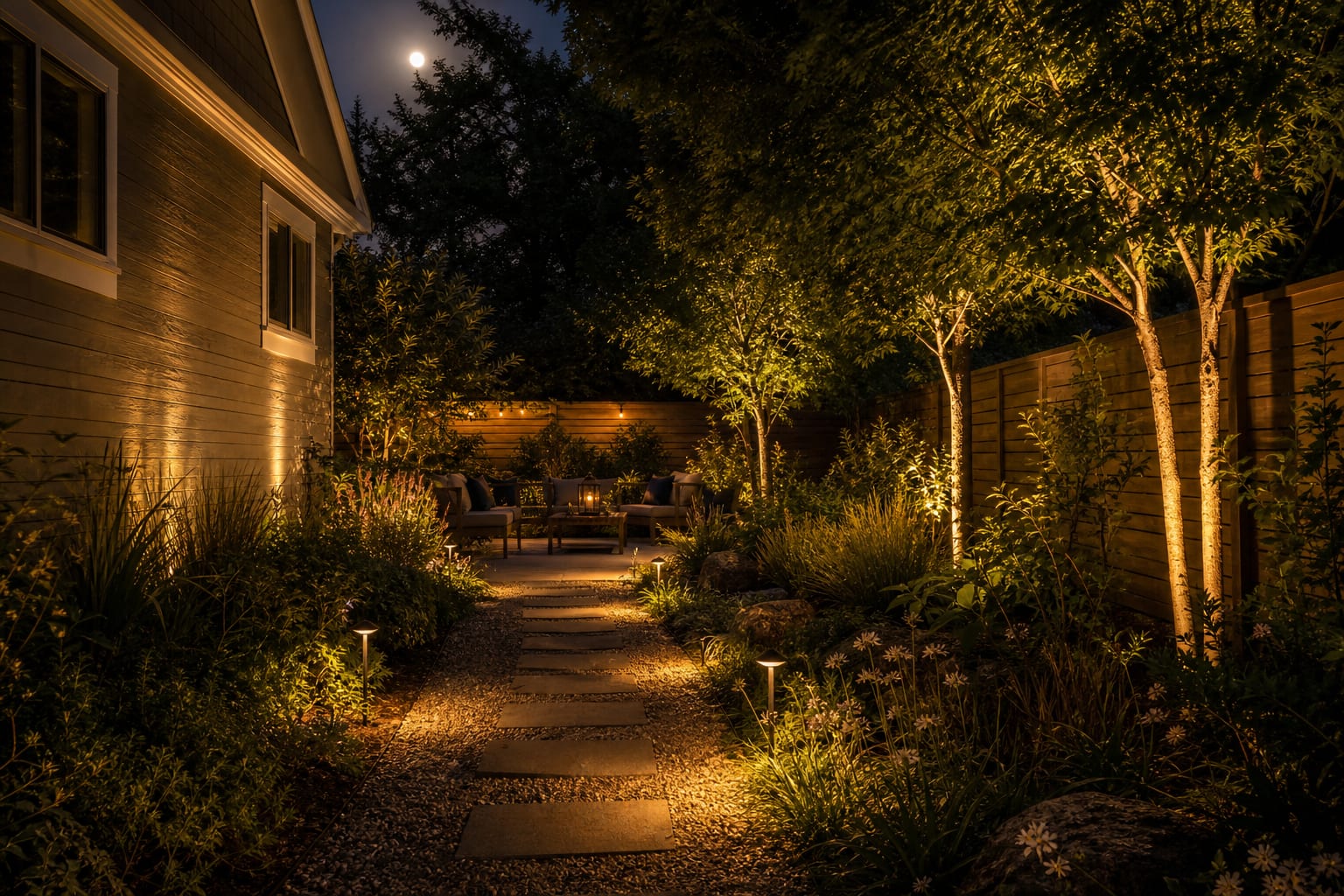
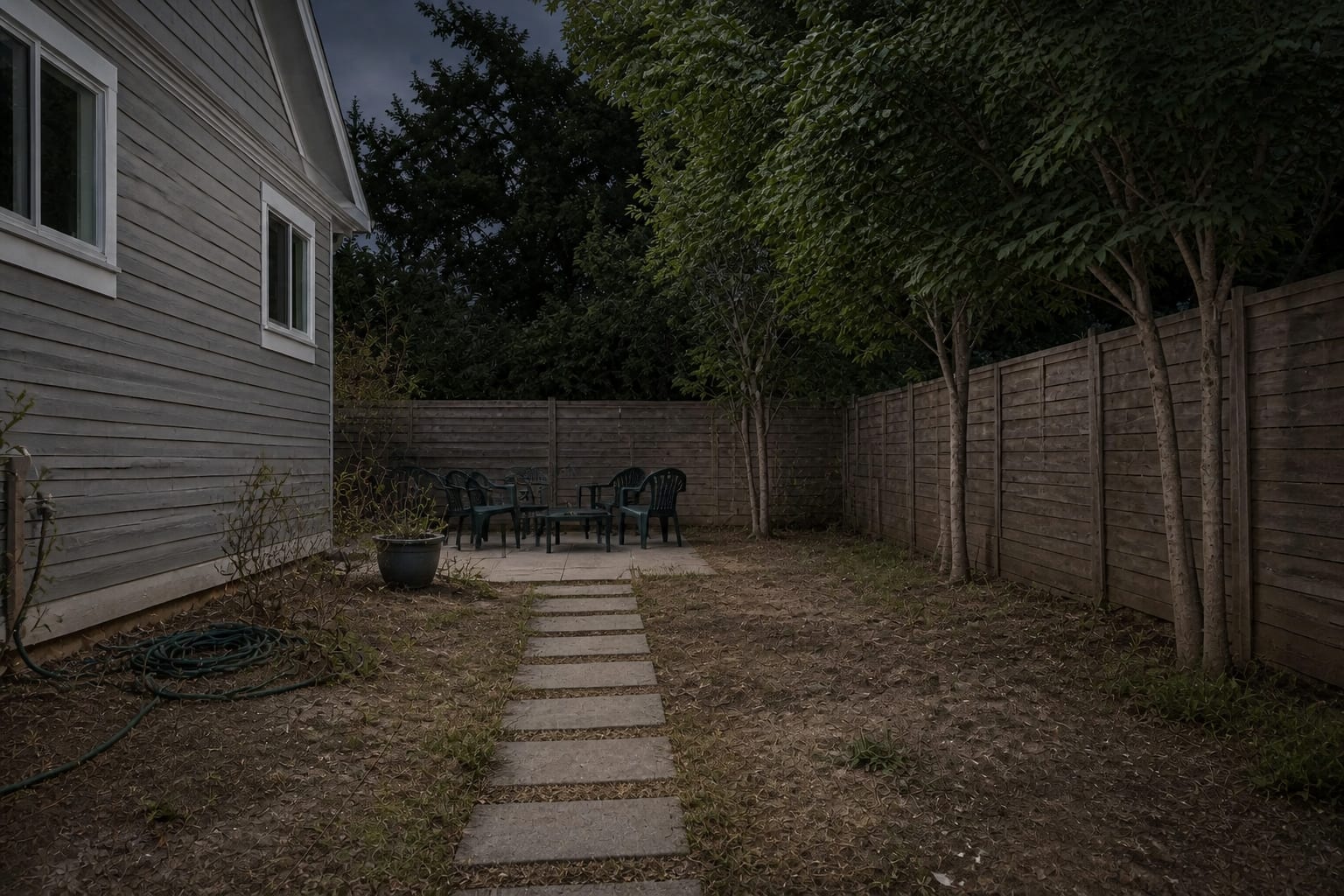
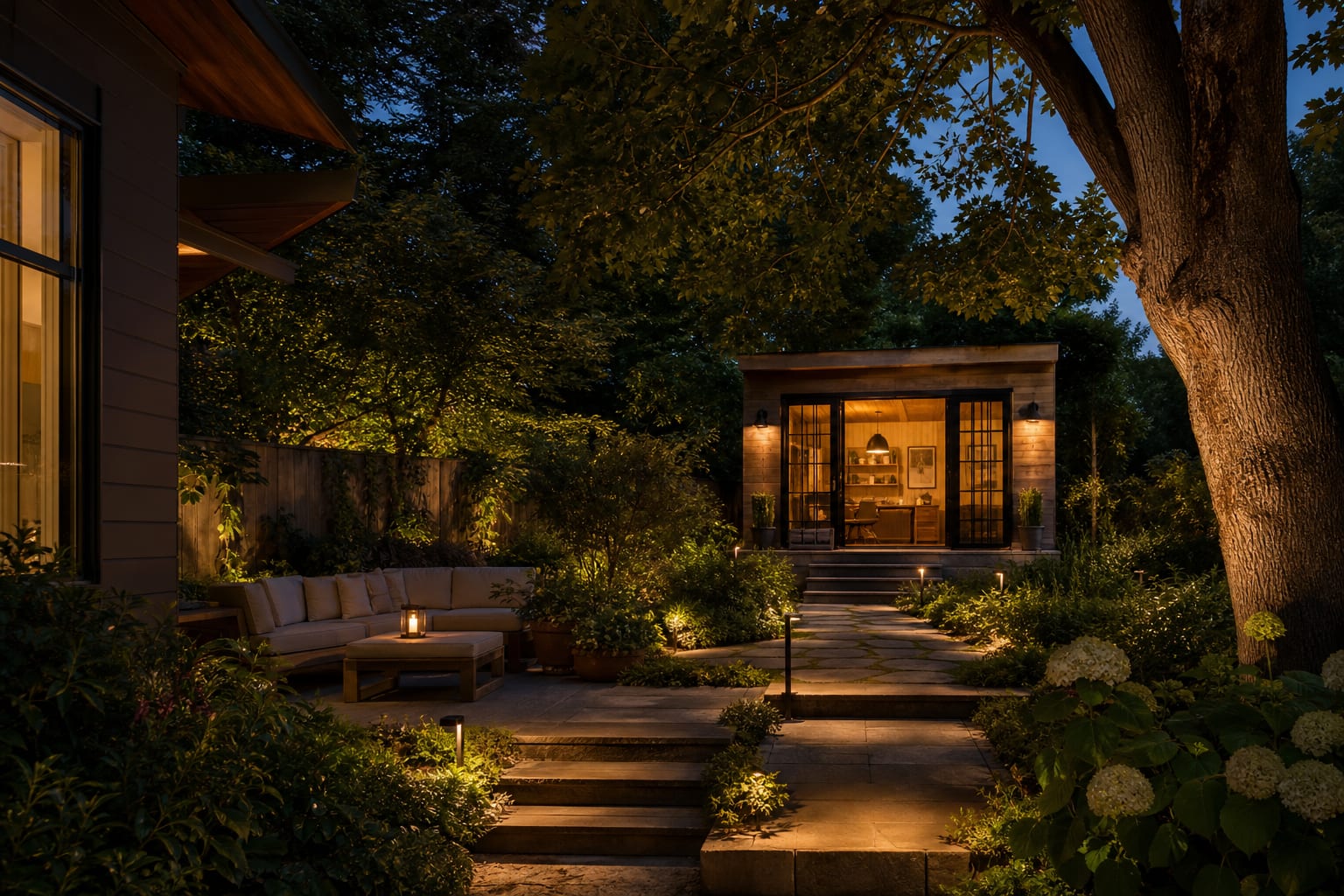
Garden lighting design works best in three layers: 2700K task lights on paths and steps for safety, 3000K accent uplights on trees and walls, and a cool 2900K moonlighting downlight mounted high in a tree for a dappled wash. Put every layer on dimmers and one astronomical timer. Most plans fail from too many bright fixtures and not enough darkness left to show them off.
How do I light a garden professionally?
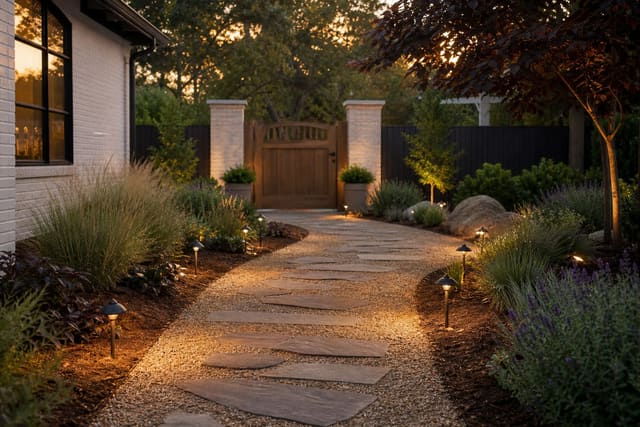
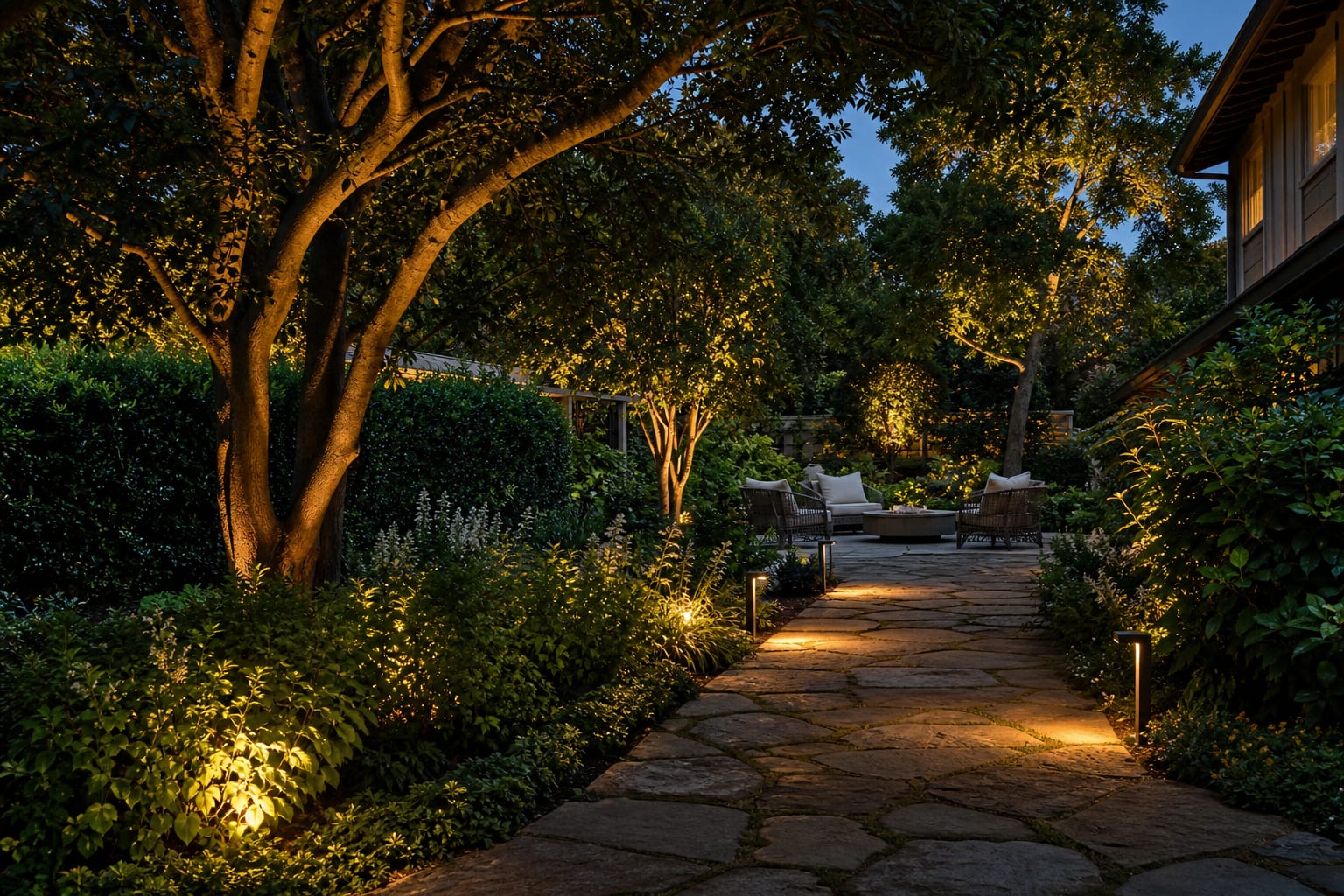
Build the plan in layers: low path lights for circulation, narrow uplights for trees, shielded accents for planting, and warm lamps throughout so the garden reads softly at night. Start with routes people actually use — back door to dining area, gate to trash enclosure, stepping stones to the shed. Those routes need enough light to show edges and level changes, not a runway of identical dots.
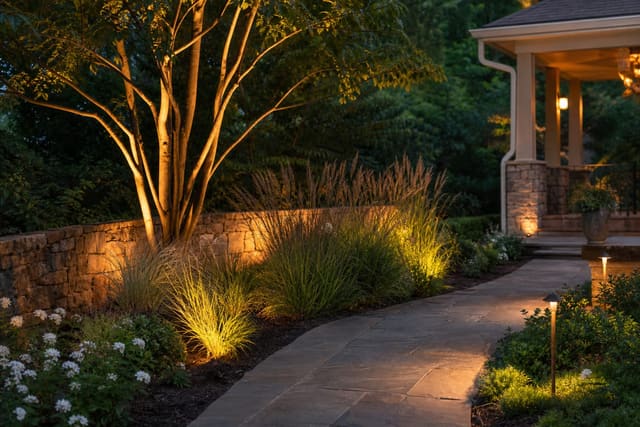
The second layer is vertical structure. One well-aimed uplight on a multi-stem tree usually beats five fixtures scattered through mulch. Place the fixture 12 to 24 inches from the trunk for bark texture, or 3 to 6 feet away for a wider canopy wash. Mature olives, Japanese maples, birches, and crape myrtles take narrow beams well; loose shrubs and grasses need softer side grazing.
The third layer is restraint. Leave some planting in shadow so lit elements have contrast; a garden with every bed edge glowing goes flat. Layered grasses, evergreen mounds, and seed heads catch light beautifully, especially with a daytime scheme that follows naturalistic planting design ideas instead of isolated specimen shrubs.
Test this on your own photo with ReDesign before choosing a final direction. Keep the house edge, horizon line, hardscape, planting beds, and main path visible so the preview solves the space you actually have.
Which landscape lighting techniques belong where?
Each fixture should have a job you can describe in one sentence. A professional plan often uses fewer fixtures than a DIY kit, placed more deliberately.
| Technique | Best use | Spec to start with |
|---|---|---|
| Path lighting | Steps, gravel walks, gate routes, bed edges | Low fixtures 18-24in tall, spaced 6-10ft apart |
| Uplighting | Trees, stone walls, pergola posts, sculptural shrubs | Place 12in to 6ft from subject, adjust beam after dark |
| Moonlighting | Branching trees above seating or paths | Mount shielded fixtures 15-25ft high, aim downward through foliage |
| Grazing | Textured masonry, fences, tall grasses, hedges | Set fixtures close to the surface so texture casts shadows |
| Silhouetting | Plants with strong outlines against walls or fences | Hide the light behind the plant, wash the background not the leaves |
- Use path lights only where feet need help; staggered lights on alternating sides beat a light at every stone.
- To uplight trees successfully, aim across the trunk rather than straight at the canopy so bark and branching read as dimensional.
- Try moonlighting only when the tree can hide the hardware, with a glare shield so light filters through leaves instead of into faces.
- Light seating from the edges, not the center — a shielded downlight, lantern, or nearby accent beats a fixture aimed at the middle of the table.
- Treat working zones (compost, potting, tools) with honest task light; the same discipline behind compost garden ideas that look intentional helps hide utility lighting from the patio view.
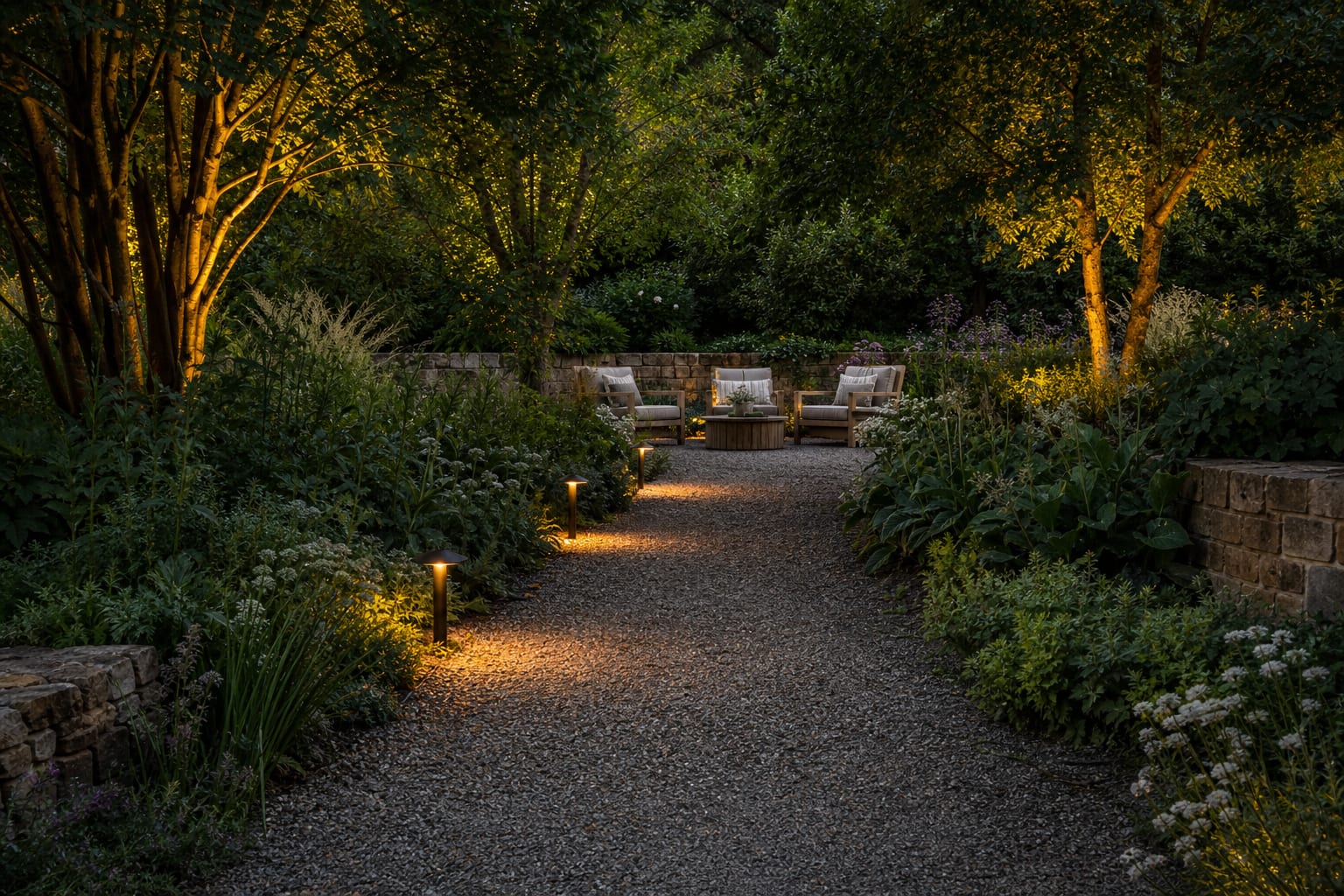
Controls matter as much as fixtures. A low-voltage transformer sized for total wattage, plus some spare capacity, beats a tangle of plug-in lights. Run cable along bed backs or hardscape edges before mulch hides the route, and confirm irrigation, drainage, and buried utilities before trenching.
What are the most common garden lighting mistakes?
The biggest mistake is using brightness to solve uncertainty. An overly bright fixture creates glare, flattens planting, and makes unlit areas feel darker by contrast. Start lower than you think, use shielded fixtures, and test at night before final aiming.
- Matching lights on both sides of a path feels stiff outside a formal entry. Stagger fixtures and let planting interrupt the rhythm.
- Spotlighting every tree makes a yard look busy. Light two or three trees from the main viewing areas and let the rest sit in shadow.
- Ignoring glare from inside the house is caught too late. Check the kitchen sink, sofa, and bedroom window after dark; if you see the bulb rather than the effect, add a hood or move the fixture.
- Relying on solar stakes for a serious plan. They suit temporary routes, but inconsistent output and cool color scatter the look; wired low-voltage fixtures give better long-term control.
- Forgetting plant growth. A fixture 8 inches from a young grass can vanish by midsummer. Leave service gaps and revisit aiming after spring growth and after leaf drop.
How can AI preview my garden lighting before I commit?
Night choices are hard to imagine from a daytime plant bed, which is where an AI preview helps. Upload a clear photo from the patio, back door, or main window, then test directions before buying fixtures or trenching cable. Keep prompts specific: warm path lights along the gravel walk, narrow uplights on the birch trunks, soft moonlighting from the oak, no floodlight on the fence.
Use the preview to compare a tree-focused scheme against a path-focused one, or to check whether seating needs a lantern, sconce, or hidden downlight — not to replace the electrician. Include any studio, greenhouse, or shed in the photo; the sightline discipline behind backyard office shed ideas helps lighting connect an outbuilding instead of stranding it in darkness.
A dusk photo shows shadow and existing house light; a daylight photo shows plant structure and fixture locations. Ask for fewer lights than you think you need, then add one layer at a time. A harsh preview will look harsher on wet leaves, pale paving, or a white fence.
Frequently Asked Questions
What's the difference between path lighting and accent lighting?
Path lights deliver safe circulation using 2700K shielded fixtures 12-18in tall. Accent lights highlight trees, walls, or sculpture with directional spots aimed at the feature, not the viewer.
What is moonlighting in garden design?
Moonlighting is a downlight mounted 15-25ft up in a tree that casts a soft dappled pattern through branches onto the ground below, mimicking real moonlight. It's the most romantic technique in landscape lighting.
How many lighting layers does a garden need?
Three: safety (paths and steps), accent (trees, walls, sculpture), and ambient (moonlighting, downlit dining, perimeter glow). Put each on a separate dimmer so you can combine layers for different moods.
Are LED lights bright enough for a garden?
Yes. Modern landscape LEDs from 4-15W replace legacy 20-50W halogen fixtures one-for-one, draw less wire and transformer capacity, and last 25,000-plus hours.
How is garden lighting controlled?
An astronomical timer or smart relay triggers lights at sunset and shuts them off at a fixed hour, commonly 11pm to 1am. Manual switches at the patio door can extend or end the evening as needed.
> Try this: Ready to see this on your own outdoor space? Open ReDesign and run the preview before you buy materials, plant, drill, or move furniture.
Three transformations to try
1. Garden with path, accent, and moonlighting layers