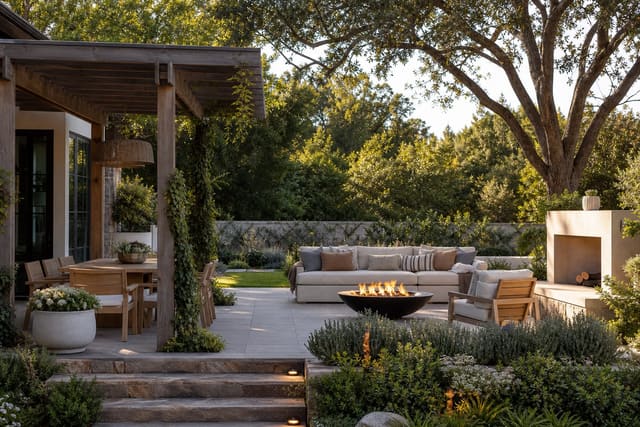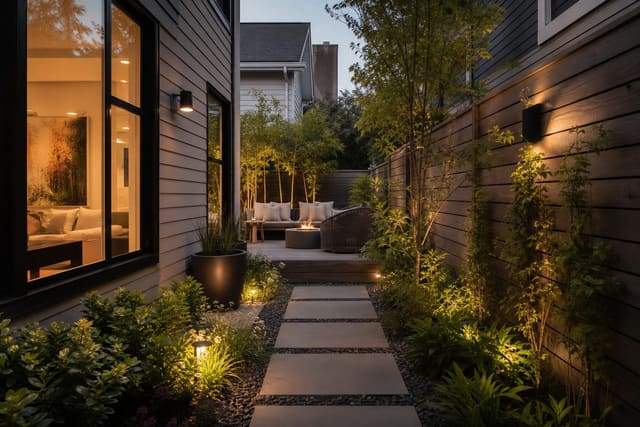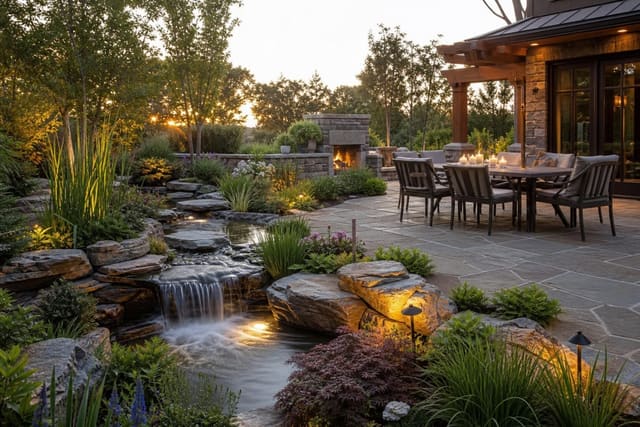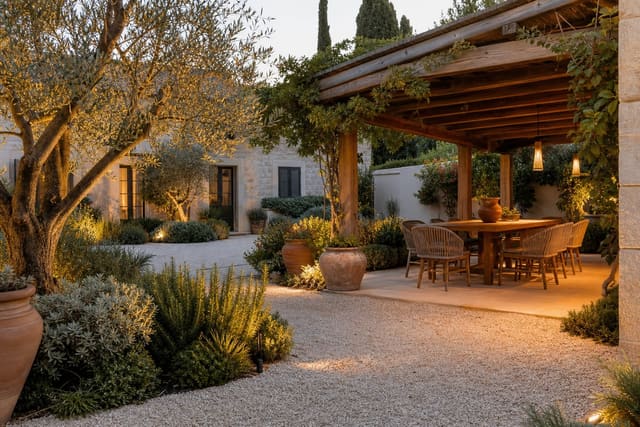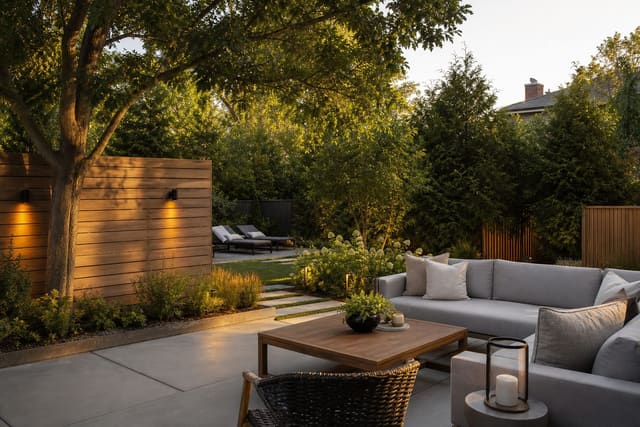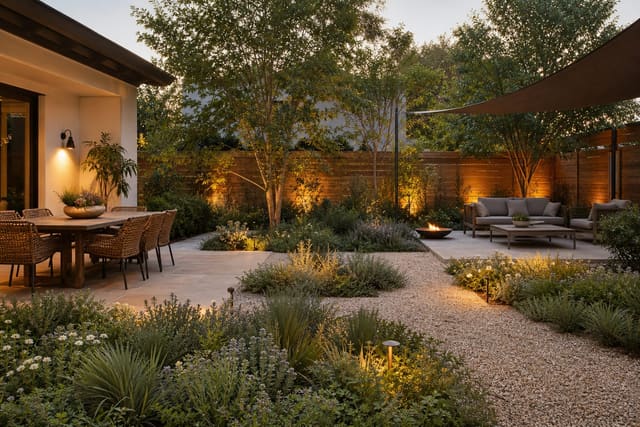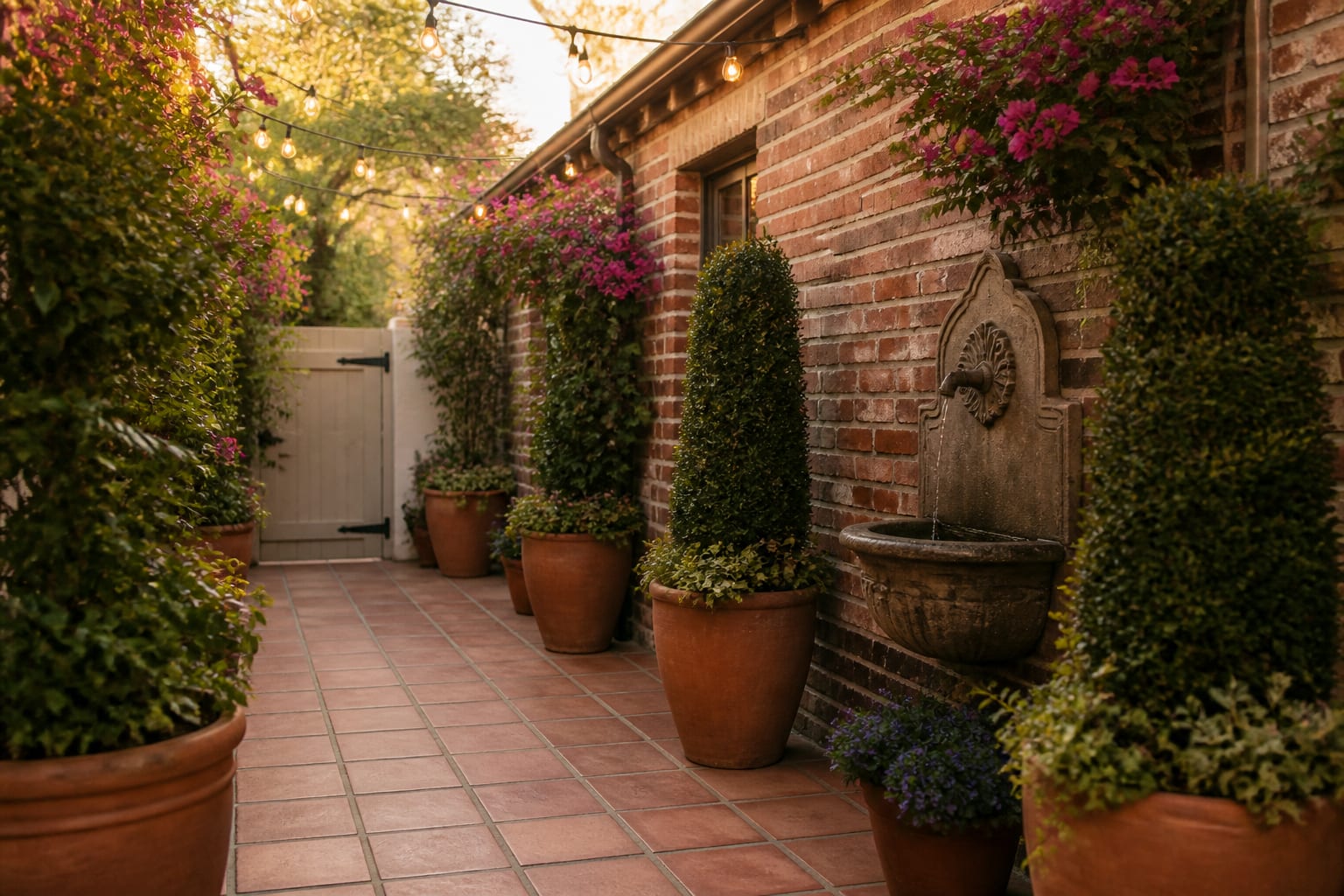
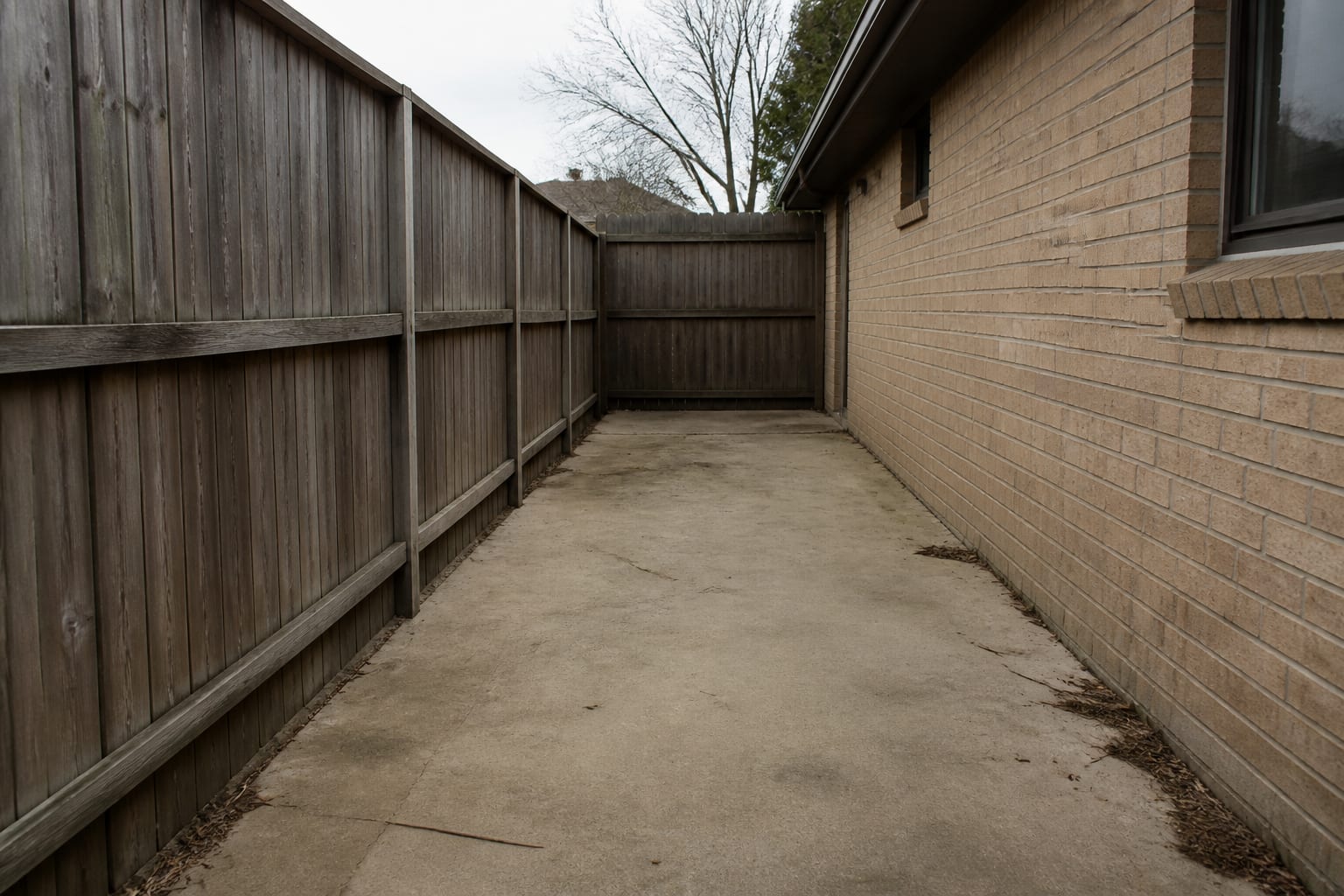
A courtyard is an enclosed or semi-enclosed outdoor room bounded by walls, fencing, hedges, or the structure of the home itself. It delivers privacy, wind protection, and an interior-like sense of enclosure that open yards cannot match — and it is the defining outdoor form of Spanish, Mediterranean, Moroccan, and modern minimal architecture worldwide.
What exactly is a courtyard, and how is it different from a patio?
A courtyard is defined by enclosure, not surface material. A patio is simply a paved area adjacent to the house; a courtyard is a room-like outdoor space where walls, fences, hedges, or the building's own wings wrap around you on at least two to three sides. That enclosure creates a microclimate — wind drops, ambient heat stays, and the psychological sense of shelter rises sharply. A patio faces outward; a courtyard turns inward. That distinction drives every design decision that follows: scale, planting density, lighting approach, and focal-point placement all behave differently when the space has walls.
Historically, the courtyard form appears across Mediterranean Europe, North Africa, the Middle East, and East Asia — each culture solving the same problem of privacy and thermal comfort through enclosure. In contemporary American residential design the form is strongest in the Southwest and California, but demand is rising in every region as homeowners prioritize privacy over openness.
How do you design a small courtyard from scratch?
Start with the enclosure, not the furniture. Before choosing a single plant or paving stone, establish what will form the walls: an existing fence heightened with a trellis panel, poured-concrete or CMU walls, a clipped hedge of arborvitae or bamboo, or the L- or U-shape of the house itself. Once you can feel the enclosure on paper, move to the four decisions that govern all small courtyard design:
1. Entry and circulation. A courtyard needs an entry moment — a gate, a threshold step change, an arbor — that signals you are passing from outside into a room. Circulation inside should be clear but not rigid; leaving room to move around the focal point prevents the space from feeling cramped.
2. Focal point. Every successful courtyard has one dominant feature that the eye goes to first. Common choices: a wall fountain with the sound of moving water, a fire bowl or slim gas fire column, a mature specimen tree in a large container, or a tiled feature wall. One strong focal point beats three competing ones.
3. Paving. The floor of a courtyard is proportionally much larger than a border garden, so material choice matters enormously. Spanish- and Mediterranean-style courts lean on terracotta tile, Zellige, and irregular limestone. Modern minimal designs use large-format concrete pavers or pale quartzite. Japanese-influenced courts use raked gravel with stepping stones. Herringbone or basket-weave brick reads as traditional and works in cottage and Colonial contexts.
4. Layers of greenery. Wall-trained vines (jasmine, bougainvillea, climbing roses) and tall containers provide the vertical layer. Mid-sized pots with architectural plants — agave, olive, bay laurel, clipped boxwood — hold the middle. Ground-level planting or low creeping ground covers soften edges. Even a ten-foot-square space can sustain three full layers.
What should you put in a courtyard?
The contents of a courtyard divide neatly into four categories, and the best designs include at least one strong element from each.
Water. A wall-mounted or freestanding fountain is the single most requested courtyard feature, and for good reason: the sound of moving water masks street noise, adds coolness in warm climates, and delivers a sensory richness that no plant can replicate. Wall fountains require only a modest pump and a water line or bucket-filled basin; recirculating systems are straightforward to install.
Fire. A slender gas fire column, a chiminea, or a small fire bowl gives a courtyard an evening anchor. Because courtyards are often wind-sheltered, fire performs better here than in open yards. Check local codes on open flame in enclosed spaces before selecting.
Plants. Container planting dominates because in-ground soil may be absent or poor. High-impact container choices include olive trees, standard bay laurel, clipped myrtle topiaries, Moroccan or Italian cypress in terracotta, bougainvillea trained to a post, and seasonal annuals for color rotation.
Shade structure. Pergolas, shade sails, a mature specimen tree, or a simple canvas umbrella prevent a stone-paved courtyard from becoming a heat trap. A pergola draped with wisteria or climbing roses creates filtered shade while adding an overhead architectural layer that reinforces the sense of room.
What are the main courtyard styles, and which fits your house?
Style alignment with the architecture of the home matters more in courtyards than in open gardens because the space is so intimate and enclosed. A jarring style mismatch reads immediately.
| Style | Key Materials | Signature Plants | Best Suit | |---|---|---|---| | Spanish / Mediterranean | Terracotta tile, wrought iron, whitewash | Bougainvillea, citrus, rosemary | Stucco, adobe, Mission-style homes | | Moroccan | Zellige tile, carved plaster, mosaic | Palms, jasmine, herbs | Eclectic, bohemian, or Spanish Colonial | | Japanese Zen | Raked gravel, flat stone, bamboo screen | Japanese maple, moss, black pine | Modern, craftsman, or any neutral exterior | | Modern Minimal | Large-format concrete, Cor-Ten steel | Agave, ornamental grasses, single olive | Contemporary, flat-roof, or industrial homes | | Cottage / English | Brick, reclaimed stone, painted timber | Climbing roses, lavender, foxglove | Traditional, Colonial, or farmhouse exteriors |
How do you make a courtyard private enough?
Privacy in a courtyard is a layered achievement. Start with height: walls or fences at six feet provide legal and visual separation from neighbors at grade; eight feet eliminates most sightlines. Where codes cap fence height, a trellis panel topped with trained evergreen vine — star jasmine, climbing hydrangea, English ivy — adds another two to three feet of living screen without requiring a permit in most jurisdictions.
For overhead privacy from second-story neighbors or upper apartments, a pergola canopy, shade sail, or dense overhead vine cover is the answer. Wisteria, grape, and hops are fast-growing options that create dense leaf cover within two to three seasons.
The third layer of privacy is acoustic: water features, careful lighting (which draws the eye inward rather than outward), and dense container planting all reduce the psychological permeability of the space even where a physical gap exists.
How much does a courtyard cost to build?
Cost varies enormously based on whether you are enclosing a raw side yard from scratch or enhancing an existing paved area. The table below reflects typical professional installation ranges; DIY approaches reduce labor by a significant margin.
| Scope | Estimated Range | What's Included | |---|---|---| | Basic refresh (existing paved area) | Low to mid thousands | Containers, plants, lighting, small fountain | | Mid-range new build | Mid to upper tens of thousands | New paving, wall or fence enclosure, pergola, basic irrigation | | Full custom courtyard | Upper tens of thousands and above | Custom masonry walls, water feature, premium tile, built-in seating, professional lighting | | DIY weekend courtyard | A few hundred to low thousands | Gravel, pavers from a home center, containers, solar lighting |
Note: the brief for this topic does not provide specific dollar figures, so ranges are kept qualitative above. Your landscaper or mason can produce an itemized quote once the enclosure material and square footage are fixed — those two variables drive the bulk of the cost.
What are the right dimensions and clearances for a courtyard?
A courtyard does not need to be large to function well. The minimum usable footprint for a seating group is roughly eight by ten feet of clear paving — tight but workable with scaled-down furniture. A comfortable conversational grouping needs twelve by fourteen feet or more. Side yards that are five to six feet wide are better treated as passage courtyards (stone path, wall planting, lighting) than as social spaces.
Clearances to keep in mind: - Gate width: 36 inches minimum for furniture delivery; 48 inches preferred. - Furniture clearance: 24–30 inches between chair backs and adjacent walls. - Fountain setback: A recirculating wall fountain can sit flush to the wall; freestanding basins need at least 18 inches of clear circulation around them. - Pergola height: 8 feet minimum clear height under the beam; 9–10 feet feels generous and allows climbing vines to develop without crowding the space. - Planting bed depth: 18–24 inches minimum for perennials in raised beds; containers can be smaller but benefit from the largest practical pot size to reduce watering frequency.
How can you preview a courtyard design before you build?
The clearest way to test a courtyard transformation before committing to masonry or fencing is to upload a photo of your current space to [Re-Design](https://re-design.app) and describe what you want. The AI renders a photorealistic version of your actual yard or side yard in seconds.
Try prompts like: - Spanish courtyard with terracotta tile, wall fountain, and bougainvillea - Modern minimal courtyard with concrete pavers, agave, and Cor-Ten steel screen - Moroccan courtyard with zellige tile, potted palms, and string lights overhead
Being able to see your actual walls, fence lines, and proportions reflected in the render — rather than a stock photo of someone else's yard — is what makes the tool genuinely useful at the design-decision stage. You can test paving patterns, enclosure height, and plant scale before a single dollar is spent.
Frequently Asked Questions
What is the difference between a courtyard and an atrium?
A courtyard is an open-air enclosed space at grade level, typically accessible from the interior through a door or gate. An atrium is an enclosed, roofed space inside a building, often with a skylight. Both offer a sense of interior shelter, but courtyards are outdoor rooms; atriums are interior rooms with natural light. In residential design the terms are sometimes used loosely, but the functional distinction — roofed vs. open-sky — is what matters.
Can I build a courtyard in a narrow side yard?
Yes, and side yards are among the most compelling courtyard conversions. A five- to six-foot side yard works best as a passage courtyard: a stone or gravel path with wall-trained plants, sconce lighting, and a gate at each end that creates the impression of moving through a garden room. For a social courtyard you generally need eight feet of clear width to seat two people comfortably with circulation on both sides.
Do courtyards work in cold climates?
Yes. The enclosure that defines a courtyard also moderates temperature, often making it measurably warmer than surrounding open areas in shoulder seasons. Deciduous vines and trees drop their leaves to allow winter sun; evergreen hedges retain their screening value year-round. Container plants are simply moved inside before frost, and a fire feature extends comfortable use into cool evenings in any climate.
What paving material is best for a courtyard?
There is no single best material — the right choice aligns with your home's architecture and your maintenance tolerance. Terracotta tile is beautiful and evocative but requires sealing in wet climates. Large-format concrete pavers are durable, low-maintenance, and increasingly available in high-quality finishes. Flagstone is versatile and ages gracefully; brick is traditional and handles cold climates well. For any enclosed courtyard, avoid very dark surfaces in full-sun exposures — they absorb heat and create a less comfortable space.
How long does it take to build a courtyard?
A basic container-and-lighting refresh of an existing paved space can be completed in a weekend. A full courtyard build involving new paving, a fence or wall enclosure, and a water feature typically takes a professional crew two to four weeks once permits are in hand and materials are delivered. Planning and permit timelines vary by municipality and add lead time before construction begins.