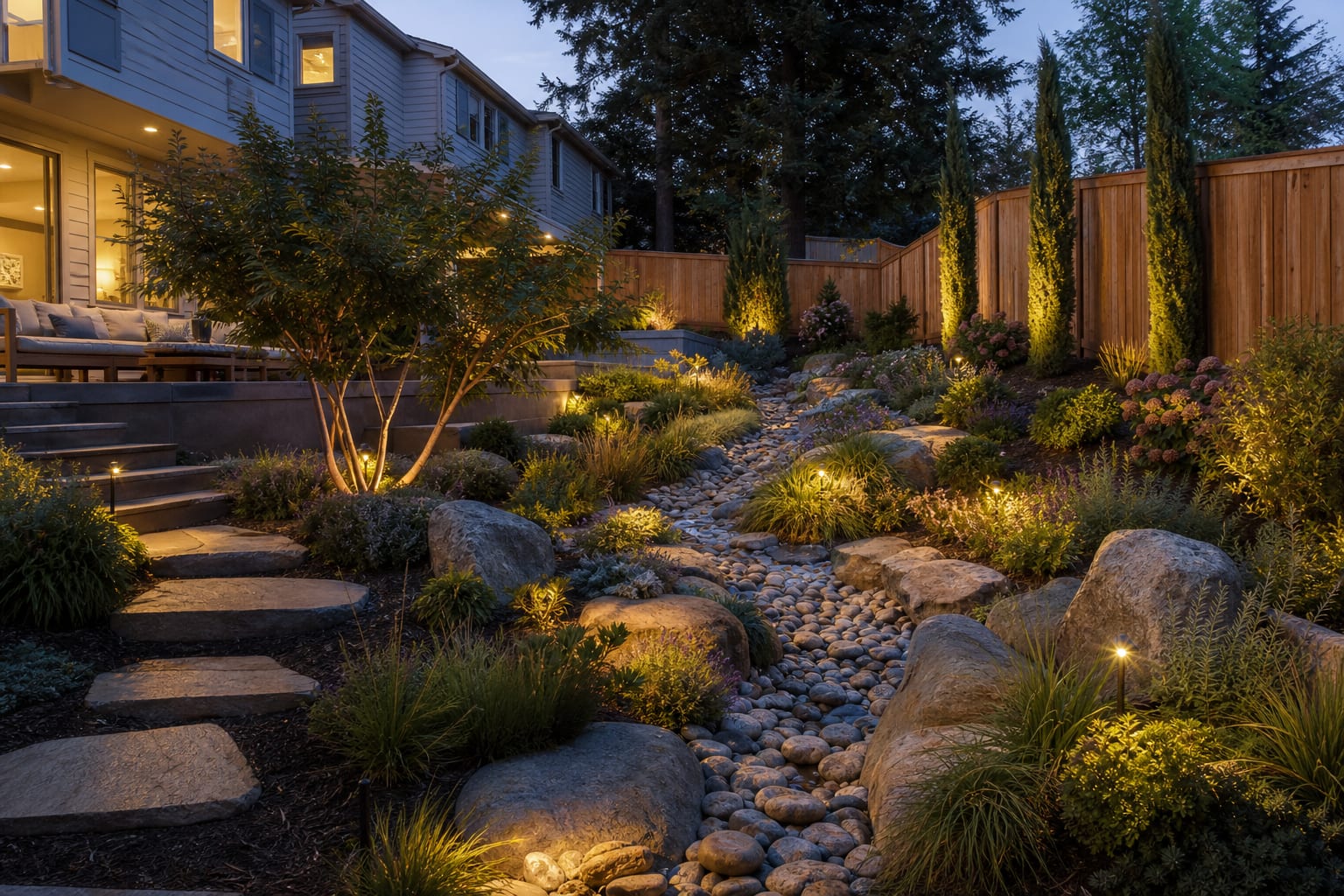
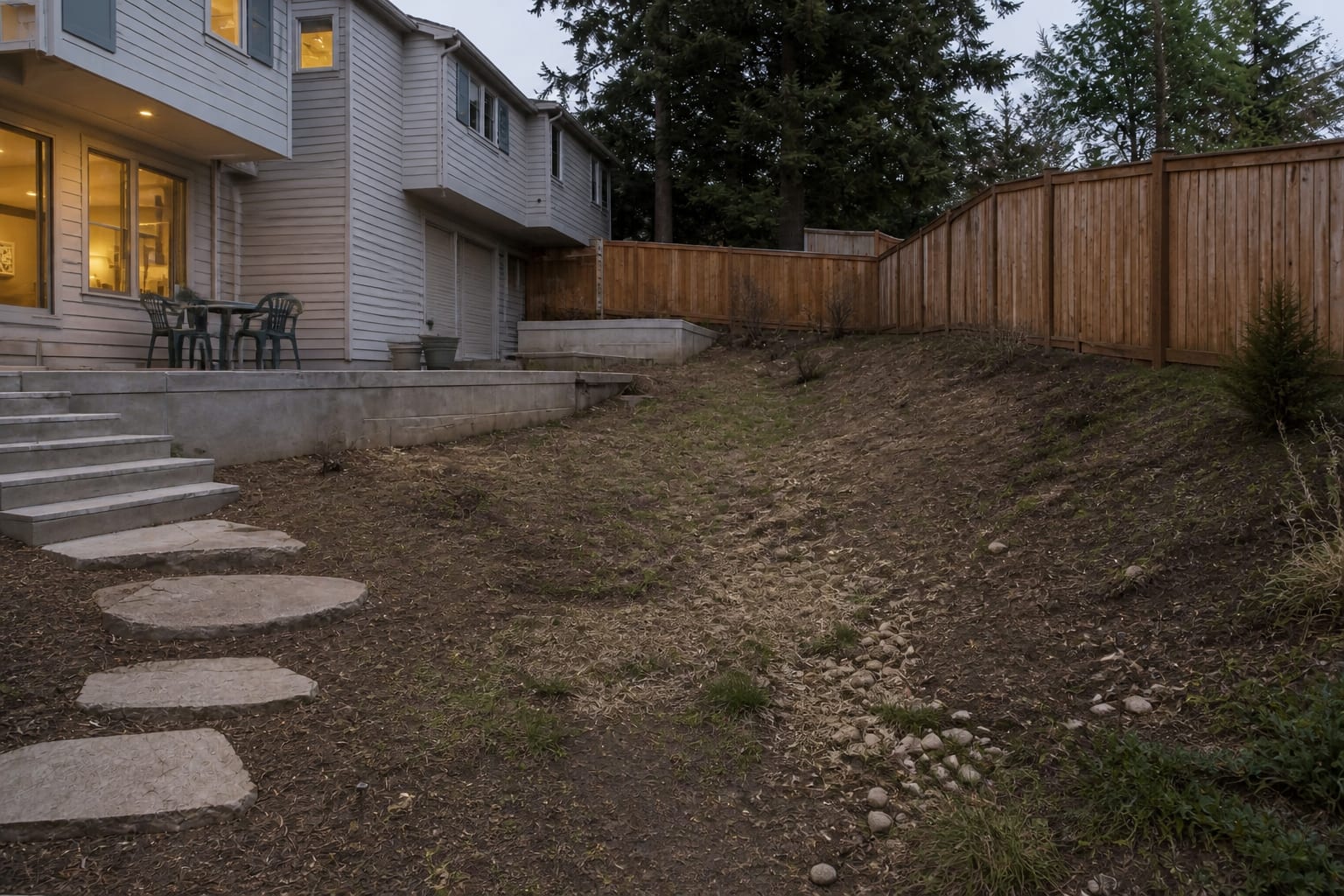
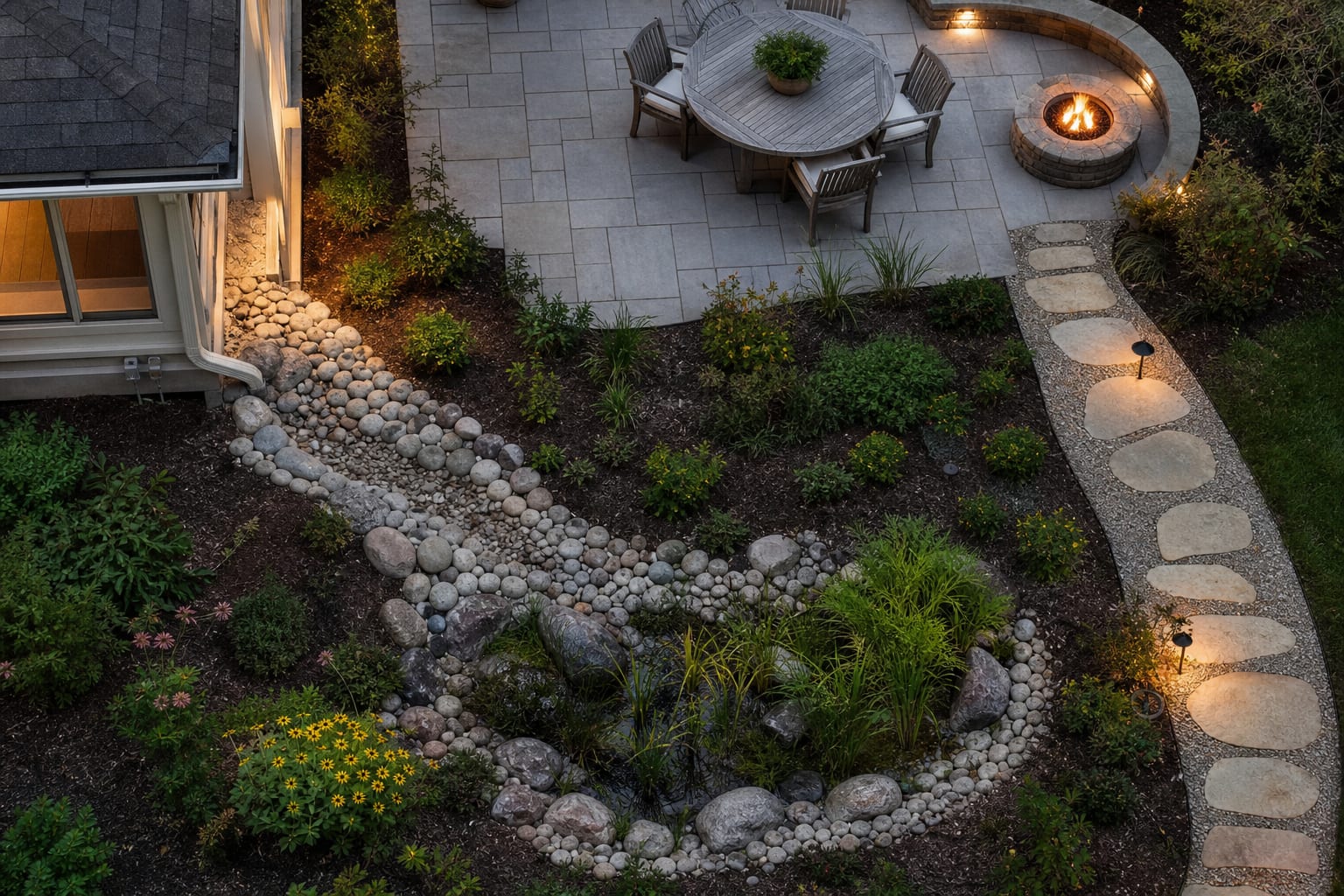
A dry creek bed drains well and looks natural when the channel runs twice as wide as it is deep, follows the yard's low line in a gentle S-curve, layers mixed stone over landscape fabric, and empties into a real outlet. Get the slope and stone mix right first; the rustic look follows once the drainage logic works.
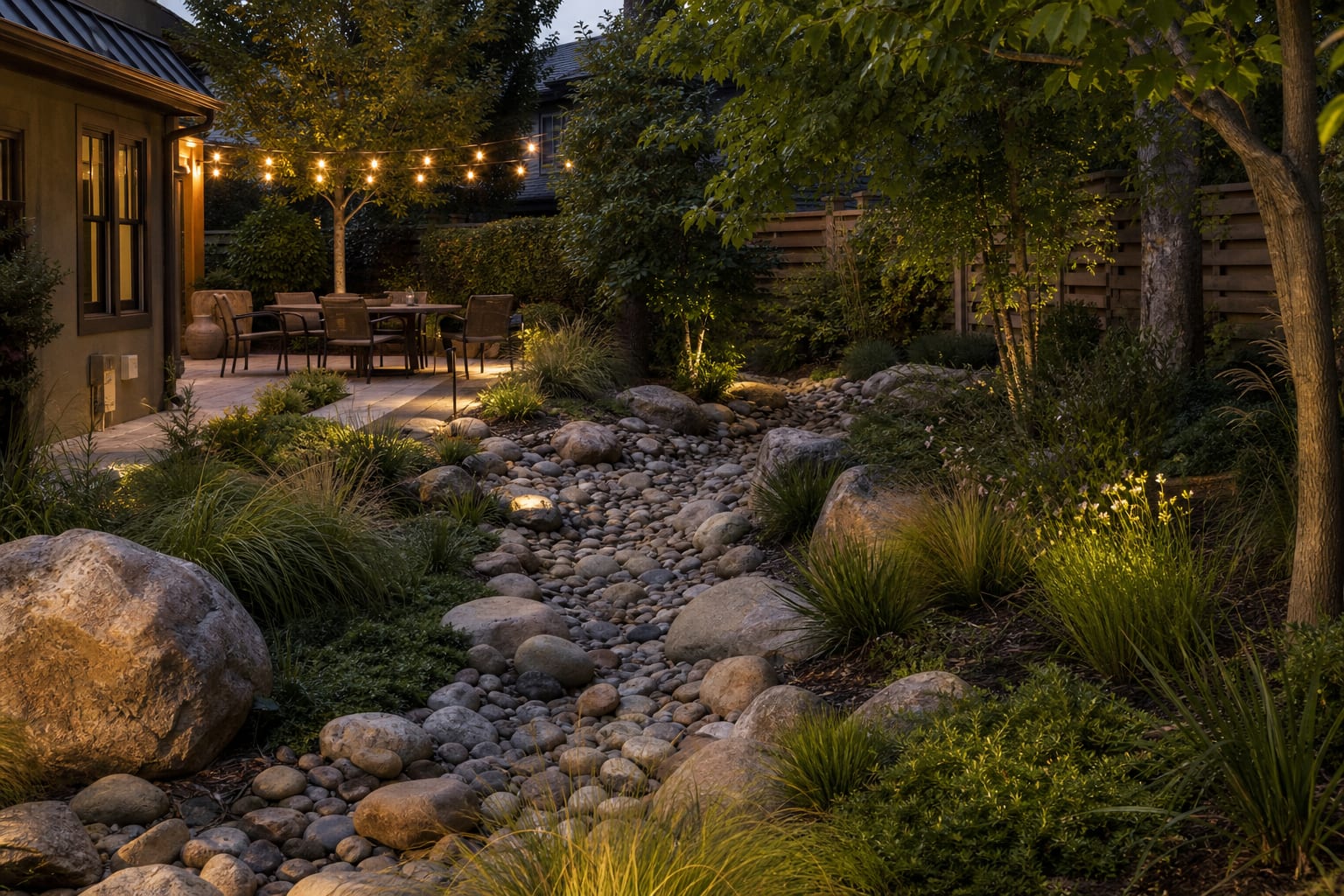
How do I build a dry creek bed that actually drains?
Start at the problem: a downspout, a patio edge, a driveway runoff point, or a high-side slope sending water into planting beds. Line a shallow, sloped channel from that source to a safe outlet with fabric, then layer varied rock sizes so water moves without the bed looking like a trench. In small gardens, plan for 18 to 36 inches of width and 3 to 6 inches of depth at the edges, going deeper only where you need to collect short bursts of water.
Aim for a fall of about 1% to 3% where the site allows — a 1 to 3 inch drop over 8 feet. Steeper beds need more boulders and check stones to slow water; flatter beds need a cleaner outlet so water doesn't linger in the middle.
| Creek decision | Better choice | Why it works |
|---|---|---|
| Stone mix | 3/8 inch gravel, 1-3 inch river rock, and 8-18 inch accent boulders | Real streambeds mix sizes, and varied stone locks together better in rain. |
| Fabric | Nonwoven landscape fabric under the stone | Separates rock from soil while still letting water pass through. |
| Edge shape | Irregular, planted edges instead of a perfect ribbon | Soft edges read as landscape, not a construction line. |
| Outlet | Daylight, rain garden, dry well, or approved storm connection | A creek that just moves water to a new puddle hasn't solved the yard. |
Which creek shape looks natural instead of fake?
Let the creek begin where water visibly arrives, widen slightly at bends, narrow through planted sections, and disappear into a lower garden area, gravel sump, or rain garden. A creek that starts in the middle of a flat lawn with no source reads as decoration pretending to be geology.
Use broad curves believable enough to suggest flow: a shallow S-curve with at least a 4-foot radius in a compact yard, one major bend near a boulder grouping in a larger one. Too many tight turns make the bed look nervous.
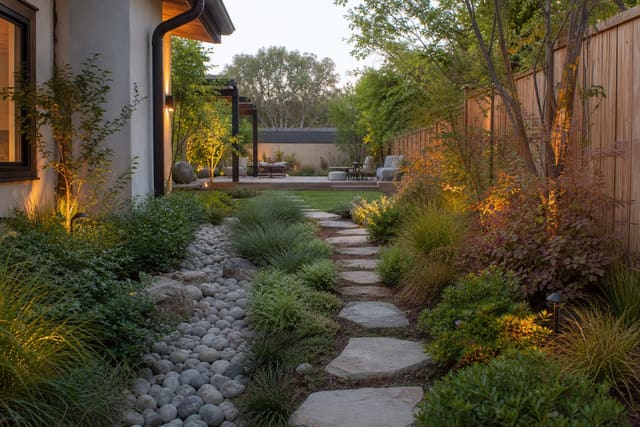
Most amateur designs fail at the edge. Don't outline the creek with identical stones like a necklace — bury larger rocks one-third into the soil, pull smaller cobbles toward the center, and let plants overlap in clumps. If you're adding lighting, keep fixtures from a path lighting layout outside the active wash zone.
Test this on your own photo with ReDesign before choosing a final direction; keep the house edge, horizon line, hardscape, planting beds, and main path visible so the preview solves the space you actually have.
Dry creek bed ideas that solve ugly runoff
- Downspout to planted basin: run a solid extension or buried pipe to the creek head, then set the first stones 2-3 inches below grade so water enters cleanly.
- Boulder clusters at bends: one 14-18 inch stone with two smaller companions looks more convincing than evenly spaced rocks.
- Front-yard creek parallel to a walkway: keep 30 inches of clear path width, hold the creek 12 inches off the paving, and use low plants near the entry.
- Side-yard gutter conversion: a 24 inch wide channel with stepping stones set 24-28 inches on center carries runoff and gives pets and bins a durable route.
- Grasses and sedges on the bank: plant in groups of 3, 5, or 7 at 18-24 inches apart, keeping woody shrubs high enough that leaves stay out of the channel.
- Edge lighting near a patio: shielded fixtures from a landscape uplighting plan can graze boulders and grasses; fixtures inside the wash path tend to tilt or silt over.
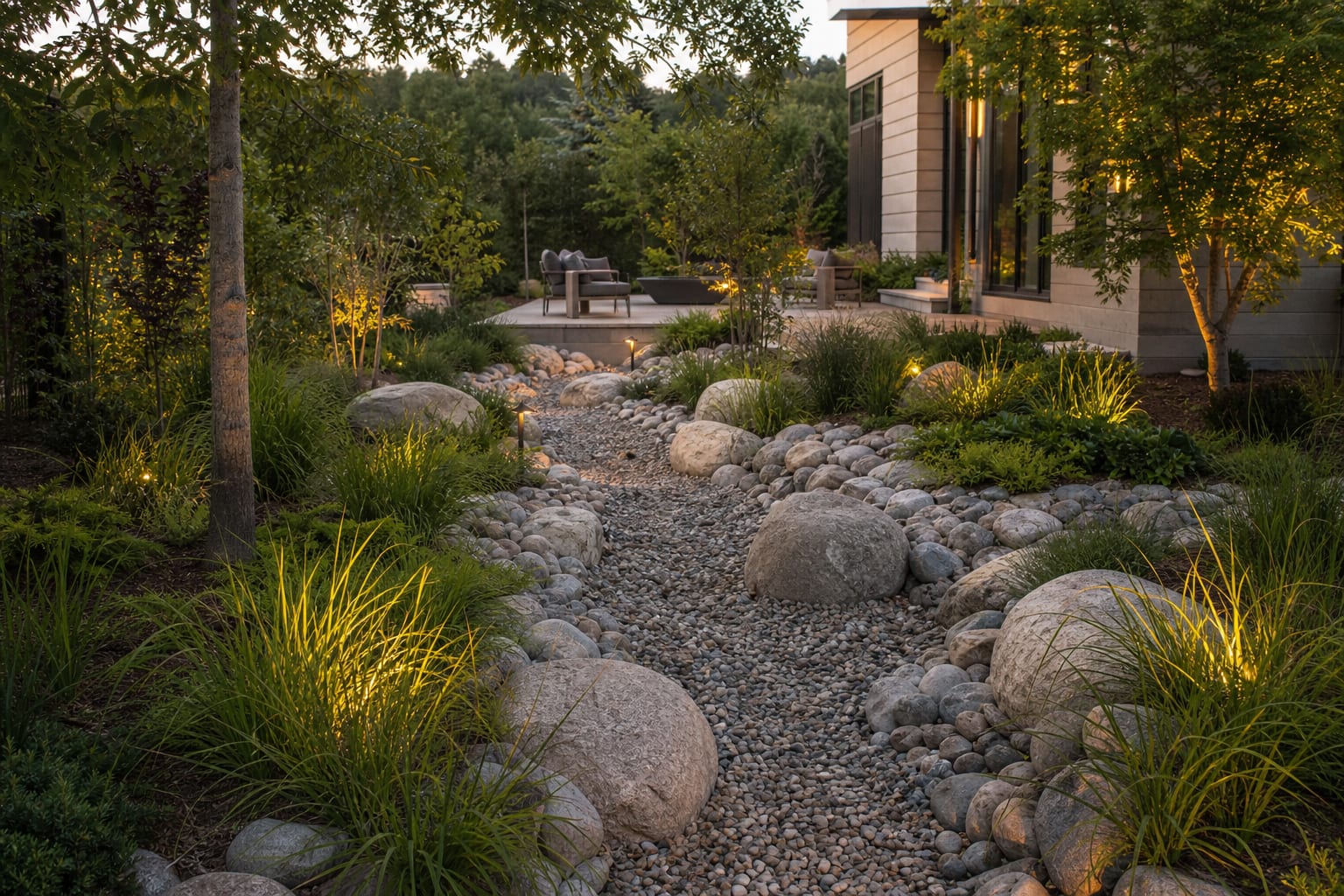
Design-check shorthand: depth before decoration, repetition before variety, maintenance before novelty.
What mistakes make a dry creek bed look fake?
A whole bed of polished, uniform pebble looks store-bought and can shift under fast runoff. Mix matte river rock with angular gravel underneath, saving smooth stone for one small accent near the entry.
Digging too deep creates a ditch, not a creek. Keep the center only 2 to 4 inches below the shoulders, with deeper pockets only at catch points; hide extra capacity with wider curves and planted banks instead of a harsh trench.
Stopping the creek at a fence line is a drainage failure in disguise. Water needs an approved place to go, and some lots require a civil plan before discharge changes — solve the legal outlet before ordering materials.
Planting directly in the channel creates maintenance headaches, since mulch and roots migrate into the rock after storms. Keep planting on the shoulders and leave the center open enough to clear with a blower. Where the creek crosses a walking route, add stable stepping stones and consider outdoor step lighting so the feature doesn't become a trip hazard.
Should I preview the creek with AI before I dig?
AI design helps because the hardest choices are visual: curve, width, stone color, boulder placement, and planting density. Upload a straight-on photo of the runoff area and preview a narrow creek with grasses, a wider river-stone bed with boulders, and a version ending in a rain garden.
The preview won't calculate stormwater capacity, pipe sizing, or local discharge rules. It will show whether gray river rock fights your brick house or whether a curve steals too much lawn from a play area — use it to judge design character, then handle grading, fabric, and outlet planning for real weather.
A finished dry creek bed should look inevitable from the kitchen window and practical during a downpour. If it feels like a decorative stripe, simplify the curve, vary the stone, and give the water a more honest route.
Frequently Asked Questions
How wide and deep should a dry creek bed be?
Plan for a bed twice as wide as deep — a 24in wide bed runs about 12in deep at center — sized to the storm volume it must move rather than the look you want.
Do dry creek beds actually drain water?
Yes, when sized to volume and lined with permeable fabric over a graded base. Cosmetic-only versions built over solid clay will puddle in heavy rain instead of moving water through.
What stones work best in a dry creek bed?
Use fist-sized rounded river cobble for the bulk, 1-2in river stone fines for the base layer, and two or three softball-to-soccer-ball boulders placed at curves to anchor the design and slow fast water.
How long should a dry creek bed be?
Long enough to carry water from the source — a downspout or low spot — to a daylight outlet or basin. Aim for at least 15 feet of run with a 1-2 percent slope and a meandering centerline.
What plants line a dry creek bed?
Ornamental grasses for movement, low sedges for the wet edge, and one or two flowering perennials like black-eyed susan for color. Cluster plants in odd-numbered groups along the banks, set back from the active channel.
> Try this: Ready to see this on your own outdoor space? Open ReDesign and run the preview before you buy materials, plant, drill, or move furniture.
Three transformations to try
1. Curved dry creek bed with grasses 2. Dry creek bed with boulder anchors 3. Dry creek bed under wood bridge