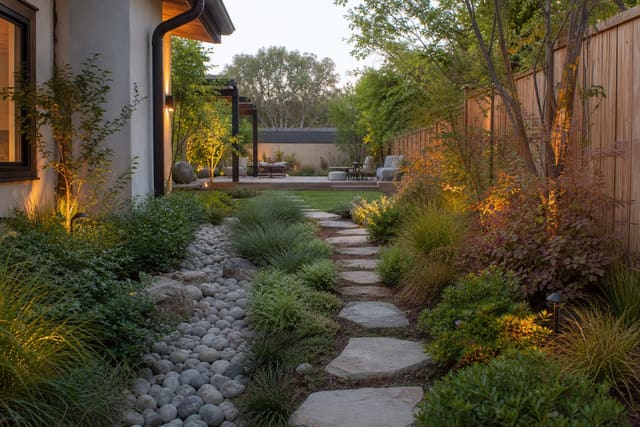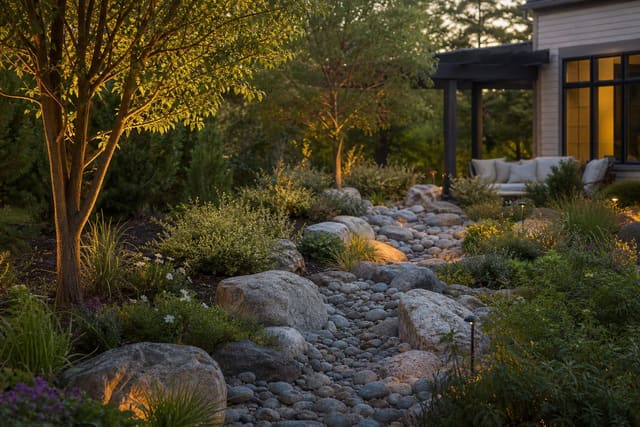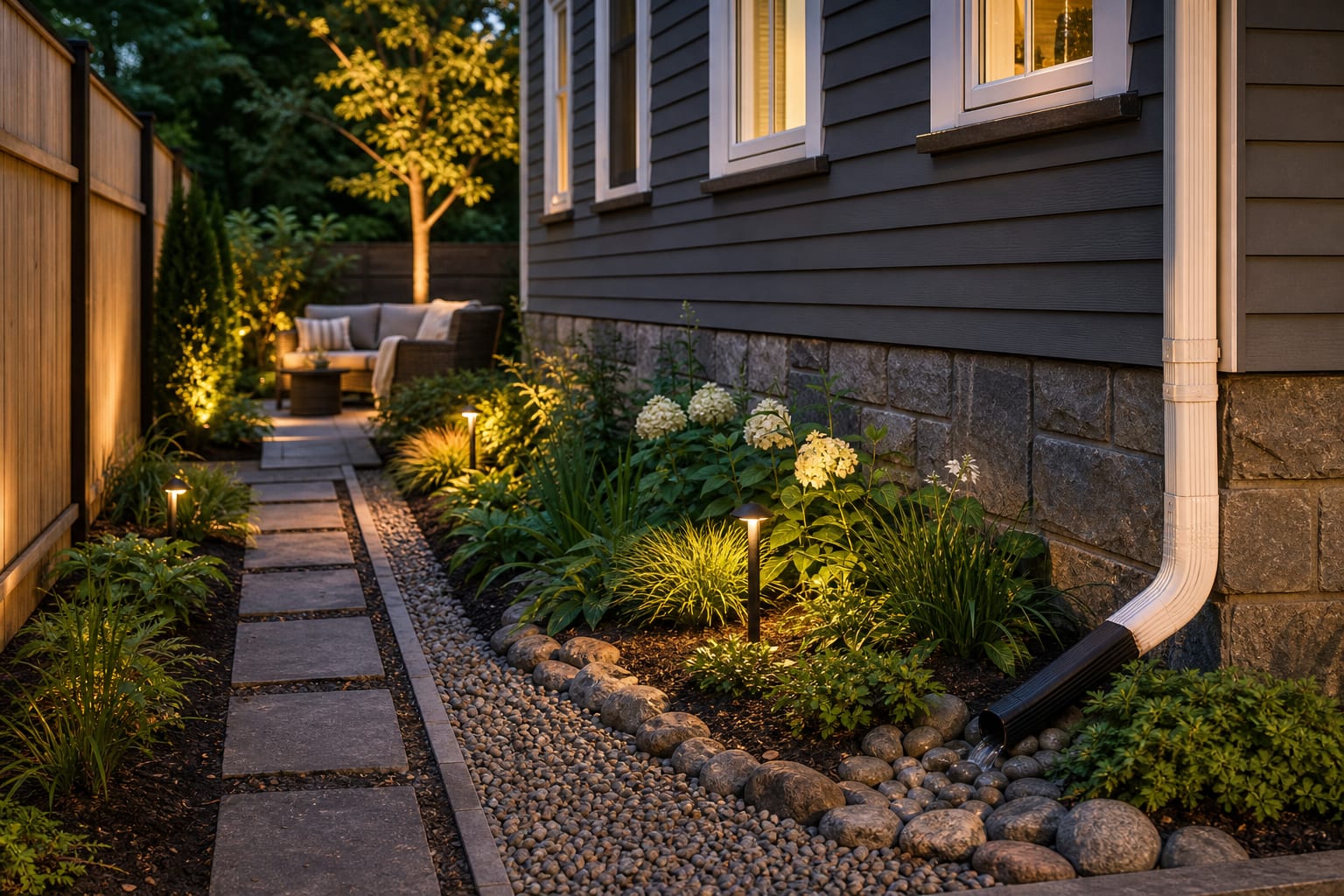
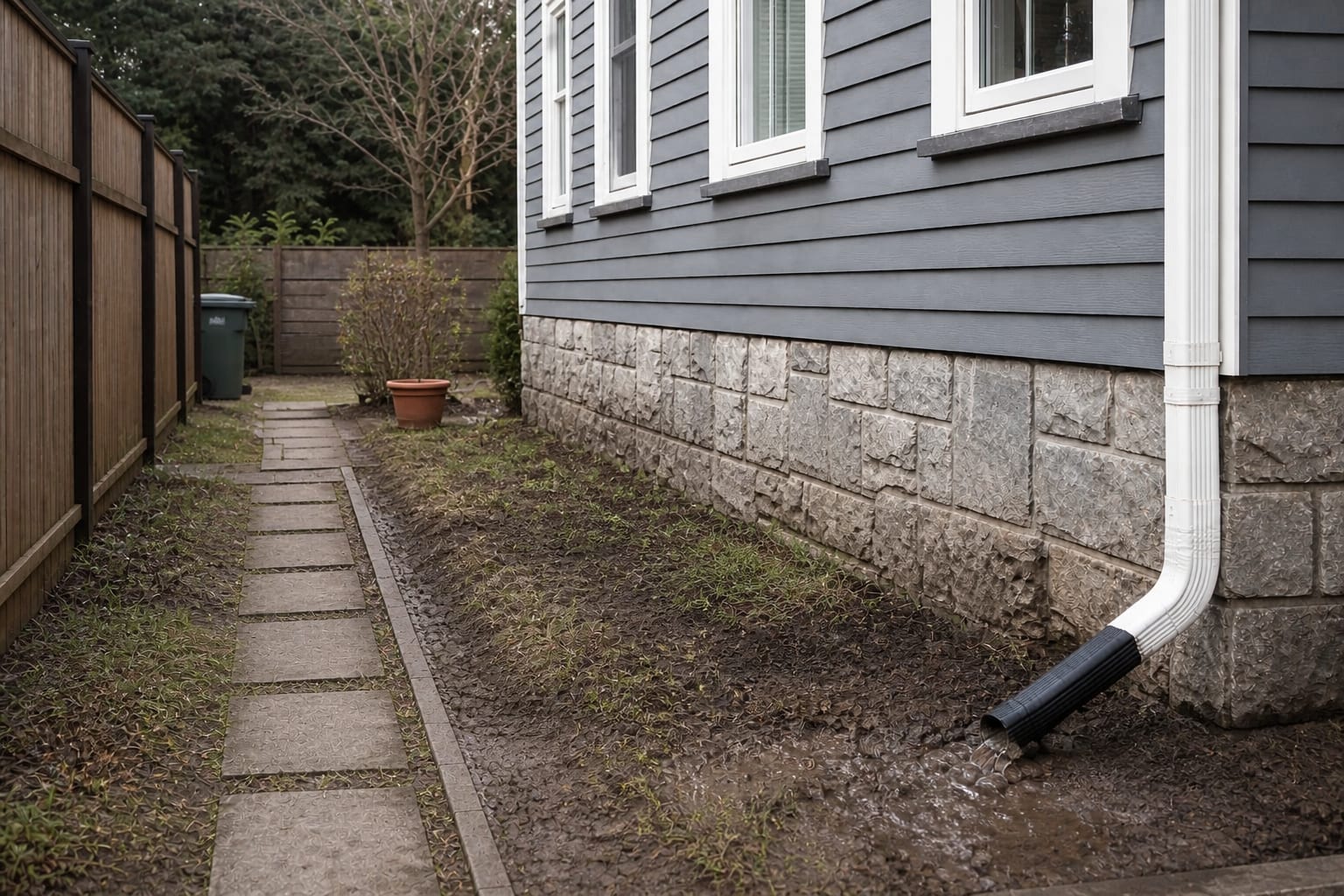
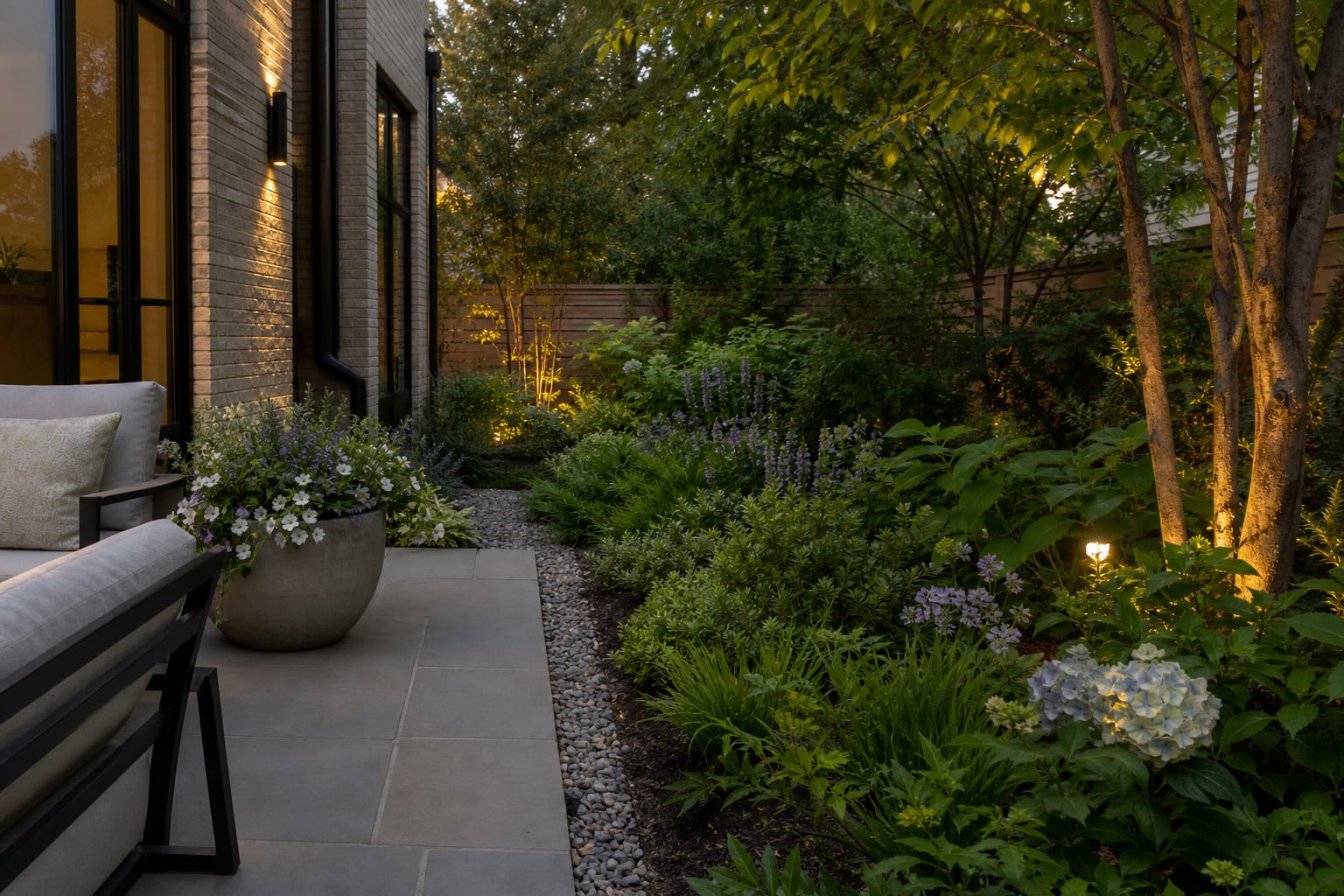
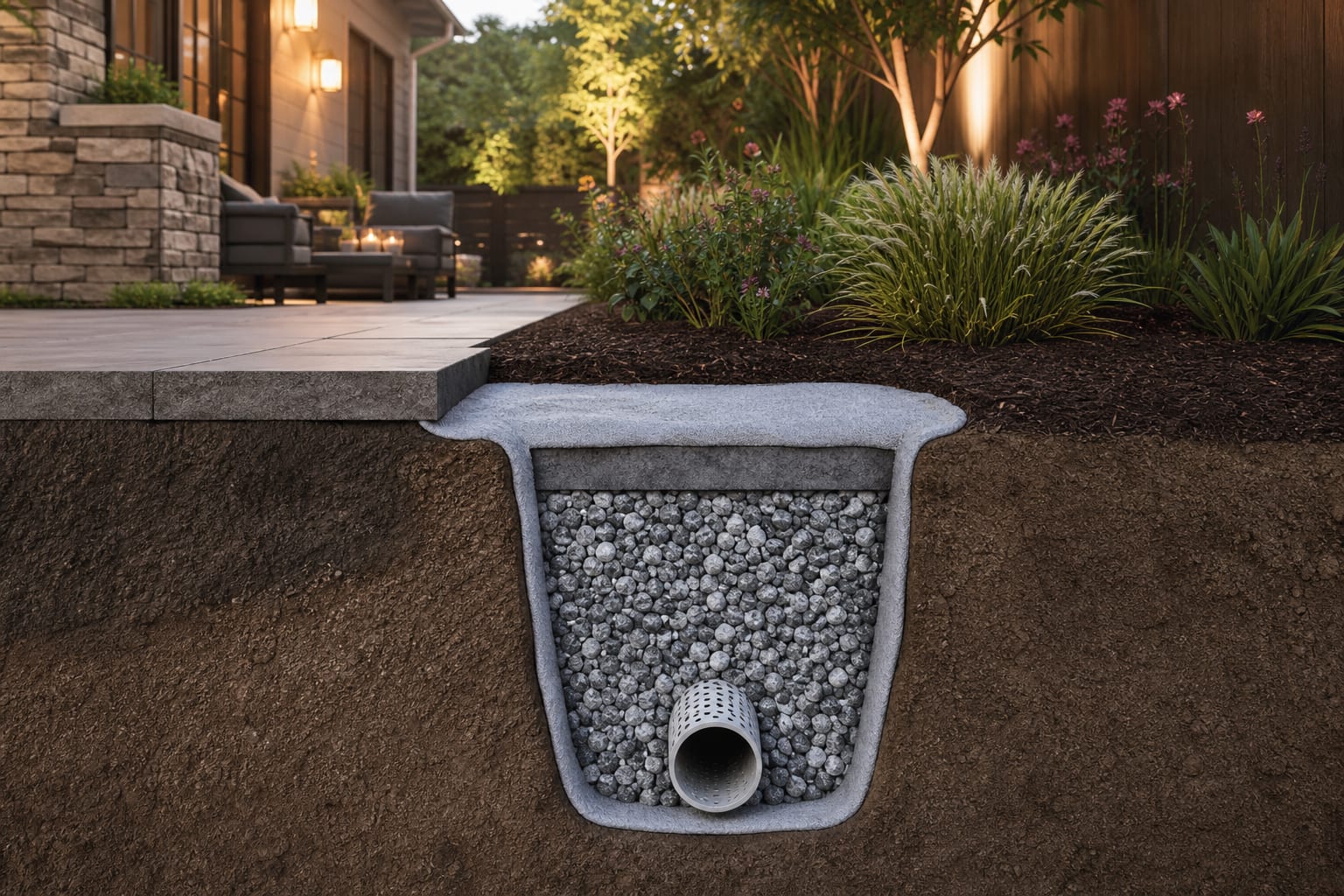
A French drain garden hides the pipe at the bed centerline under 6-8 inches of round stone capped with filter fabric, soil, and shallow-rooted perennials at the edges. It solves chronic wet-bed and foundation-seepage problems by collecting subsurface water and carrying it downslope to a safe outlet, rather than letting soil stay saturated between storms.
How does a French drain work in a garden?
A French drain collects water below the soil surface in a gravel-filled trench, moves it into a perforated pipe, and carries it downslope to a safe outlet. It suits soggy soil, wet foundation beds, and low strips that stay damp after surface runoff passes — not every puddle, and never a route that pushes water toward a neighbor or basement wall.
A typical garden build uses a 4-inch perforated pipe, washed angular stone, and nonwoven filter fabric in a trench 12-18 inches deep and 8-12 inches wide, sized below the wet root zone. The pipe needs continuous fall; even 1/8 inch per foot beats a flat run that becomes a muddy storage tube.
Treat the drain as a hidden spine for the bed. Plants and gravel dress the surface, but the underground route still needs a source, a slope, and an exit. Plan the drain before adding a living hedge boundary, since saturated soil punishes privacy plants before they fill in.
Test this on your own photo with ReDesign before finalizing the layout; keep the house edge, horizon, hardscape, beds, and main path visible so the preview matches your real space.
Which route and build choices keep the drain from clogging?
Follow the route where water already collects, then turn toward an outlet without cutting across the garden. In a narrow side yard, that might sit 12-18 inches off the foundation planting; in a larger bed, the drain can run behind a planting layer with gravel visible only at cleanouts.
Too close to the foundation and it can undermine soil without catching bed water; too far and the wall-side soil stays wet. Probe the soil after steady rain: wet in the top 4-6 inches but firm below usually means a grading fix, not a trench. Wet deeper and sour for days means subsurface drainage is the right call.
| Decision | Better garden choice | Concrete spec |
|---|---|---|
| Pipe | Rigid or flexible 4-inch perforated pipe | Continuous fall of about 1/8 inch per foot where possible |
| Stone | Clean, washed 3/4-inch angular gravel | At least 2-3 inches of stone on all sides of the pipe |
| Fabric | Nonwoven geotextile around the stone bed | Overlap seams by about 12 inches |
| Surface | Gravel, planted edge, or stepping stones | Finished gravel about 1/2 inch below nearby paving |
| Outlet | Daylight, dry well, storm connection | Away from foundation; confirm local stormwater rules |
Gravel alone can look harsh beside a soft border, while mulch over a drain migrates into the stone during storms. A narrow gravel reveal with overhanging plants is the better compromise. In shaded gardens, a low ground-cover plan softens the line without hiding cleanouts.
Ways to make the drain look designed:
- Run gravel parallel to a path or edge. Keep the strip 10-18 inches wide and repeat the stone near a gate or hose bib.
- Set stepping stones over the trench where foot traffic already happens, spaced 24-28 inches on center and bedded firmly.
- Plant moisture-tolerant species at the shoulders. Sedges, rushes, and tough perennials spaced 12-18 inches apart knit the drain into the bed.
- Keep woody shrubs 2+ feet off the pipe line so future service does not require tearing out the border.
- Coordinate with privacy features. A garden sound barrier layout should leave drainage gaps, not create a wet dam.
Design-check shorthand: depth before decoration, repetition before variety, maintenance before novelty.
Common French drain garden mistakes
- Burying pipe directly in soil. Fine particles choke the slots; wrap washed stone in nonwoven fabric, never plastic sheeting, which blocks water entry entirely.
- Installing the pipe dead level. Water enters but won't leave; if the site lacks fall, use a dry well, sump, or approved storm connection instead.
- Choosing plants before solving discharge. Moisture-loving species can't fix a drain with no outlet — settle the route and outlet first, then plant for the new moisture pattern.
- Covering the drain in bark mulch. It floats and slides into the gravel during heavy rain; keep the active band in gravel or stable stone instead.
- Skipping cleanouts. Add a capped riser at the upper end or major bends, and clear the outlet after storms in leaf-heavy gardens.
Use AI design to see the drainage line before you dig
Upload a straight-on photo of the wet bed, mark the downspout, low point, and possible outlet, then preview surface treatments: a narrow gravel runnel, a planted drainage strip, stepping stones over the trench, or a dry creek finish. The preview won't size pipe, test soil, or verify stormwater rules, but it shows whether gravel color, stone placement, or trench route works before you dig.
A finished French drain garden should be boring in the best way during a storm: water enters, soil dries, plants recover, and the garden still looks like a garden.
Frequently Asked Questions
Can I plant on top of a French drain?
Yes, for shallow-rooted perennials and ornamental grasses. Keep trees and deep-rooted shrubs at least 6 feet off-center to prevent roots from infiltrating the perforated pipe.
How deep does a French drain need to be?
12-18 inches deep with a 4-inch perforated pipe at the bottom, surrounded by 4-6 inches of round stone wrapped in nonwoven filter fabric. That depth handles foundation seepage and surface runoff together.
What slope does a French drain need?
A consistent 1-2 percent fall toward daylight or a dry well. A 50-foot run needs roughly 6-12 inches of total drop from inlet to outlet.
How do I disguise a French drain outlet?
Daylight into a pop-up emitter inside a planted basin, a dry creek bed, or a rain garden. Never let it discharge into open lawn, where it will carve a wet rut over time.
Will a French drain stop foundation seepage?
Yes, when paired with a 10-foot downspout extension and proper grading. A French drain alone won't help if water still pools at the wall itself.
> Try this: Ready to see this on your own outdoor space? Open ReDesign and run the preview before you buy materials, plant, drill, or move furniture.
Three transformations to try
1. French drain along foundation bed 2. French drain under perennial border 3. French drain daylighting into dry creek