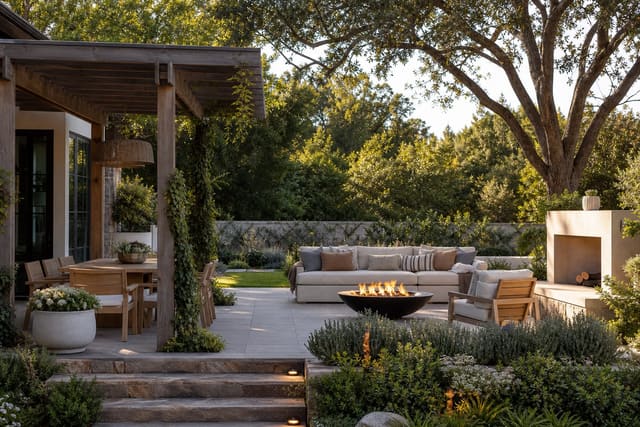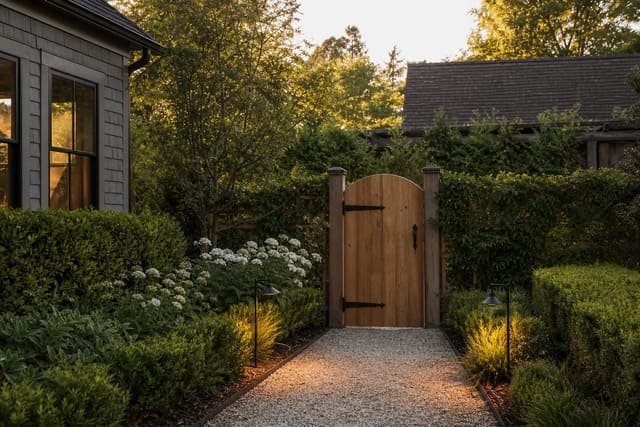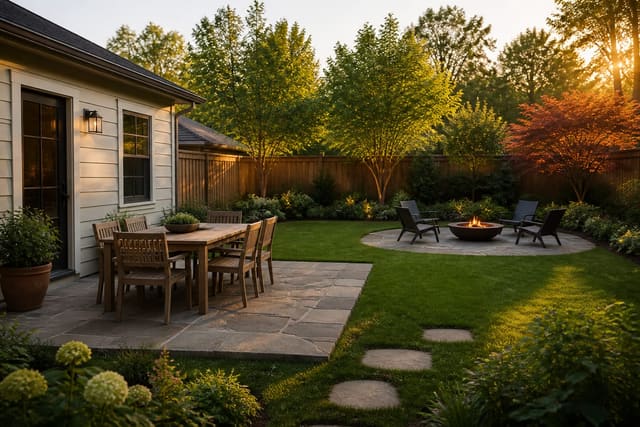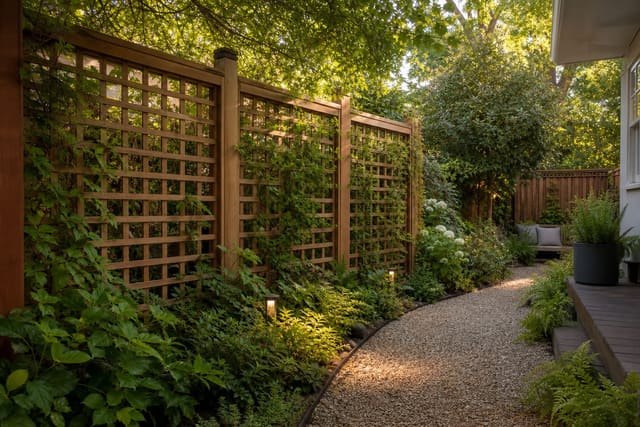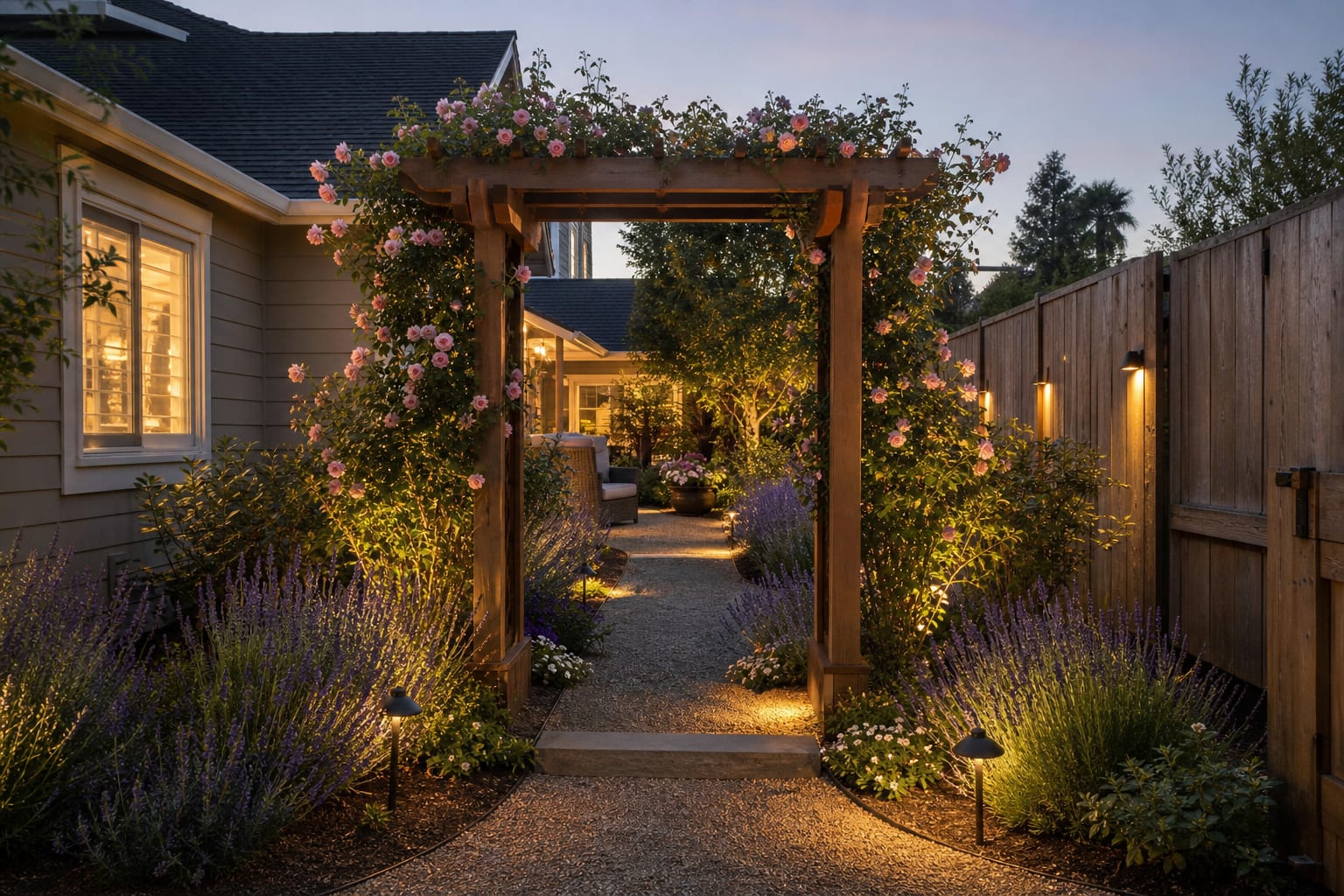
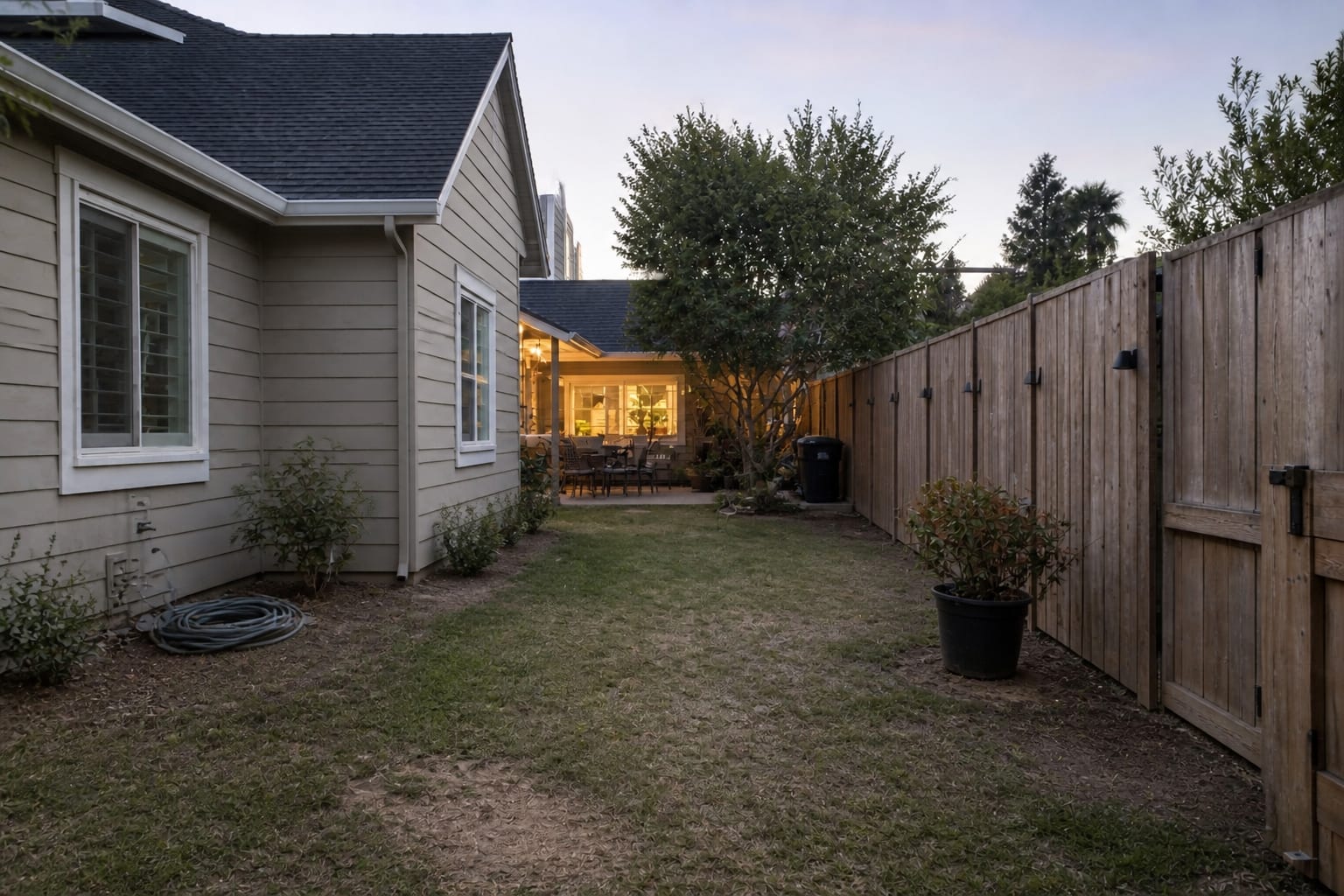
A garden arbor works as an entrance or focal point when it marks a real transition, scales 7-8ft tall by 4ft wide for comfortable passage, and carries one climbing plant so it never reads as a bare frame. Place it where someone enters, turns, or pauses, then finish it with a path, layered planting, and low lighting so the threshold reads clearly day and night.
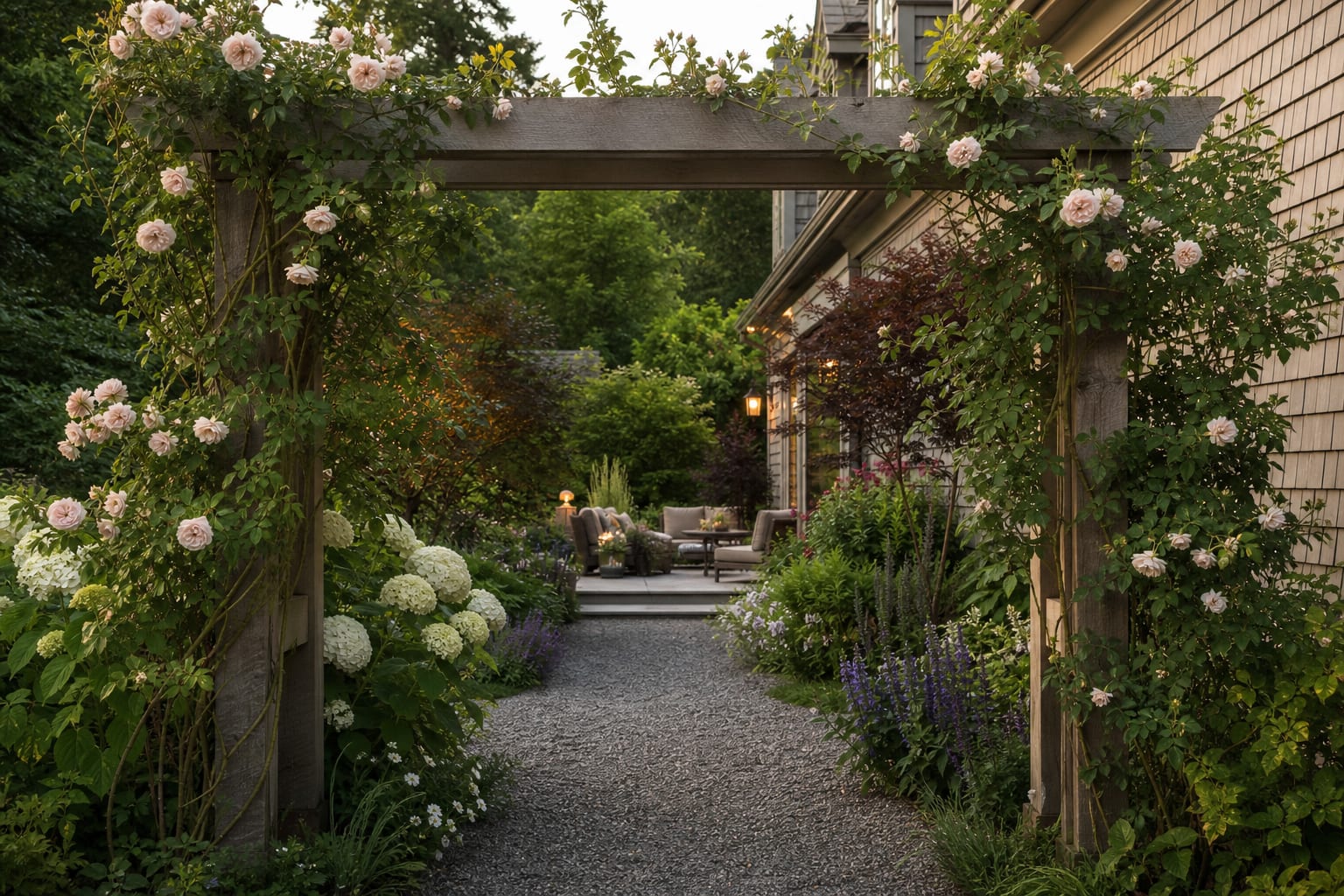
What makes a garden arbor feel like an entrance instead of a decoration?
An arbor reads as an entrance when it marks a real change in the garden: street to front yard, patio to planting bed, lawn to kitchen garden, or open yard to a quiet seating spot. If it doesn't change how someone moves through the space, it usually looks like a prop.
Start with the route. A 36" path works for one person, but an opening of 42"-48" feels more generous, and 54" suits two people walking side by side. Keep the top of the opening at least 84" high, or 90" if climbers will hang down.
Give the posts visual weight. Thin 2"x2" members look flimsy in an open yard; 4"x4" posts suit most residential gardens, and 6"x6" posts suit a large arbor or one carrying heavy roses. Cedar, painted timber, powder-coated steel, and weathered oak age more gracefully than white vinyl once planting fills in.
Put the arbor where the garden already asks for a pause: one step before a path bend, centered on a side gate, or aligned with a bench at the end of a border. If the boundary feels exposed, pair it with the approach in lattice fence privacy ideas: open structure up top, denser screening or planting lower down.
Which garden arbor idea fits how you use the space?
Pick the job first, then the shape.
- Front walk arbor: center it on the path, leave 6"-12" of planting space outside each post, and match the roofline to the house — arched for cottage, flat-topped for modern, pitched for traditional.
- Garden entrance: use a 4' wide opening between lawn and vegetable beds so a wheelbarrow fits; a simple cedar frame can carry beans, grapevine, or thornless blackberry.
- Rose arbor: give each planting pocket 18"-24" of soil width and tie canes horizontally across the frame for more blooms; avoid squeezing roses into a 24" side passage.
- Side-garden arbor: at the end of a narrow 36" path, keep the frame slim and plant one climber rather than two competing vines.
- Bench-framing arbor: a 48"-60" bench fits under most arbors; leave at least 30" of open space in front for knees and watering cans.
- Metal arbor: powder-coated steel or black iron disappears behind wisteria or grapevine, useful when the planting should be the star.
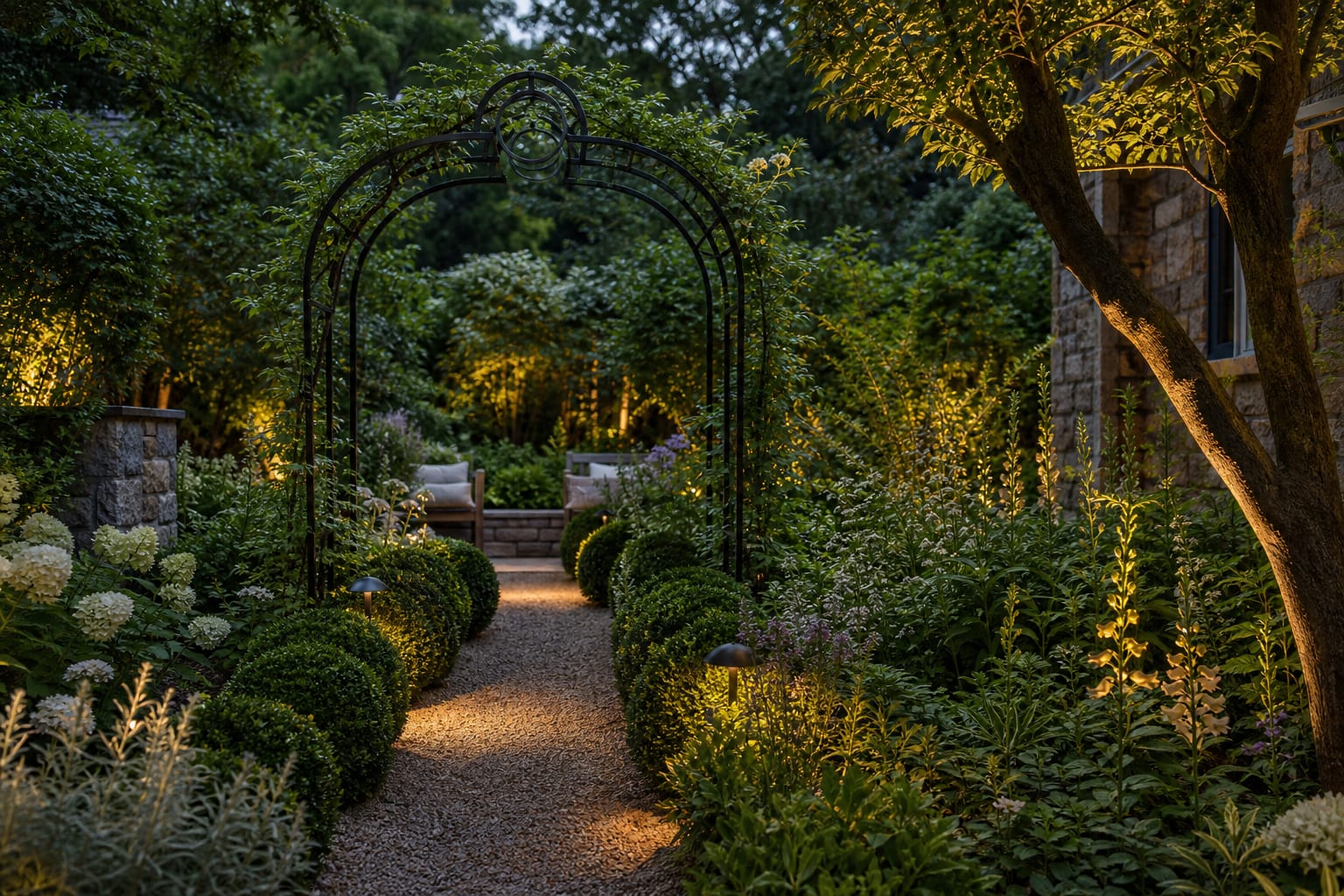
Test this on your own photo with ReDesign before you commit; keep the house edge, horizon line, hardscape, planting beds, and main path visible so the preview solves the space you actually have.
Common garden arbor mistakes
Most bad arbors fail because they're too small, too isolated, or planted wrong for the frame.
- Buying a lightweight arch. A 7' tall, 30" wide metal arch can vanish between mature shrubs viewed from 20' away; choose thicker posts, a wider opening, or a stronger roofline for visibility.
- Planting the wrong climber. Wisteria gets heavy and woody and needs serious support and pruning; climbing roses are easier but still need tying and airflow; clematis wants cool soil at the base and sun on top, so mulch the roots.
- Skipping the path. Grass under the posts turns muddy or thin; run gravel, brick, pavers, or stepping stones through the opening and past the posts.
- Ignoring slopes and steps. Coordinate the arbor with garden steps ideas so posts don't crowd the first tread — a comfortable step is roughly 6"-7" high with a deep tread.
Use AI design to preview your garden arbor before you commit
Scale is hard to judge from a product photo. A 4' cedar arbor, a black metal arch, and a white rose arbor can each look right online, then feel too thin, too bright, or too formal against your actual fence and planting.
Upload a straight photo from where you see the garden most: back door, front gate, kitchen window, or patio chair. Keep the path, fence, and main beds visible so the preview shows whether the arbor creates a real threshold.
Test one change at a time — arbor shape and position first, then climbing plants, then path material or lighting. That order shows whether the structure itself solves the flatness before flowers disguise the problem. For a quiet retreat, the same process pairs well with outdoor meditation space ideas, especially when the arbor frames a bench or shaded sitting point.
How should planting, lighting, and paths finish the look?
The path should pass through the opening cleanly, the planting should frame rather than smother, and lighting should mark the threshold after dark.
Keep path material simple: pea gravel with steel edging for cottage gardens, brick or stone for older homes, or compacted decomposed granite in dry climates. Where the arbor meets a patio, let the patio material run under the posts or add a 12" border band for a clean transition.
Layer the planting — climber on the post, low plants at the base (lavender, catmint, thyme, hakone grass, boxwood, salvia) so the arbor doesn't look like it's wearing a skirt of pots. Keep thorny plants away from narrow openings.
For lighting, aim for guidance, not glare. Two low path lights 18"-24" before the arbor mark the approach, while one small uplight catches the frame; warm 2700K-3000K light is kinder to timber and planting than blue-white. Shield fixtures near bedroom windows so the glow stays on the path.
Frequently Asked Questions
What size should a garden arbor be?
7-8ft tall, 4ft wide opening, and 24-36in deep for a path arbor; tunnel-style arbors stretch to 8-12ft deep and need at least two climbers per side.
What materials work best for a garden arbor?
Cedar, white oak, and powder-coated steel hold up outdoors and accept climbers; pressure-treated pine fails fast at the joints, and rough-painted softwood needs repainting every 3 years.
What plants belong on a garden arbor?
One vigorous climber — climbing rose, clematis, wisteria, or American honeysuckle — trained up two adjacent posts; mixed climbers compete and the arbor looks chaotic by year three.
Where should an arbor be placed in the garden?
At a transition point — the entrance from lawn to garden room, the head of a path, or a gateway through a hedge — never floating mid-lawn with no destination behind it.
Does an arbor need a footing?
Yes. Bury 4x4 cedar posts 24-30in in concrete piers or set them on metal post anchors with adjustable bases; wind load on a fully climbed arbor can exceed 200 lb in summer.
> Try this: Ready to see this on your own outdoor space? Open ReDesign and run the preview before you buy materials, plant, drill, or move furniture.
Three transformations to try
1. Cedar arbor with climbing roses