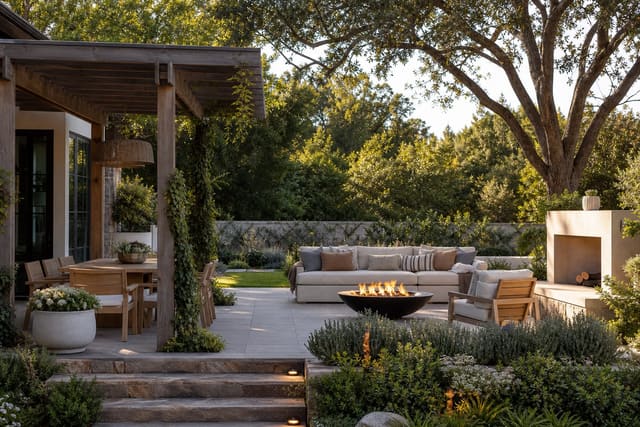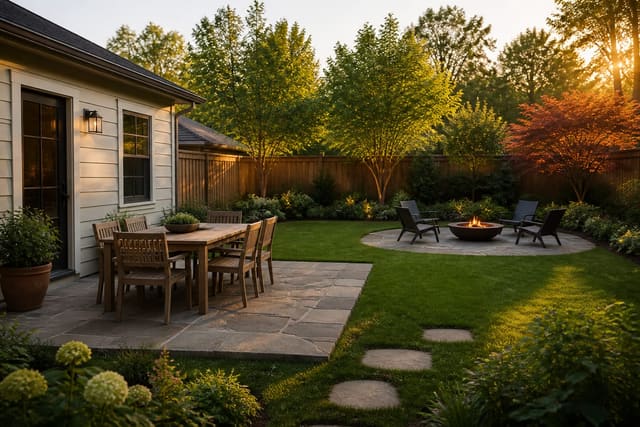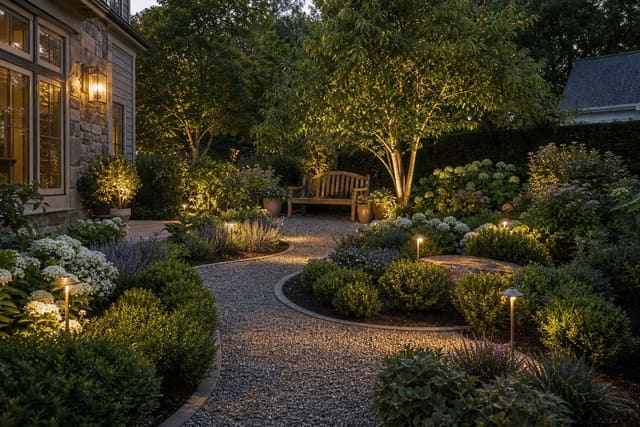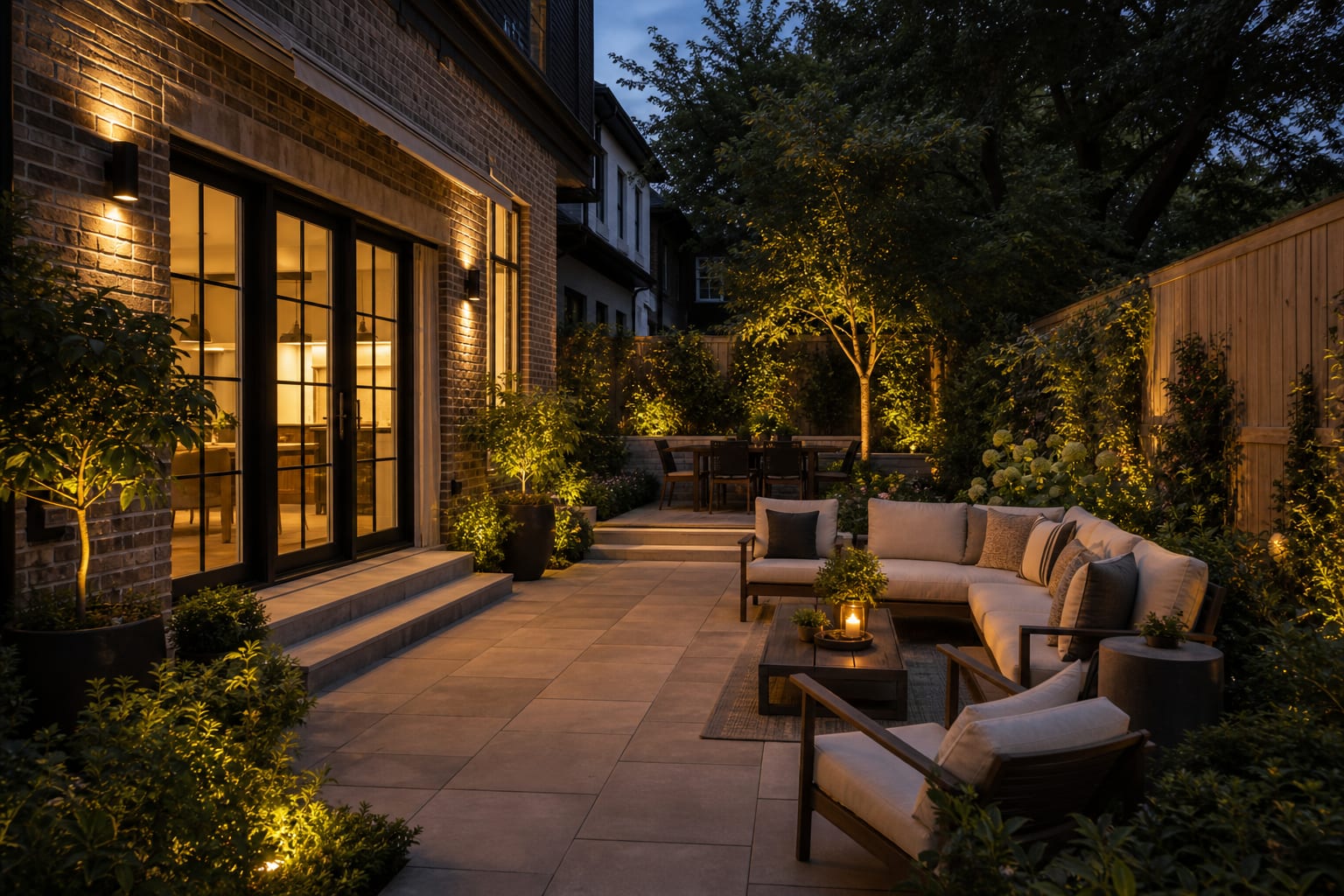
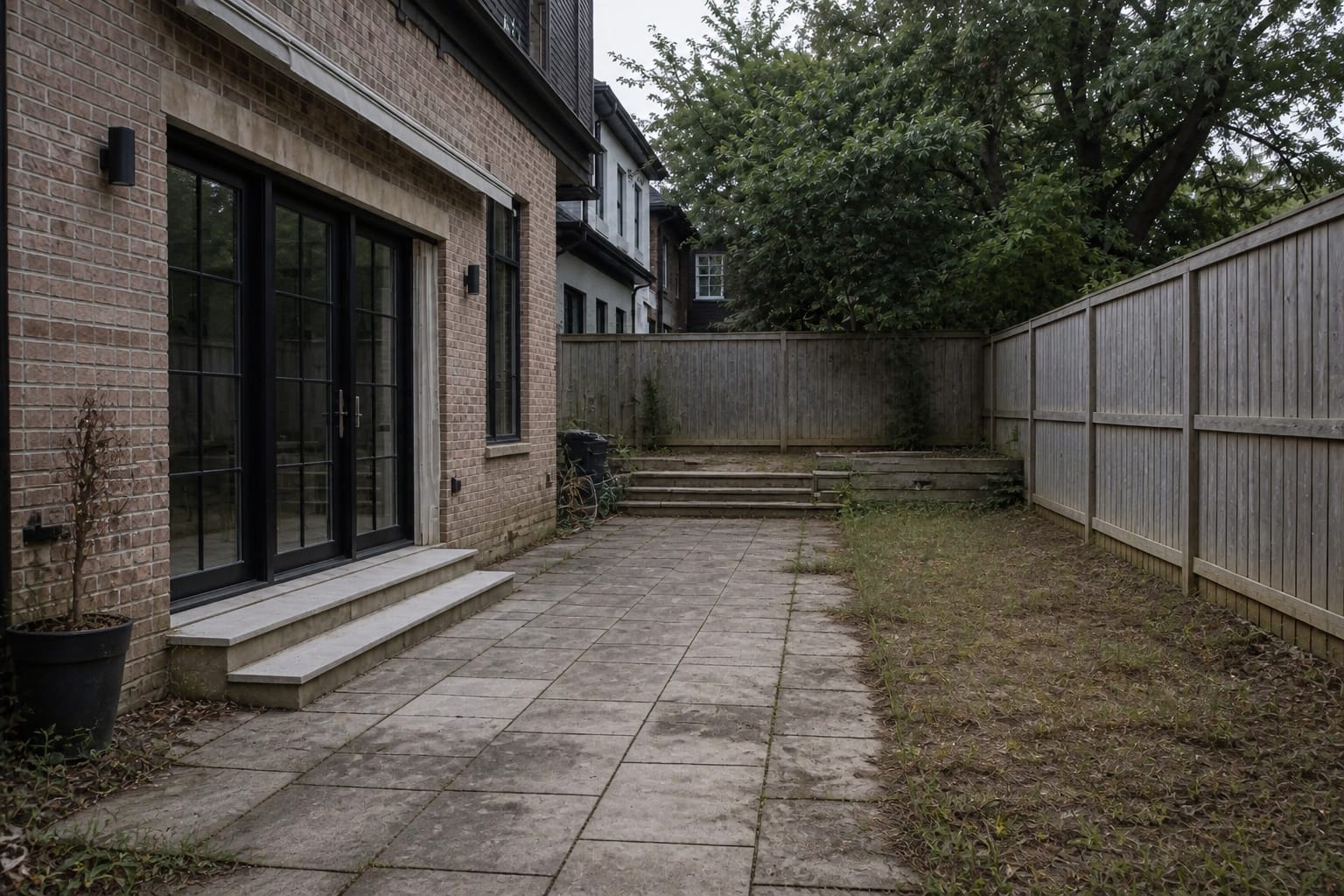
The best outdoor lighting ideas layer three types of light: ambient for overall glow, task for cooking and dining, and accent for trees or walls, all in warm 2700K on a single dimmer. Separate safety, walking, seating, and atmosphere so the yard works after dark instead of looking like a driveway lit by one floodlight.
How do I light an outdoor space without glare?
Good garden lighting hides the bulb and shows the surface. If you can see a bare lamp from the dining chair, the fixture is doing more harm than good — light should skim a path, wash a fence, or mark a step, not blast into faces at chest height.
Work in four layers: circulation light for paths, stairs, and gates; task light at the grill, sink, or bar; accent light on trees, walls, and planters; and ambient light from sconces, pendants, and lanterns. A small patio can run on two shielded sconces at 60-72 inches high, one dimmable pendant over the table, and a few low beams into planting. A larger yard needs rhythm: path markers at turns, step lights at level changes, and accent fixtures spaced far enough apart that darkness stays between them.
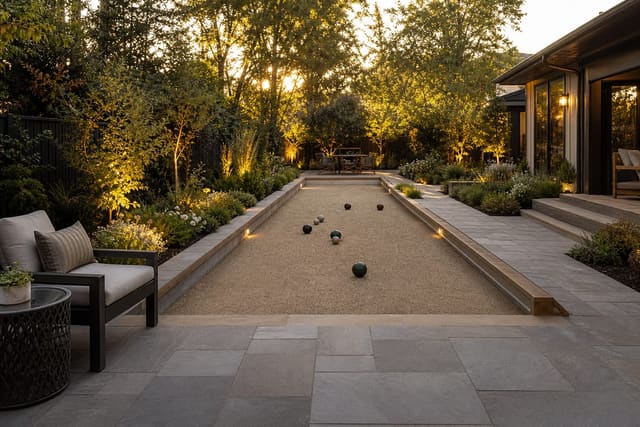
If the backyard doubles as a games area, plan its light separately — a court or lawn zone needs more even brightness than a dinner patio, so backyard game areas like a bocce court shouldn't borrow the seating corner's lighting plan.
The layer decision that changes every patio and garden
Decide which layer dominates. A path-dominant yard feels orderly, a planting-dominant yard feels lush, and a patio-dominant yard feels social. Making every layer equally bright just creates a nervous yard with no quiet corners.
| Lighting layer | Where it belongs | Concrete spec |
|---|---|---|
| Path lighting | Walks, gates, side yards, steps | Keep fixtures 12-18 inches high, staggered 6-8 feet apart rather than lined up like runway markers. |
| Patio task lighting | Grill counters, prep tables, sinks | Use shielded sconces or downlights placed so your body doesn't shadow the work surface. |
| Accent lighting | Trees, masonry, planters, water | Use narrow or medium beams aimed across texture, not straight up into bare branches. |
| Ambient seating glow | Dining areas, lounges, pergolas | Put fixtures on dimmers and keep the brightest source out of normal eye line. |
Path lighting comes first for most homes because it solves what people actually fear after dark: tripping or missing a step. Skip identical pairs on both sides unless the design is formal; alternating sides looks softer and uses fewer fixtures. String lights should hang at least 8 feet over the walking line — they're atmosphere, not a full lighting plan.
Test this on your own photo with ReDesign before choosing a direction; keep the house edge, horizon line, hardscape, planting beds, and main path visible so the preview solves the space you actually have.
Which outdoor lighting ideas fix specific dark spots?
- Light a garden bed from the side when plants vanish into a black fence. Place a shielded fixture 18-30 inches from the plant mass, aimed across grasses or shrubs.
- Mark a path turn, not the whole route. One low fixture at the bend plus one near the destination gives enough guidance without a dotted-airport look.
- Put step lights into vertical surfaces. Under-cap lights on walls or risers stay below knee height, lighting feet instead of faces.
- Give the grill a real task source. A covered kitchen can use 3000K downlights or sconces; an uncovered grill works better with a wall-mounted task light than a portable lamp.
- Use one tree as the evening focal point. Two small uplights at different angles reveal bark and branching without turning the canopy into a hotel entrance.
- Keep movie-night light separate from path light, since the screen zone needs to stay dim while the route stays lit — the same logic applies to outdoor movie night setups.
- Protect wet zones with the right rating. Near a pool, shower, or hose-heavy garden, use damp- or wet-rated fixtures and code-compliant switches; a backyard redesign needs lighting that respects water, privacy, and footing.
Common outdoor lighting mistakes that make a yard feel worse
- One oversized security flood as the whole plan. It creates hard shadows and glare. Keep it motion-controlled and downward-aimed, then add lower landscape lighting for everyday use.
- Path lights spaced like soldiers. Perfect pairs every few feet feel commercial. Mark decisions instead — gates, steps, bends, and grade changes.
- Choosing cool white because it seems brighter. Around planting, brick, and stone, cool light looks exposed and bluish. Warm 2700K is more flattering and just as functional when aimed well.
- Ignoring beam control. A cheap uplight with no glare shield can hit a window or your own bedroom. Use shields, louvers, and narrow beams to keep light where it belongs.
- Skipping maintenance planning. Solar stakes in deep shade underperform, small fixtures get swallowed by mulch, and exposed cable gets clipped by edging tools. Leave transformer access and choose finishes that weather well.
Use AI design to preview your backyard lighting before you commit
The hard part isn't picking a fixture; it's judging where glow, darkness, path, planting, and furniture belong in one view. Upload a dusk or daylight photo of your patio or path, then test a warmer path plan, a brighter grill zone, or a softer seating corner before trenching any cable.
For the clearest preview, shoot from standing height, include the house wall and path edges, and clear loose toys, hoses, and extra chairs from the frame. Ask for layered lighting with 2700K path lights, shielded sconces, subtle planting accents, visible steps, and no exposed glare — the useful image makes the existing yard easier to read after dark, not the one with the most fixtures.
Frequently Asked Questions
What color temperature is best for outdoor lighting?
2700K warm white is the outdoor standard. It reads natural against wood, stone, and foliage, bridges visually to interior lighting, and attracts fewer insects than neutral-white (4000K+) fixtures.
How many lumens do I need for outdoor patio lighting?
Use 60-120 lumens per path light, 400-600 lumens for a dining-area downlight, and 40-80 lumens for accent uplights on plants. Keep totals low — most over-lit patios read harsh because they're lit at interior levels (800+ lumens) outdoors.
Should outdoor lights be on a timer or photocell?
An astronomical photocell dimmer works best: it turns lights on at dusk, dims to about 30% after midnight, and shuts off at dawn. Smart switches like Lutron Caseta outdoor add phone control for seasonal schedule changes.
How do I avoid a runway effect with path lights?
Space fixtures on alternating sides rather than directly opposite each other, vary height between 12-18 inches, and choose warm, shielded fixtures that cast an oval pool of light instead of a circular flood.
Can string lights stay outdoors year-round?
Commercial-grade string lights rated IP65 or higher, with Sunbrella or rubber-encased wire, handle year-round outdoor use in zones 3-10. Avoid indoor extension-cord-style string lights even in mild climates; they're a fire hazard in rain.
> Try this: Ready to see this on your own outdoor space? Open ReDesign and run the preview before you buy materials, plant, drill, or move furniture.
Three transformations to try
1. Three-layer outdoor lighting plan with 2700K 2. String light canopy with shielded path lights 3. Uplights on specimen tree with dining downlight